In 2024, organizations spent an average of $150,000 resolving ransomware attacks. While 51% of the attacked organizations paid, only 13% recovered their data. With the global ransomware costs expected to exceed $275 billion by 2031, a robust data backup solution is an essential line of defense, especially for industries like technology, telecommunication, government, and education that are the most susceptible to attacks.
However, effective data protection extends beyond merely creating backups — it requires ensuring these backups stay secure, even against sophisticated threats, where bad actors target backups alongside primary data. Air gap and immutable backup are two methods for safeguarding data against unauthorized changes. Though both are designed to make backups ransomware-proof, their approaches differ.
Learn more about air-gapped systems and immutable backups to understand how to shield your organization’s data.
What Is Air Gap Backup?
Air gap backup is a cyber resilience and disaster recovery (DR) method for isolating critical data by creating a separate copy to prevent unauthorized access. This method works by creating logical separation of backup data from the storage environment or primary network. Isolation is achieved through cloud air gaps or physical methods in one of two ways:
- Physically: Physical air gaps enhance security by creating offline backup storage media, such as external drives or tapes, from all networks and systems. The backups are then placed in off-site storage at a secure location, ensuring inaccessibility to attackers.
- Logically: Cloud air gaps establish a logical separation by storing data in access-controlled environments — specific permissions or credentials are necessary to gain access.
A key advantage of air-gapped systems, especially physical approaches, is their inherent isolation. You can prevent direct access from even the most advanced cyber threats through offline backup by completely disconnecting data and preventing network access. This isolation with data stored offsite offers even more independence from network-related security measures and noticeable network constraints, reducing vulnerability through network segmentation and preventing to ransomware spreading through network ports throughout your network.
What Is Immutable Backup?
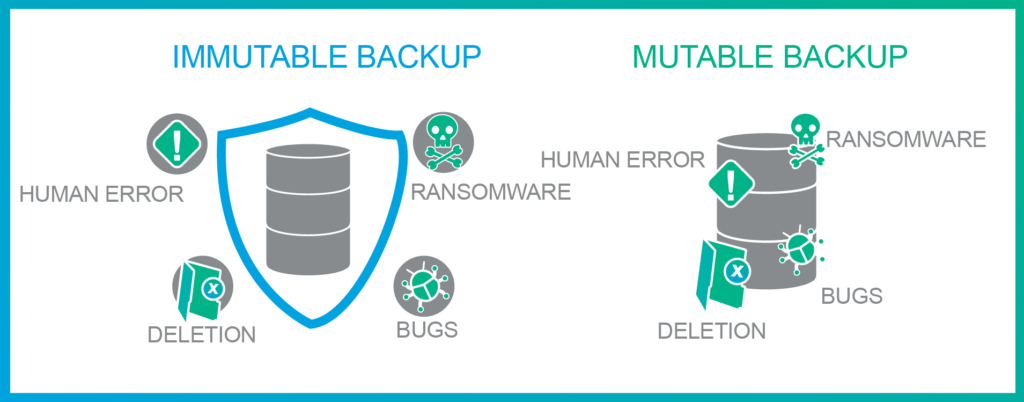
Immutable backup involves creating a data copy that can’t be altered in any way. Implementing this data protection method can be crucial for organizations with a high risk of ransomware attacks targeting their production environment.
The primary strength of immutable backups is their ransomware-proof design. Even in a ransomware attack or another cyber threat where attackers gain administrative access, your information will be unchangeable, preventing overwrites, deletions or modifications.
This method works by allowing you to object-lock data stored in the system, avoiding deletion or alteration, whether by accident or malicious activity. In most cases, the user who creates the backup specifies a specific time frame for the lock to be active. During this time frame, verified users can access the secure snapshots of immutable data but can’t overwrite it. Once the information is unlocked, the data will be mutable, allowing modifications.
While some organizations make backups immutable indefinitely, this is not a common practice. The dynamic nature of business data often demands changes and updates, making long-term immutability impractical.
Air Gap Backup and Immutable Backup Differences
Though both methods provide ransomware protection, air gap backups vs. immutable backups differ in their fundamental approach. The former isolates data, whereas the latter makes it unchangeable. Additional key differences include:

Security Strengths and Weaknesses
Physical air gap backups can offer robust protection against online access. However, this method typically involves manual transport and storage media. These operational complexities introduce the risk of not handling backup media properly and of human error and require considerable time and effort. Additionally, physical damage to your offsite storage could compromise both your backups and primary data.
Although cloud air gaps eliminate manual handling and the risk of physical damage, they can be vulnerable to insider threats. Compromised credentials or misconfigurations can still provide unauthorized access.
On the other hand, immutable storage backups offer a significant advantage in defending against insider threats. As mentioned, even those with administrative privileges cannot alter or delete data. This method’s operational simplicity is another strength. With automated retention policies, there is no need for manual processes, minimizing the potential for human error.
However, the effectiveness of immutable backups depends on role based access controls and the accurate configuration of immutability settings. An improper setup can increase the risk of data loss or corruption.
Recovery Time and Complexity
Recovery is a time-consuming and complex process with air gap backups, with the physical retrieval and restoration of data causing delays for your business continuity efforts. Restoring data to its last known state can involve re-initializing each server node and re-establishing your entire network configuration to match its original settings.
Only once these steps are complete can the backup be loaded, and the entire process can take anywhere from a few days to weeks. Based on recent research, downtime can cost as much as $9,000 a minute for large organizations and $5 million an hour for high-risk industries like healthcare and finance.
Immutable backups provide a much more streamlined recovery process. Because backup files are stored in active backup environments and you can automate critical recovery tasks, data restoration is quicker. As a result, recovery time objectives are met with downtime and disruptions are kept to an absolute minimum.
Additionally, you can easily recover data following a ransomware attack or other cyber event with immutable backups. While air-gapped backups can be useful for maintaining duplicate data copies, this method is often ineffective for restoring encrypted data after an attack.
Cost and Scalability
Air-gapped backup systems have limited scalability. While it can be challenging to accurately predict future data storage requirements, underestimating these needs can lead to inadequate backup capacity. As a result, your organization may incur additional expenses beyond the initial setup costs of your backup and DR system. Even with sufficient storage, physically maintaining and managing data can become burdensome with increasing data volumes.
As a public cloud provider solution, immutable backups eliminate the need for upfront investment in physical backup infrastructure, which may become insufficient as your data volumes grow. Instead, you can easily adjust storage capacity to meet your business’s evolving needs. Because you only pay for the storage used, there is no chance of over- or underprovisioning. Plus, immutable backups can integrate across both cloud and on-premises environments from multiple technology vendors, offering the flexibility and scalability to accommodate modern hybrid architectures.
Air Gap Backup and Immutable Backup Similarities
Though there are many differences between air gap backup and immutable backup systems, there are also some similarities. As both offer protection from ransomware, immutable and air gap methods share the common goal of safeguarding your organization’s data from loss, corruption or unauthorized access. However, it’s not a matter of choosing one over the other.
Instead, they should be seen as complementary methods that can be used together to form a robust data protection and DR strategy. Each addresses different threats — immutability shields you from internal threats and data corruption, whereas air gaps primarily defend against external online attacks. Leveraging them in tandem significantly increases the chances of successful recovery after a cyber incident. In fact, businesses using both enjoy a 95% higher success rate in data recovery without paying ransom.
Let’s take a look at a real-world example. In 2022, a Fortune 500 company was the target of a ransomware attack. Fortunately, they had implemented both an air-gapped system and immutable backups to minimize the risk of ransomware encrypting their backup files. Implementing these measures ensured that their backups stayed intact, enabling a complete and quick recovery without paying the attacker’s demanded ransom.
Need a Comprehensive Data Protection and DR Strategy?
A comprehensive data protection and DR strategy should defend against internal and external threats while creating ransomware-resistant recovery points. This approach ensures business continuity and provides peace of mind. When disaster strikes, using both immutable backups and air-gapped systems can help you accelerate data recovery.
As a leading provider of enterprise-grade backup solutions, Zmanda is here to help you recover your most vital assets when you need them most. With Zmanda Pro, you can increase your organization’s cyber resilience, reduce operational disruption and achieve an extra layer of protection with off-site backup. Our solution’s immutable technology delivers robust ransomware defense and implements the advanced 3-2-1-1-0 backup strategy for complete data security and integrity.
Are you interested in learning more about Zmanda’s capabilities? Start a free trial today.