Data breaches are significant causes of financial losses, reputational damage, and other adverse organizational outcomes. In 2023, the average cost for data breaches across all industries was nearly $4.5 million. However, some industries are more susceptible to data attacks and can have considerably more expensive outcomes.
Below are the industries with the most cyber attacks.
1. Healthcare
Healthcare and pharmaceuticals are among the industries most targeted by hackers because these organizations handle the sensitive information of millions of people. The complexities of these environments may also create more opportunities for vulnerabilities to fall through the cracks.
Healthcare has experienced an upward trend in data breaches for the last several years. With the digitization of health records, the industry is becoming more attractive to malicious third parties. IT incidents and hacking are the top causes of data breaches in this industry. Credential-stealing malware is one of the most prevalent causes of healthcare data breaches, indicating a need for more robust security measures.
2. Financial
Financial organizations and insurance companies are major targets for data breaches, with the United States experiencing more than $6 million in losses in 2024.
The global financial system is undergoing a massive change, with digitization at the forefront of the movement. As banks, credit unions, and other financial institutions adopt new technologies to meet modern convenience, hackers are adapting to the landscape and taking advantage of vulnerabilities. The top concerns for financial institutions are state-sponsored groups, cybercriminals, and insider threats.
3. Energy
Utility and energy companies are highly vulnerable to cyber threats because these organizations provide essential services to businesses and homeowners — and have access to sensitive financial data. Interconnected systems and high-tech infrastructure contribute to a growing reliance on technology, increasing cyber risks. Recent studies highlight that cyber attacks have been growing since 2018, with 2022 experiencing alarmingly high levels. Data breaches cost the energy sector $4.72 million that year.
4. Technology and Telecommunication
Tech companies are also a target for hackers and cybercriminals. Many tech companies manage, handle, and store sensitive information related to business functions, recent innovations, and personal information. Small and large companies alike are experiencing new threats, especially as we embrace new everyday technologies.
For example, AT&T recently faced a class-action lawsuit related to inadequate cybersecurity measures. The average cost for a data breach in the technology industry is nearly $5.5 million in the United States alone.
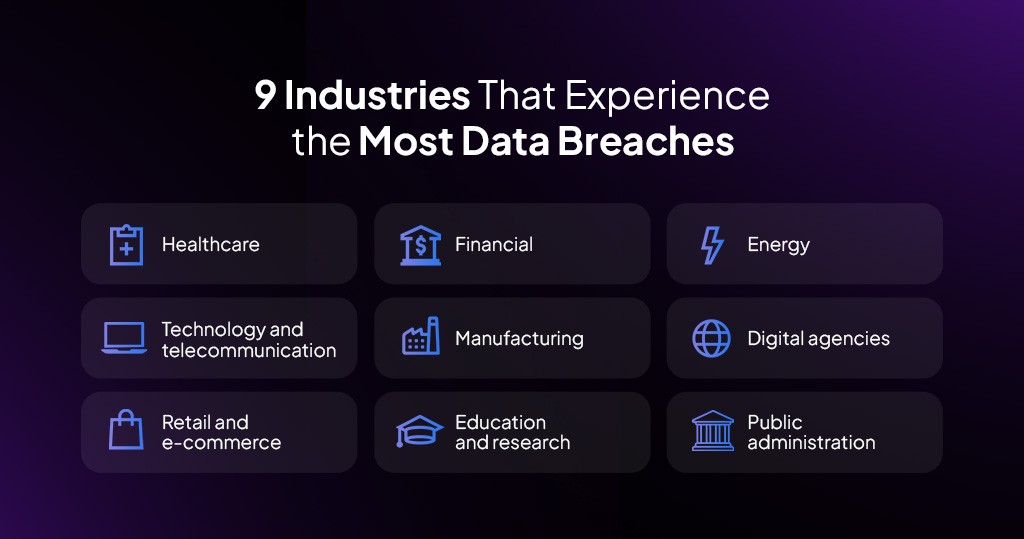
5. Manufacturing
Manufacturing is the heart of the global economy. The industry’s worldwide impact and innovations to meet modern demands make it an attractive target for hackers. Many manufacturing organizations are embracing technologies like artificial intelligence (AI), robotics, digital twins, and cloud computing, exposing the sector to new and more frequent cyber threats.
Over the last several years, the manufacturing industry has been the most targeted sector, contributing to more than 25% of attacks. Despite the recent vast increase in the cost of cyber attacks, manufacturing organizations often lag behind in cyber resiliency investments.
6. Digital Agencies
Digital agencies face cyber threats across apps, databases, clouds, and services. Social engineering, weak credentials, ransomware, and human error are among the top contributors to agency data breaches. Along with financial losses, these organizations are especially susceptible to reputational damage and customer distrust as their services are dependent on meeting customer needs and gaining a competitive advantage.
For instance, Facebook faced a data breach in 2019 that could result in a loss of millions of dollars due to exposed information like phone numbers, email addresses, birth dates, full names, and biographical information.
7. Retail and e-Commerce
Retailers often suffer from cyberattacks due to the mass handling of payment information. Increasing usage of Internet of Things (IoT) devices to enhance customer experiences lends opportunities for cybercriminals.
In 2023, e-commerce losses equated to more than $48 billion from payment fraud alone. Retail spaces also face unique threats compared to other industries, such as gift card cracking, credential stuffing, fake account creation, and social engineering attacks.
A 2021 report highlights that as many as 77% of global retail organizations experienced a ransomware attack that year.
8. Education and Research
Cyber attackers are increasingly focusing on educational spaces as many institutions rely on digital platforms to manage and store critical information.
One report details that more than 37 million records were breached in 2023, with higher education institutions accounting for over half of the total breaches. While human error and weak security measures contribute to these breaches, malicious third parties, ransomware attacks, and phishing schemes are contributors to the growing industry numbers.
9. Public Administration
Many hackers pursue government data for financial gain or to access strategic information.
For instance, from 2020 until 2022, Russian state-sponsored hackers were stealing communication infrastructure data and military information. Some of these organizations house tens of thousands of pieces of sensitive information.
Another example is the 2023 Pentagon leak that resulted in more than 26,000 individuals receiving notice of an email data breach regarding personally identifiable information.
How to Prevent Breaches in Your Organization
Industry data breaches can be detrimental, regardless of your specific sector. Deploying robust security measures and investing in ongoing innovations to overcome breaches is critical.
Here’s how you can prevent data breaches at your organization:
- Develop internal policies: Craft policies and procedures for data protection. Implementing access control, conducting risk assessments, and leveraging similar strategies can help you reduce internal and external data breaches.
- Implement technology: Software solutions for data resiliency protect information from cyber attacks while ensuring you can bounce back quickly after unforeseen events. Find software with capabilities for disaster recovery, business continuity, and flexible deployment. Working only with trusted, experienced providers like Zmanda can help your organization combat the potentially devastating impacts of cyber threats.
- Train employees: After establishing procedures and implementing solutions, it is essential to train employees. Your team should understand best practices for accessing and handling data and recognize the proper steps for reporting incidents and initiating response actions.
Secure Your Data with Zmanda
If you work in one of the most hacked industries, you likely already understand the importance of finding an effective backup solution. The right software can help reduce financial losses, minimize breaches, strengthen your threat response and business continuity strategies, and improve risk management.
If you’re looking for a solution to check these boxes, trust Zmanda to do the job. Zmanda Pro supports your industry needs by:
- Protecting against ransomware with immutable backups.
- Deploying robust recovery plans.
- Efficiently completing data transfers.
- Preventing data loss.
- Detecting and responding to threats quickly.
Talk to a data expert to learn more about Zmanda Pro, including how tailored solutions can meet specific business requirements.