Modern enterprises are shifting focus from just information protection to advanced management strategies—the ability to recover quickly, continue operations, and safeguard cloud environments no matter what.
But what does true data resiliency look like in 2025? And how can organizations architect solutions that bounce back without missing a beat? Protecting your organization’s most valuable information assets is no longer optional. Information management goes beyond traditional backups to create comprehensive systems that prevent disruptions, detect issues early, and enable rapid disaster recovery when problems occur.
This guide walks you through what data availability means, why it matters for modern enterprises, and how to build an effective strategy. You’ll learn about the three pillars of information integrity, explore common threats, and discover emerging technologies that can enhance your protection. With practical insights and actionable steps, this guide provides everything you need to strengthen your organization’s resilience posture
What is Data Resiliency?
Data resiliency isn’t just about backing up files to that external hard drive gathering dust under your desk. It’s your organization’s superpower to bounce back from digital disasters while keeping your precious data intact, available, and secure. Think of it as your system’s immune system – constantly working to prevent illness, detect problems early, and recover quickly when something goes wrong.
The most resilient organizations don’t just focus on having the fanciest tech – they build a trifecta of robust technology, smart processes, and well-trained people. This holistic approach to data resilience ensures that when digital disaster strikes (and it will), your business keeps humming along like nothing happened.
What Does Data Resiliency Mean?
Data resiliency means an organization’s ability to protect, detect, and recover data seamlessly during outages, cyberattacks, or disasters—ensuring uninterrupted access and business continuity.
The Three Pillars of Data Resiliency: Prevention, Detection, Recovery
Every great superhero team needs different members with complementary powers. Your data resiliency strategy is no different:
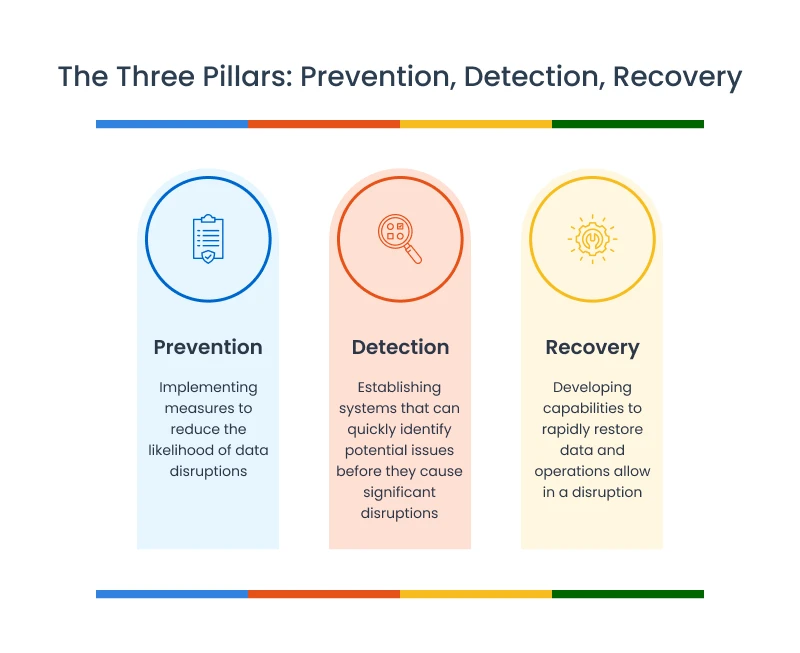
Prevention: The foundation of system reliability that focuses on proactive measures. This encompasses redundant infrastructure deployment, comprehensive security controls, and systematic maintenance protocols designed to mitigate vulnerabilities before incidents occur.
Detection: The intelligence layer that enables early identification of potential issues. Leveraging real-time monitoring systems, advanced anomaly detection algorithms powered by AI, and integrated alert frameworks allows organizations to identify threats at their earliest stages, preventing escalation.
Recovery: The response capability that ensures business continuity. This includes automated failover mechanisms, verified backup restoration procedures, and documented recovery processes that minimize downtime and information loss during critical incidents.
When these three work together, your systems stand a fighting chance against whatever the digital world throws at them!
How Data Resiliency Differs from Traditional Backup
If traditional backup is a snapshot of your vacation, data resiliency is the full travel insurance package:
| Traditional Backup | Data Resiliency |
|---|---|
| Focuses primarily on data copies | Addresses the entire data ecosystem |
| Recovery-oriented | Prevention, detection, and recovery-oriented |
| Often involves lengthy restore times | Aims for minimal or zero downtime |
| Typically point-in-time recovery | Continuous data protection and availability |
| Primarily addresses data loss | Addresses data loss, corruption, and availability issues |
Why does Data Resiliency Matter to Modern Enterprises?
As organizations become increasingly dependent on their digital assets, the importance of data resiliency continues to grow. Let’s explore the key reasons why this approach has become essential for businesses of all sizes.
1. The Business Impact of Disruptions
When systems fail, it’s not just an IT headache – it’s a full-blown business migraine:
- Operations screech to a halt faster than a car hitting a brick wall
- Customers left hanging (and potentially leaving for competitors)
- Your brand reputation takes a hit that makes a heavyweight boxing punch feel gentle
- Regulators knocking on your door (and they’re not bringing cookies)
No wonder cloud environments and data management have moved from “IT’s problem” to “everyone’s problem”! The impact on businesses and their operations can be devastating.
2. Cost Implications of Downtime and Data Loss
The numbers tell a scary story:

- Data disruptions carry significant financial implications:
- Organizations experience an average downtime cost of $5,600 per minute, according to recent studies
- According to IBM’s Cost of a Data Breach Report, the average cost of a data breach reached $4.45 million in 2023
- Ransomware attacks cost businesses an average of 16 days of downtime
Suddenly, investing in resiliency seems like a bargain compared to these nightmare scenarios!
3. Regulatory and Compliance Considerations
The regulatory landscape has more rules than a board game instruction manual:
- Healthcare organizations juggling HIPAA requirements for protecting patient information
- Financial services navigating SOX, GLBA, and PCI DSS mazes with their complex requirements
- European operations wrangling with GDPR’s strict protection requirements
- Public companies meeting SEC guidelines on cybersecurity disclosure requirements
A solid management strategy helps you stay on the right side of these regulations (and avoid painful penalties). Proper documentation and compliance tools become essential components of any comprehensive approach.
How to Build a Data Resilience Strategy
With a clear understanding of information quality and its critical importance, the next logical step is transforming this knowledge into strategic action. Developing an effective approach requires methodical planning, cross-functional alignment, and systematic implementation. The following framework offers a structured approach to building resilience capabilities that align with your organization’s specific needs, risk tolerance, and business objectives.
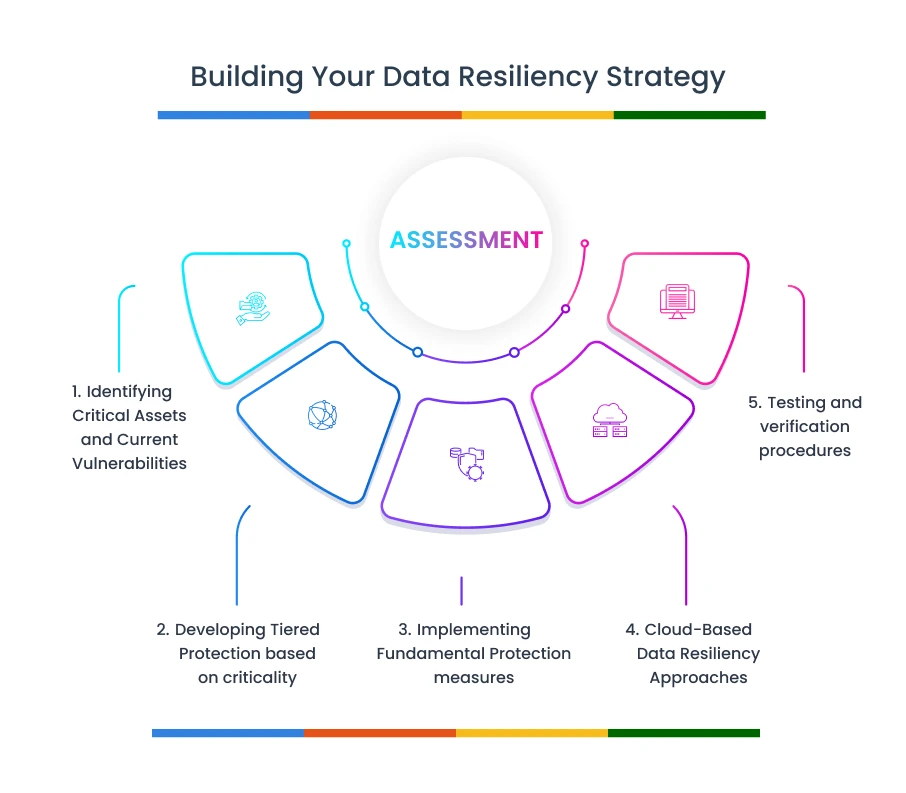
1. Assessment: Identifying Critical Assets and Current Vulnerabilities
Start by getting to know your landscape:
- Inventory: Cataloging all information assets across the organization
- Criticality Assessment: Identifying which elements are most essential
- Recovery Priority Determination: Establishing restoration sequence for different systems
- Vulnerability Mapping: Finding the weak spots in your current protection measures
A proper assessment requires involving stakeholders from across the organization – not just IT. Business leaders need to define what’s truly critical from their perspective. Remember that information resilience starts with understanding what needs to be protected and why.
2. Developing Tiered Protection Based on Criticality
Not all information is created equal, so protect it accordingly:
- Tier 1 (Mission Critical): Maximum protection with zero or near-zero downtime tolerance
- Tier 2 (Business Critical): High protection with minutes to hours of acceptable recovery time
- Tier 3 (Operational): Standard protection with hours of acceptable recovery time
- Tier 4 (Non-essential): Basic protection with days of acceptable recovery time
This tiered approach optimizes your resources by focusing the most robust resilience measures on truly critical systems, rather than treating everything as equally important. It’s like having different security systems for your jewelry box versus your garage – both need protection, but at different levels.
3. Implementing Fundamental Protection Measures
Core resilience capabilities should include:
- Backup Strategy: Comprehensive copy approach with appropriate frequency and retention periods using modern backups
- Storage Redundancy: Multiple copies across different storage media and locations, including cloud storage, on-premises storage, and hybrid storage solutions
- Network Redundancy: Alternative connectivity paths for critical systems
- Access Controls: Strict permission management to prevent unauthorized modifications
4. Cloud-Based Resilience Approaches
Modern resilience increasingly leverages cloud capabilities and various applications:
- Hybrid Backup Strategies: Hybrid environments require specialized backups strategies that combine on-premises and cloud solutions for comprehensive protection using advanced applications and tools.
- Disaster Recovery as a Service (DRaaS): When outsourcing disaster recovery, many organizations turn to DRaaS providers who manage the entire recovery process through specialized applications and services.
- Multi-Region Deployments: Distributing workloads across different geographic areas using cloud platform services
- Automated Failover: Configuring systems to transition between environments without manual intervention through AI-powered tools
Cloud services can democratize advanced resilience features, making enterprise-grade protection accessible to organizations of all sizes. However, remember that using cloud services doesn’t absolve you of responsibility – you still need to configure and test your resilience measures appropriately. Various applications and cloud solutions provide extensive services for modern businesses, enabling better technology integration effectively for clients.
5. Testing and Verification Procedures
Regular validation ensures your resilience capabilities actually work:
- Scheduled Drills: Planned exercises that test recovery procedures
- Chaos Engineering: Controlled introduction of failures to verify system responses
- Tabletop Exercises: Discussion-based sessions exploring response scenarios with stakeholders
- Continuous Validation: Automated testing integrated into regular operations using AI and advanced tools
What are the Common Threats to System Resilience?
Understanding the threats to your information is essential for building effective resilience. Let’s examine the most common challenges organizations face when protecting their critical information assets.

1. Hardware Failures and Infrastructure Issues
Physical components fail – it’s not a matter of if, but when. Hard drives crash, servers malfunction, and network equipment decides to take early retirement. These failures can lead to significant outages if not properly managed.
2. Cyberattacks: Ransomware and Other Malicious Activities
- Ransomware: Malicious software that encrypts your information
- Information Exfiltration: Unauthorized copying of sensitive information
- Information Manipulation: Unauthorized changes to critical information
- Distributed Denial of Service (DDoS): Attacks that overwhelm your systems
- Cyberthreats: Various forms of digital attacks targeting your infrastructure
Security breaches continue to be one of the most significant threats to modern organizations, requiring robust encryption and security measures.
3. Natural Disasters and Environmental Factors
Floods, fires, earthquakes, and severe weather events threaten physical infrastructure. These environmental challenges can cause widespread outages and require comprehensive business continuity planning.
4. Human Error: Accidental Deletions and Misconfigurations
People remain both the strongest and weakest links in information protection. Human errors can cause significant disruptions and require proper training and safeguards.
What are Some Industry-Specific Data Resiliency Considerations?
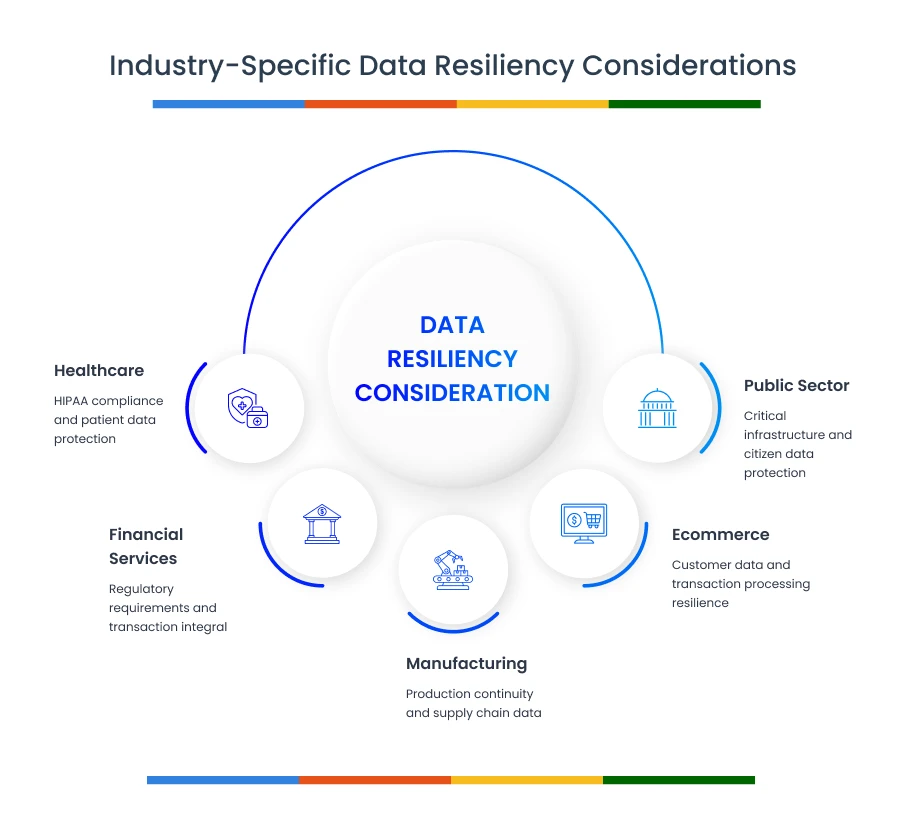
Different industries face unique data resiliency challenges based on their regulatory environment, operational needs, and the nature of the information they handle.
1. Healthcare: HIPAA Compliance
Healthcare organizations navigate complex resilience challenges by ensuring life-critical systems remain operational, maintaining strict regulatory compliance with HIPAA, integrating legacy and modern clinical applications, and managing specialized medical device connectivity to protect patient data and support critical healthcare services. The role of proper documentation and compliance tools becomes paramount in healthcare environments.
2. Financial Services: Transaction Integrity
Financial institutions develop sophisticated resilience strategies that guarantee transaction completeness, preserve immutable audit trails, minimize critical service downtime, and meet rigorous global regulatory standards while protecting sensitive financial data and maintaining the integrity of complex financial operations. Advanced encryption and security measures are essential for protecting client data.
3. Manufacturing: Production Continuity
Manufacturing environments blend IT and operational technologies to create robust resilience, focusing on seamless system integration that connects physical equipment with digital networks, supports just-in-time operational dependencies, manages distributed IoT sensor networks, and maintains comprehensive supply chain visibility. The integration of various applications and tools helps maintain production continuity.
4. E-commerce: Transaction Processing
Online retail platforms implement comprehensive resilience approaches that prioritize customer profile security, manage dramatic seasonal traffic variations, ensure reliable payment processing connections, and maintain precise inventory accuracy to deliver uninterrupted, secure shopping experiences. Performance optimization and capacity planning become critical during peak periods.
5. Public Sector: Citizen Information Protection
Government agencies develop multi-layered resilience strategies that support essential citizen services, manage complex interconnected systems, balance transparency requirements with information protection, and preserve long-term records while maintaining the critical infrastructure that supports societal functions.
Data Resiliency Best Practices
Data resiliency best practices are proven methods that help organizations ensure continuous data availability, integrity, and recovery—even during disruptions like cyberattacks or system failures.
1. Use the 3-2-1 backup rule – Keep 3 copies of your data, on 2 different media, with 1 stored offsite.
This widely trusted method ensures redundancy and minimizes the risk of total data loss.
→ Learn more about the 3-2-1 backup rule
2. Enable immutable backups – Protect backups from being altered or deleted, even by internal threats or ransomware.
These write-once-read-many (WORM) backups ensure your data remains untampered.
3. Automate and test recovery plans regularly – Simulate real-world failures to validate recovery speed, accuracy, and reliability.
4. Apply zero-trust security controls – Limit access to only verified users and devices. Trust nothing by default, verify everything.
5. Monitor systems for real-time threats – Use advanced tools to detect anomalies early and trigger preventive responses.
Emerging Technologies Enhancing Data Resiliency
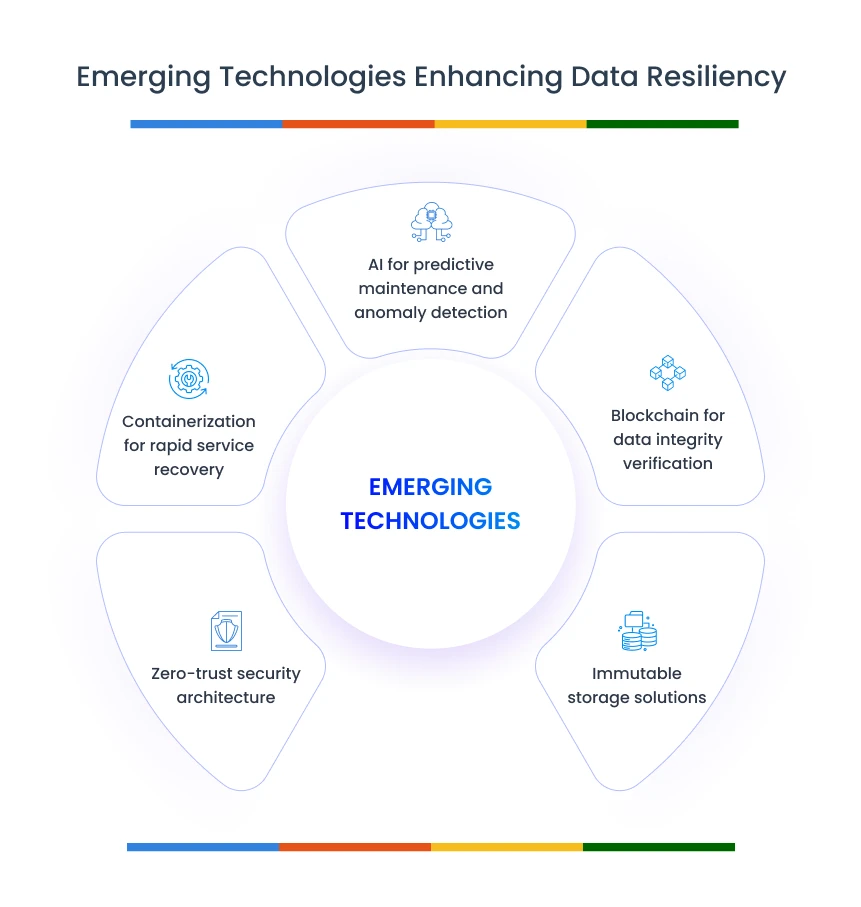
As threats to information continue to evolve, so too must our protection strategies. Let’s explore seven cutting-edge technologies that are transforming how organizations approach resilience, offering new ways to safeguard information and ensure business continuity even in the face of increasingly sophisticated challenges.
1. 1. AI for Predictive Maintenance and Anomaly Detection
Artificial intelligence transforms reactive recovery into proactive resilience by identifying unusual patterns that might indicate impending failures and forecasting potential issues before they cause disruptions. AI-powered applications can analyze vast amounts of information to predict potential problems and automate responses. Machine learning algorithms help organizations stay ahead of potential threats through advanced pattern recognition and predictive analytics. Modern AI systems provide sophisticated monitoring capabilities that enhance traditional approaches.
2. Blockchain for Information Integrity Verification
Decentralized technologies offer unique resilience properties through immutable records that protect against unauthorized modifications and consensus mechanisms that prevent corruption. Blockchain provides enhanced security for critical information assets.
3. Containerization for Rapid Service Recovery
Modern application architectures inherently improve resilience through service isolation that contains failures within specific components and deployment flexibility that allows quickly moving workloads between environments. Container technology enables faster recovery and better resource utilization.
4. Immutable Storage Solutions
Write-once technologies protect against many modern threats by physically preventing modification after information is written, providing protection against ransomware and other attempts to compromise integrity. These storage solutions offer enhanced security for critical information assets, utilizing advanced storage architectures and specialized storage hardware.
5. Zero-Trust Security Architecture
Modern security approaches enhance protection and resilience by verifying identity throughout system interactions and limiting permissions to the minimum necessary for each user or process. This approach significantly reduces the risk of breaches and unauthorized access.
6. Quantum Computing Applications
Quantum computing represents the next frontier in information processing and security. While still emerging, quantum computing promises to revolutionize encryption, processing capabilities, and threat detection methods. Organizations should begin considering how quantum computing might impact their future resilience strategies and prepare for this technological transformation.
7. Advanced Fault Tolerance Mechanisms
Modern systems incorporate sophisticated fault tolerance capabilities that automatically detect and recover from various types of failures. These mechanisms reduce the impact of hardware and software failures on business operations, ensuring better reliability and availability.
Next Steps: Building Your Resilience Roadmap
With a clear understanding of resilience concepts and emerging technologies, it’s time to put this knowledge into action. Let’s explore how to develop a practical, step-by-step approach to strengthening your organization’s protection strategy and creating a comprehensive roadmap tailored to your specific needs and priorities.
1. Initial Assessment Approach
Begin by identifying crown jewel information, mapping critical flows, and evaluating current protection measures. This assessment should involve stakeholders from across the organization to ensure comprehensive coverage.
2. Prioritizing Resilience Initiatives
Address highest-risk areas first while implementing quick wins and aligning improvements with available resources. Focus on initiatives that provide the greatest return on investment and risk reduction.
3. Building Team Capabilities
Develop cross-functional teams with clear responsibilities and necessary expertise for resilience implementation. Provide training on new tools and technologies and establish clear documentation procedures.
4. Implementation Timeline Considerations
Establish realistic milestones, manage dependencies, and align implementation with business cycles to minimize disruption. Consider the capacity constraints and available resources when planning your timeline.
5. Resource Planning
Project costs across multiple years, plan technology acquisitions, and develop clear ROI justifications for resilience investments. Include ongoing operational costs and maintenance requirements in your planning. Create comprehensive report documentation to track progress and measure success.
Bringing It All Together
From understanding what data resiliency is to examining industry-specific considerations and practical strategies, this guide provides everything you need to build a resilient data ecosystem.. Whether you’re protecting financial systems, ensuring patient safety, or enabling remote teams, the principles of data resilience remain the same: prevent, detect, and recover quickly.
Remember that data resiliency is a journey, not a destination. As threats evolve and business needs change, your resilience strategy must adapt accordingly. The most successful organizations treat data resilience as an ongoing program with regular assessment, testing, and improvement.
With the right planning and a commitment to excellence, your organization can confidently face disruptions and ensure uninterrupted access to your most valuable asset: your data. When the inevitable disruption occurs, you’ll be glad you invested in data resiliency today.
Discover Zmanda Pro for Data Resiliency
Ready to strengthen your data resiliency with a top-tier enterprise solution? Explore Zmanda Pro—a comprehensive, reliable, and scalable option for modern businesses seeking true data resilience. Here’s why Zmanda Pro stands out for building resilient data environments:
- Innovative Backup Technologies: Zmanda offers advanced backup and recovery services that go beyond simple protection to create truly resilient data systems with disaster recovery and continuous restore capabilities that maintain business continuity. Zmanda Enterprise Backup Solution
- Seamless Cloud Integration: Based on an open-source restic framework, our solutions create resilient data infrastructures that integrate effortlessly with cloud platforms such as OpenShift, OpenStack, Kubernetes, and Red Hat OpenStack Platform. Check out our compatibility matrix to figure out the workloads we support.
- Partnerships & Resources: Collaborations with industry leaders like Wasabi and Nutanix, combined with extensive resources such as case studies and documentation, provide additional value for enterprises seeking to strengthen their data resiliency posture.
Experience its resilience capabilities firsthand through a product demo, delve into customer testimonials about real-world data resilience improvements, and gather all the information you need to make an informed decision. Start building your resilient data infrastructure today by taking a 14-day free trial today.
If you’re still unsure, you can also talk to a data protection expert to get a free 30-minute consultation before choosing your data resiliency solution.