Data resiliency encompasses the ability of an organization to continuously maintain critical data operations despite disruptions, combining advanced threat protection, automated recovery, and cross-infrastructure data integrity safeguards. Organizations stake their business continuity on effective data resilience strategies that form the foundation of overall business resilience.
Beyond mere recovery, true resilience demands proactive protection, automated validation, and seamless integration across diverse cloud environments.
This comprehensive analysis examines the ten most robust data resilience solutions available, evaluating each based on protection completeness, recovery speed, ransomware defense mechanisms, compliance capabilities, and long-term value.
What Makes a Strong Data Resilience Solution in 2025
Key Evaluation Criteria
The data resilience landscape has evolved with several critical requirements now essential for any enterprise-grade solution:
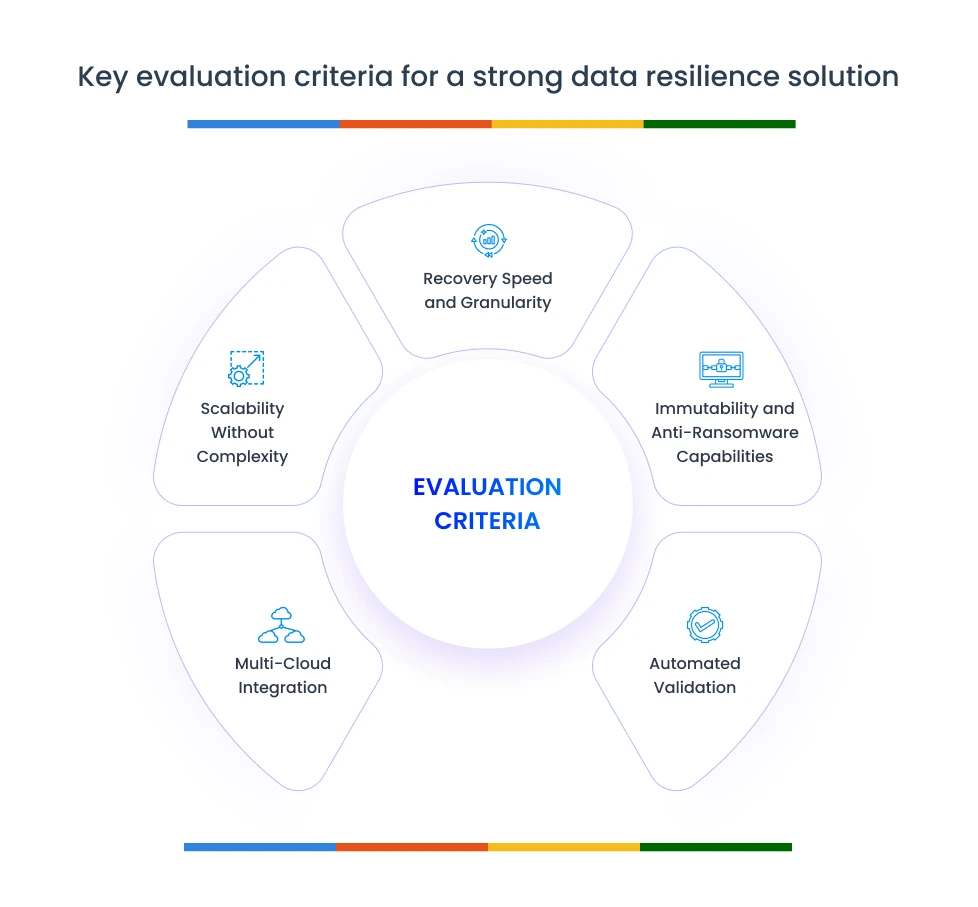
- Recovery Speed and Granularity: Modern data resilience solutions must deliver near-zero Recovery Time Objectives (RTOs) and Recovery Point Objectives (RPOs) for critical workloads. The ability to recover specific files, databases, or application components without restoring entire systems has become non-negotiable.
- Immutability and Anti-Ransomware Capabilities: With ransomware attacks now targeting backup systems directly, effective data resilience solutions must offer air-gapped protection, immutable storage options, and advanced threat detection to prevent backup compromise.
- Automated Validation: The best data resilience solutions now automatically test recoveries in isolated environments, providing evidence that backups are not only complete but also recoverable under various failure scenarios.
- Multi-Cloud Integration: As enterprises distribute workloads across multiple data centers and cloud providers, data resilience solutions must provide consistent protection and governance policies regardless of where data resides.
- Scalability Without Complexity: Enterprise data volumes continue to expand exponentially, requiring solutions that can scale horizontally across data centers without creating management silos or administrative overhead.
Modern Challenges Require Advanced Solutions
Several emerging factors have elevated requirements for data resilience:
- Sophisticated Ransomware: Modern attacks specifically target backup systems before encrypting production data. Effective data resilience solutions must protect themselves from compromise.
- Hybrid Cloud Complexity: With workloads spanning on-premises, multiple data centers, cloud environments, and SaaS platforms, data resilience must function seamlessly across heterogeneous environments.
- Container Proliferation: The rapid adoption of containerized applications requires specialized protection approaches beyond traditional VM-centric backup.
- Compliance Expansion: Global regulations increasingly mandate specific data protection, sovereignty, and data recovery requirements, particularly for personal information.
- Resource Constraints: IT teams face growing data protection demands with limited staff, requiring solutions that automate routine operations and provide clear visibility across complex environments.
The Role of Automation and AI in Data Protection
AI has transformed from a nice-to-have feature to an essential component of effective data resilience:
- Threat Detection: AI algorithms can identify potential ransomware activities by recognizing suspicious data change patterns well before human operators would notice anomalies.
- Predictive Analytics: Advanced data resilience solutions now use AI to predict potential infrastructure failures before they occur, allowing preventive action through AI-powered monitoring systems.
- Intelligent Resource Allocation: AI-driven systems automatically adjust protection policies and resource allocation based on workload criticality and risk profiles.
- Recovery Orchestration: Automated AI-powered workflows for data recovery eliminate human error during high-stress recovery scenarios, ensuring consistent execution of complex recovery processes.
Top 10 Data Resilience Solutions for 2025
#1. Zmanda Pro
Building on advanced protection technology, Zmanda Pro has established itself as a comprehensive data resilience solution delivering enterprise-grade capabilities with flexibility and cost-efficiency.

- Open-Source Benefits: Zmanda’s foundation on the open-source Restic backup project provides modern security features, strong encryption, and efficient deduplication. The platform combines Restic’s performance advantages with enterprise management capabilities, creating a compelling alternative to proprietary data resilience solutions.
- Enterprise Capabilities: Despite its open-source heritage, Zmanda delivers enterprise-grade features including centralized management, encryption, and comprehensive reporting. The platform’s straightforward architecture reduces complexity compared to many competing solutions in today’s market.
- Cloud Integration: Zmanda seamlessly extends protection to major cloud platforms, including AWS, Azure, and Google Cloud. The platform’s cloud storage integration allows organizations to implement 3-2-1 protection strategies (three copies, two media types, one off-site) without managing additional infrastructure across multiple data centers.
- Cost-Effectiveness: Zmanda’s transparent pricing model typically delivers 30-50% cost savings compared to proprietary alternatives, making comprehensive data resilience accessible to organizations with constrained budgets. The solution scales effectively from small environments to enterprise deployments without restrictive capacity-based licensing terms.
- Versatility: Zmanda protects diverse environments, including Windows, Linux, macOS, and major database platforms through a unified management framework. This versatility makes it particularly suitable for heterogeneous environments requiring consistent protection without specialized point solutions.

#2. Rubrik Zero Trust Data Security
Rubrik has emerged as a frontrunner in the data resilience market through its comprehensive Zero Trust Data Security platform, focusing on immutability, automation, and integration across hybrid environments.

Key Features and Capabilities:
- Continuous data protection for mission-critical business applications
- Native SaaS protection for Microsoft 365, Google Workspace, and Salesforce
- Policy-based automation that scales from hundreds to thousands of workloads
- Advanced APIs enabling integration with security ecosystem tools
- Zero Trust Architecture and Immutability Benefits: Rubrik’s architecture implements a true “never trust, always verify” approach to data security. The platform’s immutable file system prevents backup data from being encrypted, deleted, or modified, even with administrative credentials. This immutability extends across on-premises deployments and cloud storage, creating a last line of defense against sophisticated attacks.
- Ideal Use Cases: Rubrik excels in environments with stringent recovery time objectives, particularly for organizations facing heightened ransomware threats or those with complex hybrid cloud architectures. Financial services, healthcare, and government sectors have widely adopted Rubrik as their primary data resilience solution.
- Recent Innovations: Rubrik’s 2025 platform introduces advanced anomaly detection that correlates file changes across thousands of systems to identify potential attacks with remarkable precision. Their recent acquisition of cloud security firm CloudGuard has further enhanced their ability to protect cloud-native workloads through integrated AI capabilities.
#3. Veeam Data Platform
Veeam continues to dominate the data resilience market through continuous innovation and a focus on recovery verification that ensures backups are functional when needed.
- Comprehensive Protection: Veeam’s Data Platform offers unified protection spanning physical servers, virtual machines, cloud workloads, and SaaS applications. Their universal licensing model simplifies deployment across hybrid environments, eliminating protection gaps that often occur with fragmented solutions.
- Continuous Data Protection: Veeam’s CDP technology leverages changed block tracking and journaling to provide near-continuous backup with recovery points measured in seconds rather than hours. This capability has positioned Veeam as a preferred data resilience solution for tier-1 applications with minimal tolerance for data loss.
- SureBackup Verification: Veeam’s differentiation comes from automated recovery testing that spins up virtual machines from backup in isolated environments to validate recoverability. The system performs application-aware testing to ensure not just that systems boot, but that applications function correctly—a critical capability often missing in competing platforms.
- Cloud Integration: Veeam’s Cloud Data Management platform extends protection to AWS, Azure, and Google Cloud workloads with native integration that preserves cloud-specific attributes and ensures consistent protection policies across environments.
#4. Cohesity DataProtect
Cohesity has redefined data resilience through a platform approach that converges backup, recovery, file services, and data analytics on a single scalable architecture.
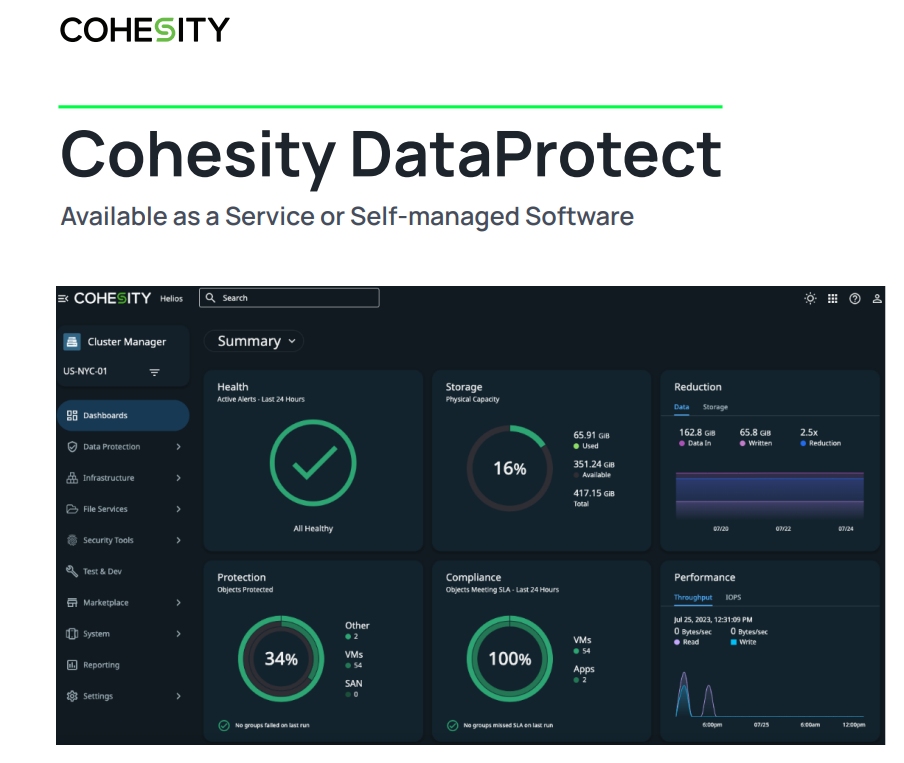
- Unified Platform Approach: Cohesity’s hyperconverged secondary storage architecture eliminates traditional backup silos by consolidating data protection, development environments, analytics, and long-term retention on a single platform. This unified approach significantly reduces the complexity typically associated with comprehensive data resilience strategies.
- AI-Driven Protection: Cohesity’s Helios management platform leverages machine learning to identify anomalous data changes that might indicate ransomware or other threats. The system analyzes patterns across the entire customer base to identify emerging attack vectors before they impact individual organizations.
- Secondary Data Utilization: Beyond traditional protection, Cohesity enables organizations to extract value from backup data through integrated analytics and development capabilities. This approach transforms data resilience from a cost center to a business enabler by making protected data available for reporting, testing, and development.
- Anti-Ransomware Technology: Cohesity’s multi-layered defense includes immutable snapshots, threat detection, and automated recovery capabilities. Their DataLock feature implements WORM (Write Once, Read Many) protection that prevents backup modification even by system administrators.
#5. Druva Phoenix
As the first enterprise-grade data resilience solution delivered entirely as SaaS, Druva Phoenix eliminates infrastructure complexity while providing comprehensive protection across diverse environments.
- Cloud-Native Architecture: Druva’s true SaaS architecture eliminates on-premises backup infrastructure, reducing total cost of ownership while delivering scalability on demand. The platform’s global deduplication across all protected workloads significantly reduces storage consumption and network bandwidth requirements, ensuring reliable connectivity for distributed teams.
- SaaS Delivery Benefits: Druva’s consumption-based pricing model aligns costs with actual protection needs, eliminating large upfront capital expenditures. Automated updates ensure organizations always benefit from the latest security enhancements without disruptive upgrade cycles.
- Diverse Workload Coverage: The Phoenix platform extends protection to physical servers, virtual environments, databases, and endpoint devices through a unified policy framework. Their specialized Office 365 protection includes granular recovery for Exchange, SharePoint, and OneDrive data across enterprise facilities.
- Compliance Capabilities: Druva’s global presence enables organizations to maintain data sovereignty while implementing consistent protection policies. Advanced legal hold, eDiscovery, and audit capabilities make Druva particularly valuable for organizations in regulated industries requiring robust data resilience solutions.
#6. IBM Spectrum Protect Plus
IBM’s enterprise-grade data resilience solution combines decades of storage expertise with modern cyber resilience capabilities, particularly for large-scale environments.
- Enterprise Protection Features: Spectrum Protect Plus delivers comprehensive data resilience across physical, virtual, and container environments, particularly strong in protecting mission-critical database workloads. The platform’s deduplication and compression technologies provide exceptional storage efficiency at scale across distributed data centers.
- Cyber Vault Technology: IBM’s cyber vault creates isolated, air-gapped environments designed to withstand sophisticated ransomware attacks. This architecture implements both logical and physical separation between production and backup data, establishing a true last line of defense.
- Container Protection: IBM has made significant investments in protecting Kubernetes environments, offering application-consistent backups that preserve both data and configuration elements. This container-native approach ensures the reliable data recovery of complex microservices applications.
- Security Ecosystem Integration: Spectrum Protect Plus integrates with IBM’s broader security portfolio, including QRadar and Security Guardian, to provide correlated threat detection across data protection and security domains. This integration enables more effective identification of potential data compromise before it impacts backup systems.
#7. Commvault Metallic SaaS
Commvault’s hybrid data resilience solution combines enterprise-grade protection capabilities with cloud-native delivery, offering flexibility for diverse organizational requirements.
- Hybrid Architecture: Metallic delivers Commvault’s proven data resilience capabilities through a SaaS model while allowing organizations to maintain local copies for performance and compliance. This hybrid approach provides the best of both worlds: operational simplicity with local recovery speed.
- HyperScale X Technology: Commvault’s scale-out appliance architecture enables seamless expansion as protection needs grow, eliminating the complex forklift upgrades often required by legacy solutions. The integrated approach combines storage, compute, and software in a unified data resilience solution.
- ThreatWise Deception Technology: Commvault’s innovative approach deploys deception decoys throughout the environment to detect ransomware and other threats before they reach production data. This early warning system provides critical time to implement defensive measures before attacks spread.
- Consumption-Based Advantages: Metallic’s flexible licensing model allows organizations to align costs with actual protection needs while maintaining enterprise-grade recovery capabilities. The platform’s self-service portal enables business units to manage their own recoveries within governed parameters.
#8. Zerto (HPE) Continuous Data Protection
Acquired by HPE, Zerto has pioneered journal-based continuous data protection that fundamentally changes the economics and capabilities of data resilience.

- Journal-Based Protection: Zerto’s unique approach captures every change to protected systems with granularity measured in seconds rather than hours or days. This continuous protection eliminates traditional backup windows and minimizes potential data loss during recovery scenarios, fundamentally changing the economics and efficiency of data protection in the modern digital economy.
- Recovery Granularity: The platform’s journal-based technology enables point-in-time recovery to any second over the retention period, allowing organizations to recover precisely before corruption, deletion, or ransomware encryption. This capability dramatically reduces data loss compared to traditional snapshot-based approaches.
- Orchestration Capabilities: Zerto excels in automating complex recoveries involving multiple interdependent systems. The platform’s orchestration capabilities ensure applications recover in the correct sequence with appropriate dependencies, eliminating the human error common in high-stress recovery scenarios.
- Analytics and Reporting: Zerto’s analytics platform provides continuous visibility into protection status, recovery readiness, and potential compliance gaps. The system’s what-if modeling helps organizations optimize recovery strategies based on business impact analysis and recovery objectives.
#9. Veritas NetBackup
As one of the industry’s most established data resilience platforms, Veritas NetBackup has evolved significantly to address modern threats while maintaining enterprise-grade scalability and reliability.
- Evolution of Capabilities: NetBackup’s 10.5 platform represents a complete modernization of the traditional enterprise backup approach, with a containerized architecture that scales dynamically based on protection workloads. The platform’s web-based management interface simplifies administration while providing comprehensive reporting.
- Autonomous Data Management: Veritas has implemented AI-driven policy optimization that automatically adjusts protection approaches based on workload characteristics, criticality, and recovery objectives. This intelligence reduces administrative overhead while ensuring appropriate protection levels across diverse environments.
- Multi-Layered Ransomware Protection: NetBackup’s integrated approach combines immutable storage, anomaly detection, and automated recovery testing to create a comprehensive defense against sophisticated threats. The platform’s Malware Scanning integration identifies potential infections within backup data before restoration.
- Platform Support: Veritas maintains exceptional breadth in platform support, protecting everything from mainframes to cloud-native applications through a unified management framework. This comprehensive coverage makes NetBackup particularly valuable for organizations with diverse technology ecosystems requiring consistent data resilience solutions.
#10. Dell PowerProtect Data Manager
Dell Technologies’ integrated data resilience platform leverages the company’s storage expertise to deliver exceptional performance for organizations heavily invested in Dell infrastructure.
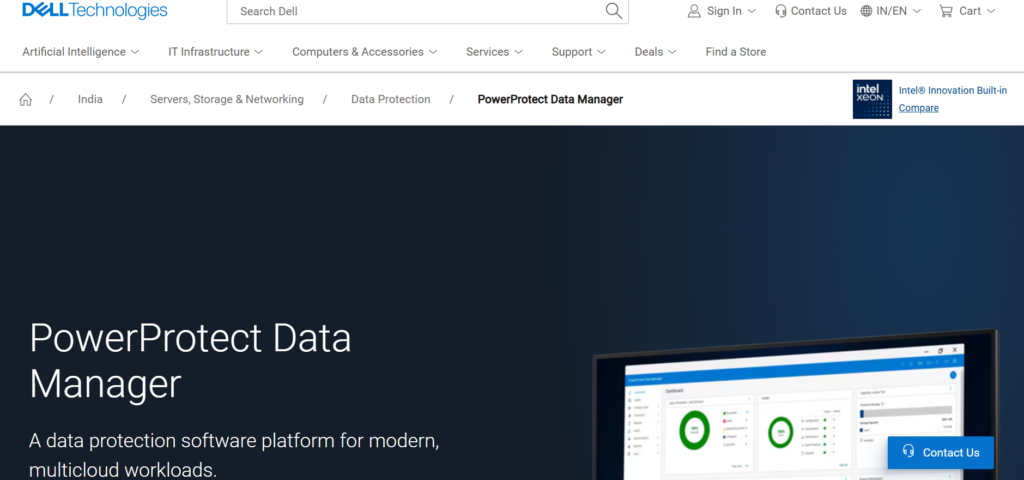
- Integrated Approach: PowerProtect combines purpose-built backup appliances with comprehensive software capabilities, creating an integrated data resilience solution that optimizes both protection and recovery performance. The platform’s tight integration with Dell primary storage enables efficient protection of Dell environments.
- Automated Discovery: PowerProtect’s discovery engine automatically identifies workloads requiring protection and recommends appropriate policies based on service-level objectives. This automation reduces protection gaps and ensures new systems receive appropriate data resilience coverage without manual intervention, leveraging AI for intelligent workload classification.
- Cyber Recovery Solution: Dell’s specialized Cyber Recovery vault creates physically isolated environments with additional security controls specifically designed to withstand sophisticated attacks. The vault implements both air-gapping and anomaly detection to maintain a secure recovery option even during wide-scale compromises.
- Dell Integration: For organizations leveraging Dell’s broader infrastructure portfolio, PowerProtect offers exceptional integration that reduces protection overhead and improves recovery performance. Native integration with PowerStore, PowerMax, and PowerScale storage platforms creates particularly efficient data movement paths.
Implementation Considerations
Successfully implementing a data resilience solution requires careful planning beyond product selection and strong partnerships with technology providers:
- Budget Planning: Effective budgeting for data resilience must consider several factors beyond initial licensing. Total Cost of Ownership should span a 3-5 year horizon, including ongoing management, storage consumption, and upgrade requirements. To simplify your process, try the Zmanda Pricing Estimator, where you can enter your environment details to calculate your precise pricing and licensing needs.
- Staffing and Skills: The increasing complexity of data resilience requires specialized expertise. Organizations should consider dedicated data protection specialists rather than adding these responsibilities to general infrastructure teams, given the critical importance of protecting business data.
- Phased Implementation: Successful data resilience deployments typically follow a phased approach. Begin with assessment and planning by documenting current protection coverage, identifying gaps, and establishing recovery objectives.
- Measuring Effectiveness: Evaluating data resilience success requires specific metrics. Track the percentage of data recovery operations that complete successfully without manual intervention, and evaluate protection costs per terabyte and per workload to identify optimization opportunities as environments evolve.
By thoroughly evaluating these factors against the list of top 10 data resiliency solutions, you will be well-positioned to select the option that best aligns with your organization’s specific protection requirements, infrastructure environment, and budgetary constraints.
For organizations prioritizing comprehensive protection with minimal downtime, Zmanda offers an enterprise data resiliency software that delivers robust capabilities, flexible deployment options, and operational efficiency needed to safeguard your critical business systems.