Data governance vs information governance share similarities and overlap in unique ways, but they do not refer to the same thing. Both are critical for organizations, but also evolve in our ever-shifting digital landscape, making it critical to understand the processes, approaches, and objectives of each.
Below, you can discover how data governance vs information governance differ and how you can intertwine them to benefit your organization through improvements to risk management, data quality, decision-making, and compliance.
Brief Overview of Data Governance vs Information Governance
In short, the pillars of data governance revolve around technical data compliance, security, integrity, and privacy, while data governance encompasses all organizational information. Data governance refers to procedures and plans to ensure the proper management of data assets. This term encompasses the processes, IT, and people necessary to support and handle a company’s data.
Data governance ensures information security, usability, availability, and integrity by using structured processes to ensure consistency, reliability, and trustworthiness. Many times, governing bodies within an organization will define the rules and procedures, and another set of team members will help implement and maintain these procedures.

Information governance relates to the framework an organization needs to manage information. Those concerned with information governance will take actions to mitigate risks, guide decision-making, and ensure regulatory compliance. Information governance aims to use and manage organizational information to support objectives.

Successful information governance requires teams to coordinate business operations, information technology, privacy measures, risk management, and several other disciplines. Businesses must determine the proper handling of information by establishing controls, procedures, and policies detailing how to archive, use, store, destroy, and create information. Any rules or procedures a team establishes must comply with relevant regulations and laws, ensure privacy, protect the organization’s intellectual property, and facilitate effective information use.
The Difference Between Data Governance vs Information Governance
While both terms relate to an organization’s data resilience strategy, there are some significant differences between the two. Understanding these differences is crucial for formulating effective processes and procedures and aligning your strategies and objectives to support business needs and promote growth. Key differences to consider are:
A Narrow or Broad Focus
The first significant difference to note is the scope. Data governance refers to pieces of the puzzle, while information governance is the complete picture. Data governance is specific to the technical aspects of managing an organization’s data assets, but information governance takes a broader approach. Information governance also involves digital and physical information, not solely structured data.
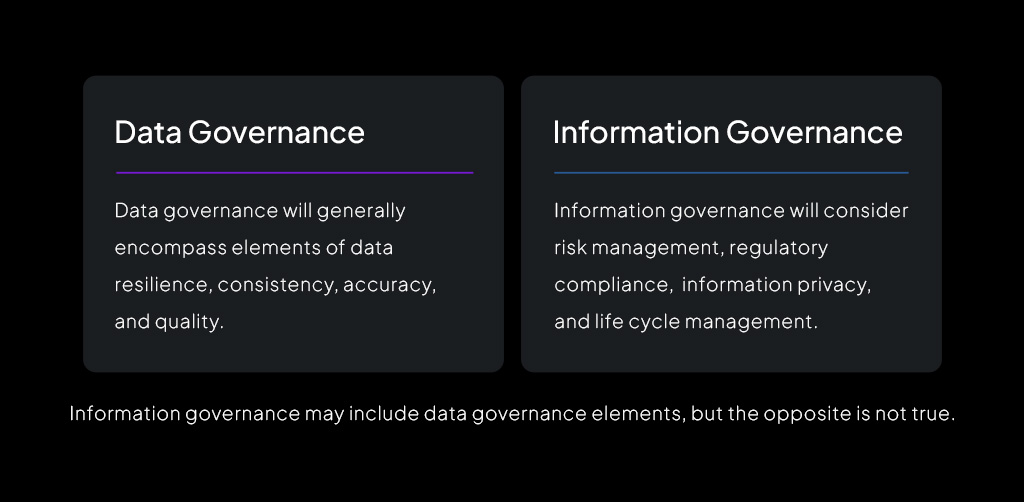
With varying scopes of focus, it’s understandable that the practices and processes would differ as well. Data governance will generally encompass elements of data resilience, consistency, accuracy, and quality, while information governance will consider risk management, regulatory compliance, information privacy, and life cycle management. Information governance may include data governance elements, but the opposite is not true.
Information Quality or Quantity
Data governance will focus heavily on data quality. The technical elements of organizational systems often have complex requirements, and IT departments generally head related practices and processes. Organizations can achieve objectives like enhancing customer trust, minimizing returns, or driving industry competition by utilizing best data governance practices.
Alternatively, information governance applies to large batches of information. Rather than focusing on information particulars, these processes will guide overarching management requirements. Teams working with this objective will focus on understanding how information adds value to the organization and the compliance needs of each asset. By leveraging best information governance practices, teams can reach goals like organizing resources, boosting collaboration, and optimizing knowledge.
Data Protection or Sharing
Another notable difference is in the aim to protect or share information. To an extent, both types of governance allow for both capabilities, but they have a stronger focus on one or the other.
For example, think of a healthcare organization. In this landscape, protecting patient information is critical. Clinics and hospitals implement strict security measures and leverage strategies like encryption to safeguard data. In this setting, it is equally vital for information to be accurate so providers can deliver the best treatment recommendations. These factors may prompt a healthcare organization to standardize data entry processes and dedicate team members to continually monitor data quality or changes.
Now, consider a manufacturing company implementing information governance practices. Information governance can empower the team to manage project information, such as designs and specifications. It could benefit this team to create a system for tracking document changes and ensuring document access to relevant workers and stakeholders. Additionally, the team will likely have information backup systems and controls to prevent unauthorized access.
Access Controls or Security Measures
Both types of governance require some preventive measures to protect the organization and its information and data assets. However, how teams accomplish this goal will vary depending on the type. Data governance often implements security measures such as using encryption, establishing privacy preferences, classifying data, managing analytical data processing, and monitoring data quality. Alternatively, information governance may implement strategies and tools like access control, user authentication, intrusion detection systems, and data organization.
Using Information Governance and Data Governance Together
As organizations increasingly deploy AI agents across their workflows, extending governance frameworks to include AI agent governance is becoming an essential part of a comprehensive data and information strategy. Aligning governance strategies for a comprehensive plan can ensure data quality, integrity, security, organization, shareability, and compliance. You can intertwine information governance and data governance to experience benefits like:
- Risk mitigation: Leveraging best practices for both governance types helps organizations mitigate risks associated with regulatory non-compliance, privacy violations, and data breaches. Regular audits and continuous improvement efforts further enhance your risk management strategies.
- Ensuring compliance: Both types of governance ensure compliance at various levels. Leveraging both empowers you to cover all your bases for structured and unstructured data. You can craft business-specific rules and remain competitive by complying with industry and application-specific regulations and standards.
- Enhanced decision-making: Data is crucial for informed decision-making. Maintaining accurate data and having proper systems for handling, storing, and sharing information empower you to follow trends, identify pain points, and drive long-lasting change.
Many organizations strengthen this alignment by adopting established frameworks such as NIST security certification and Privacy Controls to ensure consistency, regulatory compliance, and industry-standard protection. As organizations bring in outside expertise, an AI agent development company can help integrate AI-powered solutions while accounting for data access, security, and compliance requirements.

Support IT Governance with Zmanda
Whether you implement data governance, information governance, or a combination of both types, finding a reliable solutions provider is critical to achieving your goal. That’s where we come in.
Zmanada is your data protection solution. Leveraging innovative technologies, seamless cloud integrations, and partnerships with industry leaders, Zmanda offers the accessibility, affordability, and peace of mind your organization needs. Zmanda offers features like:
- Data loss prevention: Avoid losing data by using immutable storage to shield data from deletions or edits. Leverage encryption and robust security measures to meet regulations and security standards.
- Disaster recovery: Perform disaster recovery drills with restore simulations. Achieve faster backups and strategically replicate servers for business continuity.
- Threat detection: Identify risks with real-time alerting and monitoring. Ensure data integrity with corruption checks and email reporting functions.
- Threat response: Execute restores automatically and securely delegates team responsibilities to handle threats. Pause backups if necessary and manage jobs from a central location.
- Recovery operations: Restore systems quickly and recover from cloud or on-prem targets. Use incremental backups and flexible scheduling to ensure continual operations.
Ready to secure your data and enhance your processes? Schedule a 30-minute consultation with one of our experts to learn more.