Zerto built its reputation on one thing: continuous VM replication with near-zero RPO. For VMware-heavy data centers, that precision was genuinely valuable. But HPE’s 2021 acquisition of Zerto shifted the calculus for many IT teams, not because the product stopped working, but because platform acquisitions change roadmaps, pricing models, and strategic priorities in ways that take years to fully surface.
The more immediate issue is architectural. Zerto was designed around journal-based VM replication, a narrow but deep capability that leaves physical servers, databases, and SaaS platforms without native coverage. If your infrastructure is hybrid, you are already running Zerto alongside other backup tools to fill those gaps. That means more vendors, more renewals, and more complexity than you should be carrying.
This post evaluates ten Zerto alternatives that address both challenges, unified backup and DR platforms, continuous replication competitors, and enterprise-grade options. For each one, we cover what it does well, where it falls short, and which infrastructure profile it fits. If you are re-evaluating Zerto, this is the shortlist.
See how Zmanda Pro covers backup and DR in one platform
What to Look for in a Zerto Alternative
The right Zerto alternative depends on what Zerto was not doing well enough for your environment. Before evaluating any specific product, clarify what is driving the evaluation:
- Workload breadth. If you need protection beyond VMware VMs, physical Windows or Linux servers, SQL databases, Microsoft 365, or Proxmox VE, a VM-replication-only tool is still a partial solution. Look for a platform that consolidates all of these under one management console rather than requiring additional products to cover what Zerto cannot.
- RPO and RTO requirements. Journal-based continuous replication achieves sub-second RPO. Backup-based DR tools typically measure RPO in minutes or hours. Be specific about what your recovery objectives actually require, not all workloads need continuous replication, and paying for it across your entire environment when only a subset of workloads demands it is a significant cost driver.
- Total cost of ownership across 3 to 5 years. Licensing is one line item. Add storage costs, support tier pricing, infrastructure overhead, and mandatory training requirements, and the picture changes substantially. The lowest year-one number rarely wins over a multi-year horizon.
- Deployment model flexibility. SaaS, self-hosted, air-gapped. Your compliance and security posture eliminates some options before evaluation begins. Make sure the deployment model is a match before going deep on feature comparison.
- Vendor stability and roadmap visibility. Platform acquisitions are not inherently bad, but they create uncertainty. Evaluate where the product is heading, not just where it is today.
Top 10 Zerto Alternatives at a Glance
| Tool | Best For | Workload Coverage | Pricing Model |
|---|---|---|---|
| Zmanda Pro | SMB / Mid-market | Full — 30+ workloads | Per-workload (transparent, predictable) |
| Veeam Data Platform | SMB / Enterprise | Partial — VM-centric | Per-workload (VUL model) |
| Acronis Cyber Protect | SMB | Partial — VM + files + EDR | Per-GB + per-workload (dual model) |
| Druva Data Resiliency Cloud | Enterprise | Partial — cloud-native focus | Per-credit / consumption |
| Commvault Complete Data Protection | Enterprise | Full — broad coverage | Custom licensing |
| Cohesity DataProtect | Enterprise | Full | Appliance + software licensing |
| Rubrik Security Cloud | Enterprise | Full | Subscription |
| Veritas NetBackup | Enterprise | Full — broad legacy coverage | Per-socket / per-TB |
| Nakivo Backup & Replication | SMB / Mid-market | Partial — VM-focused | Per-workload |
| Arcserve UDP | SMB / Mid-market | Partial | Per-workload |
1. Zmanda Pro: Best Unified Backup and DR Alternative to Zerto
Where Zerto’s architecture narrows to VM replication, Zmanda Pro is designed for breadth. It protects 30+ workload types: VMware vSphere, Hyper-V, Proxmox VE, physical Windows and Linux servers, SQL Server, MySQL, PostgreSQL, MongoDB, Oracle RMAN, and Microsoft 365, all managed from a single console. That consolidation removes the need to patch a VM-replication tool with additional products to cover the rest of your stack.
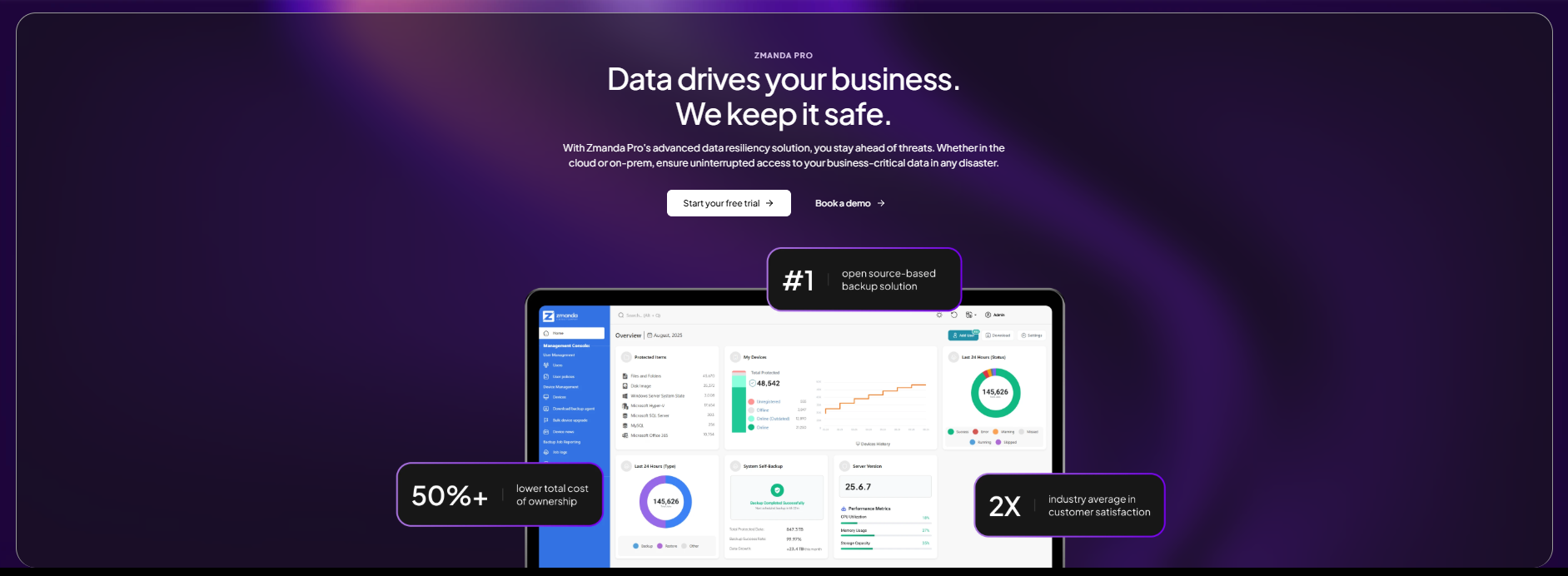
The architecture is direct-to-storage: backup data flows from the client directly to your chosen storage destination, on-premises NAS, AWS S3, Azure Blob, Wasabi, or Zmanda Cloud Storage, without passing through Zmanda servers. Client-side deduplication and compression reduce storage consumption by up to 90%, and forever-incremental backups mean only changed data is transferred after the initial full backup, supporting a sub-1-hour RPO across all protected workloads.
Deployment takes 15 minutes. There are no mandatory certifications. 24/7 expert support is included, not a paid add-on. Per-workload pricing is transparent and predictable, delivering 50%+ lower TCO than leading alternatives across 1-, 3-, and 5-year horizons. For organizations evaluating Zerto because their infrastructure has grown beyond VMware-only, Zmanda Pro covers the full surface area without the full-enterprise price tag.
Three deployment models are available: SaaS (Zmanda-hosted on Azure), self-hosted on-premises, and fully air-gapped offline for government, defense, and compliance-sensitive environments. That flexibility addresses scenarios Zerto’s architecture was not designed to handle.
Also read: Zmanda Pro Vs. Zerto: Which Data Protection Platform Fits Your Infrastructure?
2. Veeam Data Platform
Veeam remains the most widely deployed backup and DR platform in mid-market and enterprise environments.

Its VM backup capabilities are mature, its VMware and Hyper-V coverage is strong, and its ecosystem is broad enough to cover most backup scenarios organizations encounter. For teams already running Veeam and evaluating Zerto as a DR add-on, Veeam’s built-in CDP and replication features may be a more cost-effective answer, particularly given the overlap in functionality.
The challenge is cost trajectory. Veeam’s transition to Universal Licensing (VUL) has triggered renewal cost increases of 2.85x or more for customers renewing legacy contracts, a widely-reported pattern. Deployments run 4 to 8 hours and require multiple infrastructure components. The Veeam Certified Engineer (VMCE) certification is a 3-day, $3,000+ commitment. And 24/7 support carries an additional 27% annual surcharge. For organizations whose Zerto evaluation is cost-driven, Veeam solves one problem while introducing another. See the top Veeam alternatives if you are evaluating both simultaneously.
3. Acronis Cyber Protect
Acronis combines backup with endpoint detection and response (EDR) in a single platform, a differentiated positioning that appeals to SMBs looking to consolidate security and data protection vendors. Its breadth of coverage includes VMs, physical servers, file-level backup, and some database support, making it relevant for small IT teams managing diverse infrastructure on constrained budgets.
The documented challenges are real enough to flag before committing. Customer-reported software reliability issues including overnight crashes and a 20+ second startup time, are not edge cases in public reviews. A dual pricing model combining per-GB storage charges and per-workload fees creates billing unpredictability. A reported deployment failure rate from incorrect initial setup means Acronis requires a careful, supervised evaluation period before production commitment. For IT teams looking for Zerto alternatives they can rely on with minimal hand-holding, Acronis warrants extra scrutiny.
4. Druva Data Resiliency Cloud
Druva is a fully cloud-native data protection platform; no hardware, no on-premises infrastructure required.

That is its core appeal: simplified delivery, no patching cycles, and a SaaS-delivered management experience. For organizations moving toward full cloud operations, Druva represents a clean architectural bet that aligns with cloud-first infrastructure strategies.
The cost structure works against it in mixed or hybrid environments. Druva’s per-credit consumption model introduces billing unpredictability as data volumes grow, and storage destinations are cloud-only organizations that need on-premises storage or hybrid deployment options are outside Druva’s target architecture. TCO comparisons against Zmanda Pro across 650 VMs, 300 physical servers, and 1,000 Microsoft 365 users show Druva at 56% higher cost over five years. For cloud-first organizations willing to accept that premium for the management simplicity, Druva is a credible choice. For hybrid infrastructure teams, the economics are difficult to justify.
5. Commvault Complete Data Protection
Commvault is one of the most comprehensive enterprise backup and recovery platforms available, broad workload support, deep database protection, and mature DR orchestration capabilities that make it a legitimate functional replacement for Zerto’s DR capabilities in large enterprise environments. It has the pedigree and feature depth to cover almost any protection scenario a large organization might require.
The operational reality is that Commvault is built for enterprises with dedicated backup administrators. Deployments are complex and lengthy. Licensing is layered and requires careful scoping to avoid cost surprises. The learning curve is steep enough to support an entire certification and partner ecosystem around implementation. For SMBs or mid-market organizations moving off Zerto because of operational complexity, Commvault is a lateral move, more coverage, not less overhead.

6. Cohesity DataProtect
Cohesity takes a hyperconverged approach to secondary data, backup, DR, analytics, and file services running on a shared infrastructure platform. DataProtect specifically handles backup and recovery across VMs, physical servers, databases, and cloud workloads. For enterprises running large-scale VMware environments with complex secondary data requirements, Cohesity provides a unified data management layer that extends well beyond backup alone.
The architecture is appliance-first, which limits flexibility for organizations unwilling or unable to invest in certified hardware. Virtual editions exist but are secondary to Cohesity’s primary delivery model. The pricing reflects the enterprise positioning, it is not accessible for SMBs or mid-market teams working with constrained infrastructure budgets. Organizations evaluating Cohesity should approach it as an enterprise procurement process, not a product trial.
7. Rubrik Security Cloud
Rubrik has repositioned itself as a security-first data resilience platform, with ransomware detection, anomaly monitoring, and threat hunting built into its backup and recovery architecture.

That framing resonates with security-conscious enterprises that want DR tools contributing to their zero-trust posture, not just managing storage. Coverage extends across VMs, physical servers, databases, and cloud workloads.
Like Cohesity, Rubrik targets enterprise environments with pricing and complexity to match. The appliance-based delivery model has expanded to include software-only options, but implementation complexity and cost remain enterprise-scale. Organizations evaluating Rubrik as a Zerto alternative should frame it as a full data security platform investment rather than a direct backup-tool replacement. It solves a broader problem than most Zerto migrations require.
8. Veritas NetBackup
Veritas NetBackup is one of the longest-standing enterprise backup platforms in the industry, decades of maturity, broad workload coverage, and deep integration capabilities that few modern competitors can match on raw breadth. For large enterprises running complex heterogeneous environments spanning legacy and modern infrastructure, NetBackup’s support depth across operating systems, databases, and hypervisors is a genuine differentiator that covers use cases most modern platforms cannot reach.
The trade-offs are a function of that legacy. NetBackup is operationally complex, requires dedicated expertise to configure and maintain, and carries licensing costs that place it firmly in the enterprise segment. For organizations evaluating Zerto because of simplicity or cost concerns, Veritas is unlikely to address either. It is a serious option for enterprises that need comprehensive breadth and have the operational capacity to manage a platform of this complexity.
9. Nakivo Backup & Replication
Nakivo positions itself as a faster-to-deploy, more cost-accessible alternative to Veeam for SMB and mid-market VM protection. That is a valid position in a market where Veeam’s complexity and renewal cost trajectory have created a clear opening. Its coverage of VMware, Hyper-V, and Nutanix environments is solid, and its replication capabilities make it relevant as a Zerto alternative for organizations whose primary requirement is VM replication at a more accessible price point.
Coverage thins outside of VM environments. Database-native backup, Microsoft 365 protection, and physical server coverage require careful evaluation against your specific workload mix before committing. For organizations with a predominantly virtualized environment looking to reduce Zerto’s cost, Nakivo is worth evaluating. For hybrid or mixed-workload environments, additional tooling will still be required alongside it.
10. Arcserve UDP
Arcserve Unified Data Protection covers backup, disaster recovery, and some security capabilities in one platform, a positioning aimed at SMB and mid-market organizations, including MSPs looking for a Zerto replacement that handles more than VM replication. It includes VM protection, physical server backup, tape support, and multi-tenant management features that make it a candidate for managed service providers managing multiple client environments.
The platform has accumulated a broad feature set across many product generations, creating a double-edged situation: comprehensive coverage on one side, complex interface and licensing structure on the other. User-reported experiences around interface modernization and licensing clarity are worth investigating during a trial period before committing to a production deployment.
How Do These Zerto Competitors Stack Up?
The alternatives above fall into three distinct tiers. Zmanda Pro, Nakivo, and Arcserve target SMBs and mid-market organizations where cost and operational simplicity matter as much as feature depth. Veeam occupies the broad middle; it scales from SMB to enterprise, but cost and complexity grow with it. Druva, Commvault, Cohesity, Rubrik, and Veritas are enterprise plays: deep coverage, enterprise pricing, and the operational overhead to match. No tool in the enterprise tier is a lateral move for an organization evaluating Zerto because of complexity or cost.
Which Zerto Alternative Is Right for Your Team?
The answer depends on which constraint is driving your evaluation.
If the constraint is workload coverage: your infrastructure runs physical servers, databases, or SaaS alongside VMs, and Zerto only covers part of it look at platforms that provide genuine unified protection: Zmanda Pro, Commvault, Cohesity, Rubrik, or Veritas. Among these, Zmanda Pro is an option accessible to SMB and mid-market teams without enterprise-level licensing and operational overhead.
If the constraint is cost: the price-to-value equation has shifted since you first deployed Zerto — the most direct alternatives are Zmanda Pro, which delivers 50%+ lower TCO than Veeam and competitive positioning against Zerto’s enterprise pricing, and Nakivo, which is cost-effective for smaller VMware-centric environments.
If the constraint is simplicity: deployment, management, and ongoing maintenance are consuming more IT bandwidth than the product justifies — Zmanda Pro’s 15-minute deployment and zero-certification model provide the sharpest contrast to both Zerto’s complexity and Veeam’s infrastructure requirements.
For organizations that genuinely need sub-second RPO on mission-critical VM workloads and have the enterprise budget to match, Veeam’s CDP capabilities or Cohesity’s appliance-based replication remain valid enterprise answers. For the rest, SMBs and mid-market teams running hybrid infrastructure who need unified protection at a predictable cost, Zmanda Pro eliminates the need to patch multiple tools together to cover the full stack. Explore transparent per-workload pricing or review the full competitor comparison to assess fit.
Also read: Zmanda Pro Vs. Zerto: Which Data Protection Platform Fits Your Infrastructure?

FAQs