When evaluating Zmanda Pro vs. Cohesity, the comparison resolves quickly once you understand the architecture difference: Cohesity is an enterprise data management platform built for organizations with dedicated infrastructure teams, certified hardware partners, and capital budgets to match. Zmanda Pro is a backup and disaster recovery platform covering 30+ workload types from a single console, with no proprietary hardware required. For SMB and mid-market IT teams working through a Zmanda Pro vs. Cohesity shortlist, the relevant question is whether an enterprise data management platform is the right category for the problem you are actually solving.
This comparison covers the differences that matter most: deployment model, workload coverage, pricing structure, and the infrastructure profile each platform is designed for.
See Zmanda Pro pricing: transparent and per-workload
Zmanda Pro vs. Cohesity: at a glance
| Category | Zmanda Pro | Cohesity |
|---|---|---|
| Primary use case | Unified backup + disaster recovery | Enterprise data management + backup (DataProtect) |
| Target market | SMB and mid-market (50–9,999 employees) | Enterprise and large mid-market |
| Deployment model | Software-only: SaaS, on-premises, or air-gapped | Appliance-first: certified hardware partner required |
| Hardware requirements | None: deploys on any server or VM | Proprietary appliance or certified hardware required |
| Workload coverage | 30+ types: VMs, physical, databases, M365 | VMs, physical servers, cloud workloads (enterprise-focused) |
| Air-gapped deployment | Yes: fully offline, no hardware required | Available via appliance: hardware required |
| Deployment time | 15 minutes | Days to weeks: appliance procurement and setup |
| Pricing model | Per-workload: transparent and predictable | Enterprise / custom: not publicly disclosed |
| SMB accessibility | Yes: no minimum spend, no certification required | No: enterprise minimum spend, requires specialized staff |
| 24/7 support | Included: no premium tier required | Enterprise support tiers: contract-dependent |
| Vendor ownership | BETSOL: independent data resilience brand | Independent (raised enterprise funding; acquired Veritas data protection assets) |
What each platform is actually built for
The architecture difference in any Zmanda Pro vs. Cohesity evaluation starts here.
Cohesity DataProtect is the backup component of a broader enterprise data management platform. Cohesity’s architecture is designed around scale-out nodes, typically physical appliances or certified hardware configurations that consolidate backup storage, data classification, and secondary workload management in one platform. The design philosophy is convergence at scale: eliminate backup silos by running everything on a unified Cohesity cluster. For large enterprises with dedicated infrastructure teams and significant capital budgets, this approach has genuine advantages in terms of data visibility and management consolidation.
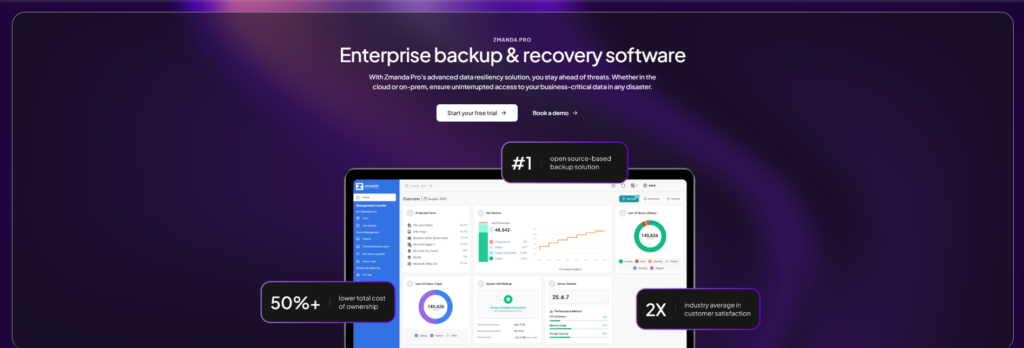
Zmanda Pro is an enterprise backup and recovery software: it deploys in 15 minutes on any server or virtual machine, requires no proprietary hardware, and protects 30+ workload types from a single console. Forever-incremental backups reduce storage consumption by up to 90% through client-side deduplication before data ever leaves the source, and three deployment models: SaaS, on-premises, and fully air-gapped offline, covering environments from SaaS-first to classified government sites.
Deployment model and hardware requirements
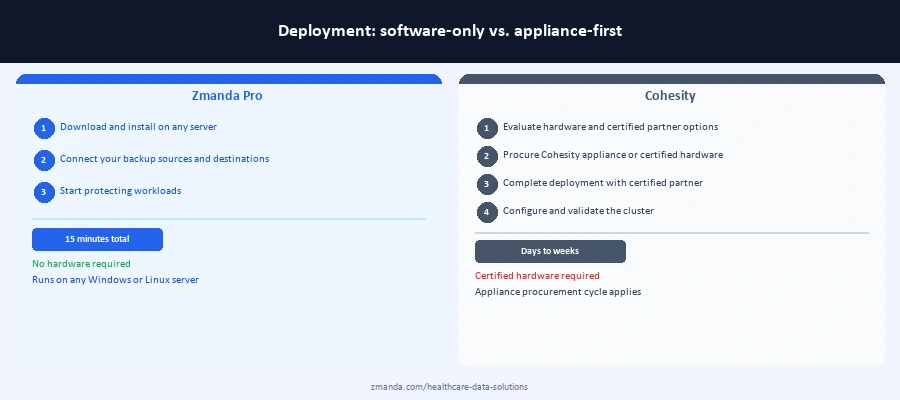
This is the most consequential difference for mid-market buyers. Cohesity’s primary deployment model is designed to run on hardware nodes or certified third-party hardware configurations. This means getting started with Cohesity involves hardware procurement, certified partner engagement, and a deployment timeline that typically runs days to weeks rather than hours.
Zmanda Pro deploys in 15 minutes on any existing infrastructure, with no hardware purchases, no certified partner requirement, and no proprietary components. Three deployment models are available: SaaS hosted by Zmanda on Azure (fully managed, zero infrastructure overhead), self-hosted on-premises on any Windows or Linux server, and fully air-gapped offline for government, defense, and compliance-sensitive environments. The air-gapped model requires no hardware appliance: it runs entirely in software on your existing infrastructure. For organizations evaluating air-gap capability specifically, this distinction matters: Zmanda’s offline deployment does not require additional hardware procurement.
Workload coverage
Cohesity DataProtect covers VMware vSphere, Hyper-V, physical servers, and cloud workloads (AWS, Azure, GCP) with enterprise-grade data management capabilities. It is a strong fit for large VMware-centric environments with mature infrastructure teams.
Zmanda Pro covers 30+ workload types natively from a single console: VMware vSphere, Hyper-V, and Proxmox VE for virtualization; Windows and Linux physical servers; MySQL, MariaDB, PostgreSQL, SQL Server, MongoDB, and Oracle RMAN for databases; Microsoft 365 including Exchange, SharePoint, OneDrive, and Teams; and disk images, Windows Server System State, and bare-metal recovery. For mid-market organizations running hybrid infrastructure (VMs, physical servers, databases, and SaaS), Zmanda Pro eliminates the multi-tool stack that enterprise platforms like Cohesity require to achieve equivalent breadth at the SMB/mid-market tier.
Pricing and total cost of ownership
Zmanda Pro uses transparent per-workload pricing: every workload type has a published price, and 24/7 expert support is included at every tier. Storage costs are reduced by up to 90% through client-side deduplication and forever-incremental architecture.
Cohesity uses custom enterprise pricing and does not publicly disclose standard list pricing. Costs vary based on deployment model, capacity, support requirements, and contract terms. It is sold through enterprise channels and involves custom quoting that includes hardware, software licensing, support tiers, and often professional services for initial deployment and ongoing management. The total cost of ownership is higher by design. Cohesity is built for enterprises that can justify the cost of dedicated data management infrastructure. For SMB and mid-market organizations evaluating Cohesity primarily for backup and recovery, the total cost of deploying and maintaining an enterprise data management platform often exceeds the value returned compared to a purpose-built backup solution.
Support
Zmanda Pro includes 24/7 expert support. Zmanda’s NPS is 2x the industry average, and support quality is consistently cited as a primary reason customers switch from enterprise backup platforms where support access is tiered behind contract levels. For mid-market IT teams without dedicated backup administrators, accessible and responsive support is a practical operational requirement.
Cohesity support is delivered through enterprise support programs with SLA-based response commitments. Organizations should verify which support package is included with their purchase and how it compares with Zmanda Pro’s support offering.
When Cohesity makes sense
Cohesity is the right platform if your primary requirement is enterprise-scale data management (backup, classification, analytics, and secondary workload consolidation on a single platform) and your environment is large enough to justify dedicated Cohesity infrastructure and staff, and your budget includes hardware procurement, enterprise licensing, and professional services. Organizations running large VMware environments with complex data governance requirements, ransomware detection at scale, and a dedicated infrastructure team are Cohesity’s natural fit. If you are evaluating Cohesity primarily because you need VM backup and a disaster recovery workflow, evaluate whether the full platform is necessary or whether a simpler solution covers the actual requirement.
When Zmanda Pro is the right choice
Zmanda Pro is the most commonly evaluated Cohesity alternative for mid-market IT teams: it covers physical servers, databases, and Microsoft 365 alongside your virtualized workloads, without the hardware, deployment complexity, and operational overhead of an enterprise data management platform. It is the right choice when the IT team is small, deployment speed matters, and the pricing model needs to be predictable at budget time, not renegotiated annually.
For SMB and mid-market organizations where the infrastructure is genuinely hybrid and the IT team manages backup as one function among many, Zmanda Pro delivers enterprise-grade protection without the enterprise infrastructure requirement. The largest US franchisee operator case study: 2,600 sites, 44 states, 89% storage reduction: this demonstrates what Zmanda Pro does at scale in distributed, hybrid environments where appliance-based solutions would introduce unacceptable procurement and management overhead. The Fortune 50 certification confirms enterprise-grade performance at scale when that bar matters.
The verdict
The Zmanda Pro vs. Cohesity decision is clearer than most comparison posts suggest. Cohesity and Zmanda Pro are not competing for the same buyer. If you are running a large enterprise VMware environment with dedicated infrastructure staff, a capital budget for certified hardware, and a need for unified data management beyond backup: Cohesity’s platform is purpose-built for that. If you need complete protection across VMs, physical servers, databases, and SaaS, with software-only deployment, predictable pricing, and no appliance requirement: Zmanda Pro covers the full surface area at a fraction of the operational overhead. For most SMB and mid-market organizations evaluating both, the hardware dependency and enterprise pricing model of Cohesity resolve the decision quickly. Explore Zmanda Pro’s enterprise backup capabilities to see how it stacks up across the market.
FAQs