Zerto is a continuous replication engine, purpose-built for near-zero RPO VM failover in VMware and Hyper-V environments. Zmanda Pro is a unified backup and disaster recovery platform protecting 30+ workload types — VMs, physical servers, databases, Microsoft 365 — from a single console. Whether one replaces the other depends entirely on what your infrastructure actually looks like.
This comparison breaks down the key differences across workload coverage, deployment model, recovery objectives, pricing, and support — so you can make the right call before you commit.
See Zmanda Pro Pricing — Transparent & Per-Workload
Zmanda Pro vs. Zerto — At a Glance
| Category | Zmanda Pro | Zerto |
|---|---|---|
| Primary use case | Unified backup + disaster recovery | Continuous VM replication / CDP |
| Workload coverage | 30+ types — VMs, physical, databases, M365 | VM-centric (VMware, Hyper-V) |
| RPO | Under 1 hour | Near-zero (seconds) |
| Physical server backup | Yes — Windows and Linux | No native support |
| Database backup | Yes — SQL, MySQL, PostgreSQL, MongoDB, Oracle | No native support |
| Microsoft 365 backup | Yes — Exchange, SharePoint, OneDrive, Teams | No |
| Air-gapped deployment | Yes — fully offline, no hardware required | Not available |
| Deployment time | 15 minutes | Complex, multi-component setup |
| Pricing model | Per-workload — transparent and predictable | Enterprise / custom |
| 24/7 support | Included — no premium tier required | Varies by contract |
| Vendor ownership | BETSOL — independent data resilience brand | HPE (acquired 2021) |
What Each Platform Is Actually Built For
Zerto’s architecture is built around journal-based continuous replication — every write operation on a protected VM is captured in a journal and replicated to a secondary site in near-real time. This approach delivers recovery point objectives measured in seconds, which makes it a compelling choice for mission-critical VMware workloads where any data loss is unacceptable. DR orchestration, automated runbooks, and clean failover workflows are where Zerto has historically been strongest.
Zmanda Pro is built around a different problem: most organizations do not run a single workload type, and most IT teams cannot afford to manage four separate tools to protect VMs, physical servers, databases, and SaaS platforms. Zmanda Pro consolidates all of these under one console — backed by forever-incremental backups, client-side deduplication that reduces storage by up to 90%, and AES-256 encryption applied before data leaves the source. It supports disaster recovery through point-in-time recovery, cloud DR, and business continuity workflows across all protected workload types.
Workload Coverage
This is where the comparison is most consequential. Zerto’s replication architecture is designed for virtual machines — specifically VMware vSphere and Hyper-V. Physical servers, structured databases, and SaaS platforms are outside its native scope, meaning organizations running hybrid infrastructure need additional tools alongside Zerto to achieve full coverage.
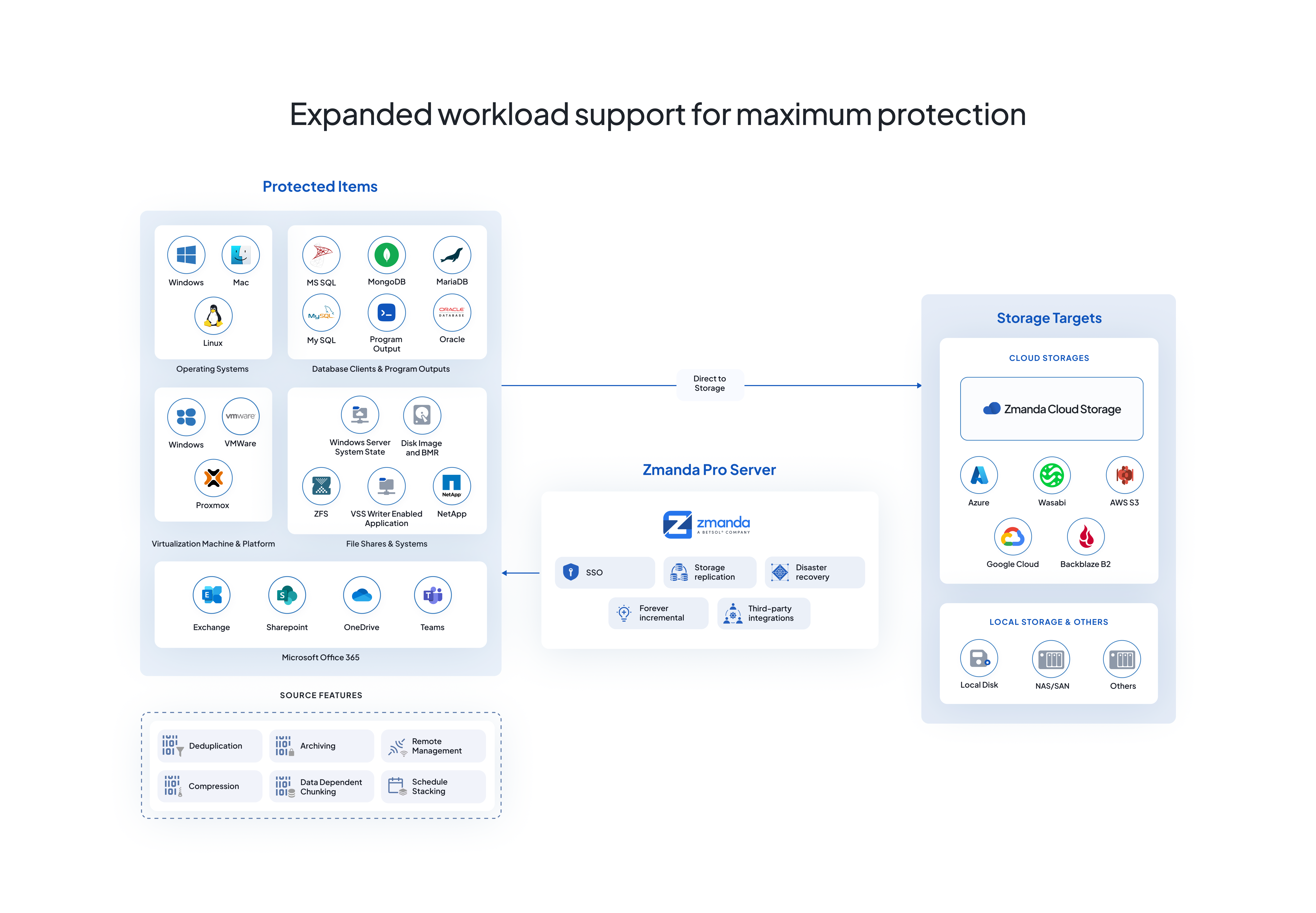
Zmanda Pro covers 30+ workload types natively from a single console: VMware vSphere, Hyper-V, and Proxmox VE for virtualization; Windows and Linux physical servers; MySQL, MariaDB, PostgreSQL, SQL Server, MongoDB, and Oracle RMAN for databases; Microsoft 365 including Exchange, SharePoint, OneDrive, and Teams; and disk images, Windows Server System State, and bare-metal recovery. If your infrastructure is hybrid — which describes most mid-market environments — Zmanda Pro eliminates the multi-vendor stack that Zerto requires to achieve equivalent coverage.
Deployment and Setup
Zmanda Pro deploys in 15 minutes. There are no mandatory certifications, no required infrastructure components beyond the Zmanda Pro server and client, and no proprietary hardware. Three deployment models are available: SaaS hosted by Zmanda on Azure, self-hosted on-premises, and fully air-gapped offline for government, defense, and compliance-sensitive environments. The air-gapped model is a meaningful differentiator — fully isolated deployments with no internet dependency and no hardware appliance required.
Zerto’s deployment involves multiple infrastructure components and integrations with the VMware or Hyper-V environment. Implementation typically requires professional services or a certified partner. For organizations evaluating ease of deployment as part of their decision criteria, the gap here is substantial. Confirm current deployment requirements with Zerto directly before using this comparison in a sales context.
Recovery Objectives — RPO and RTO
Zerto’s journal-based replication achieves recovery point objectives measured in seconds — this is its primary technical differentiator and the reason it is chosen for mission-critical VMware workloads where near-zero data loss is a hard requirement. If your organization has specific workloads that genuinely cannot tolerate more than seconds of data loss and those workloads are VMs, Zerto’s architecture is built for that scenario.
Zmanda Pro’s forever-incremental backup architecture supports a recovery point objective of under one hour. For the majority of workloads in SMB and mid-market environments — including most database and file server workloads — a sub-one-hour RPO satisfies both business requirements and compliance obligations. The distinction matters when evaluating fit: sub-second RPO is a meaningful differentiator for a narrow set of mission-critical VM workloads, not a universal requirement across a mixed infrastructure environment.
Pricing and Total Cost of Ownership
Zmanda Pro uses transparent per-workload pricing — every workload type has a published price, renewals are flat, and there are no surprise cost increases year-over-year. 24/7 expert support is included at every tier, not a premium add-on. Storage costs are reduced by up to 90% through client-side deduplication and forever-incremental architecture, which means storage spend does not scale linearly with data growth.
Zerto’s pricing is enterprise-structured and not publicly disclosed. It is sold through HPE’s commercial channels and typically involves custom quoting. For organizations that have experienced the renewal cost dynamics of other enterprise backup vendors — renewal spikes, per-VM metering, support tier surcharges — the opaque pricing model is a relevant consideration. Request a formal quote and model the 3-year and 5-year TCO before committing, including storage, support, and any professional services for initial deployment.
Support
Zmanda Pro includes 24/7 expert support at no additional cost — US-based, not outsourced. This is a deliberate product decision, not a differentiator claimed lightly: Zmanda’s NPS is 2x the industry average, and support quality is cited as a primary reason customers switch from competitors, where support reviews reflect a meaningfully different experience.
Zerto’s support is structured through HPE’s enterprise support tiers. As with most enterprise platform vendors, the level of support access and response time SLAs are tied to the support contract tier. Confirm current support structure and whether 24/7 coverage is included or requires a premium tier before finalising this comparison.
When Zerto Makes Sense
Zerto is the right choice if your primary requirement is continuous VM replication with near-zero RPO for mission-critical VMware workloads, your infrastructure is predominantly VMware-centric with limited physical server or SaaS coverage requirements, and your budget and operational capacity supports enterprise-level deployment and ongoing management. Organizations running financial services, healthcare, or other regulated environments where VM workloads carry strict RTO and RPO SLAs are Zerto’s natural fit — provided they have separate tooling for the rest of their stack.
When Zmanda Pro Is the Right Choice
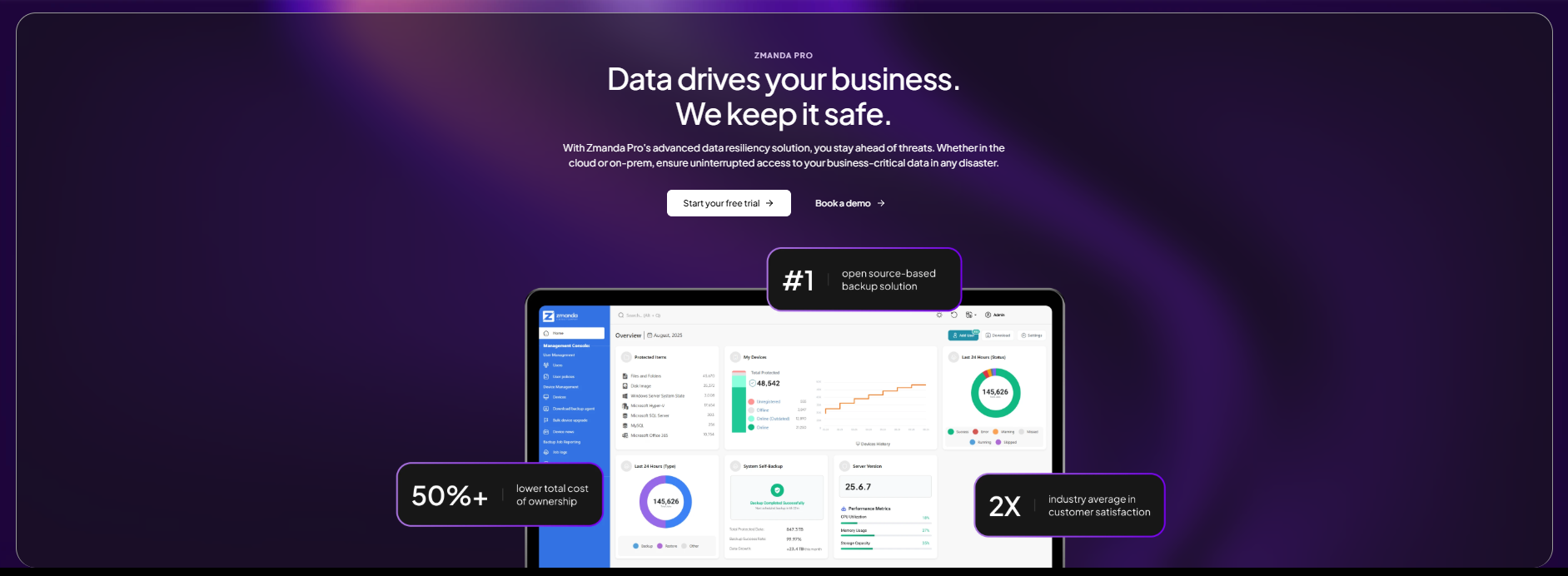
Zmanda Pro is the right choice when your infrastructure extends beyond VMs — physical servers, databases, and Microsoft 365 need to be protected alongside your virtualized workloads. It is also the right choice when operational simplicity matters: 15-minute deployment, no mandatory certifications, and a single console that eliminates the need to manage multiple backup vendors simultaneously.
For SMB and mid-market organizations where the IT team is small and the infrastructure is genuinely hybrid, the value proposition is direct: Zmanda Pro delivers enterprise-grade backup and disaster recovery at 50%+ lower TCO than leading alternatives, with transparent pricing that does not spike at renewal. The largest US franchisee operator case study — 2,600 sites, 44 states, 89% storage reduction — demonstrates what Zmanda Pro does at scale in exactly this kind of distributed, hybrid environment.
The Verdict
Zerto and Zmanda Pro solve different problems. While evaluating Zmanda Pro vs Zerto, if you need sub-second RPO for mission-critical VMs and your environment is VMware-centric, Zerto’s continuous replication architecture is purpose-built for that scenario. If you need unified protection across VMs, physical servers, databases, and SaaS — with predictable pricing, fast deployment, and no proprietary hardware — Zmanda Pro covers the full surface area at a fraction of the operational overhead. For most SMB and mid-market organizations evaluating both, the hybrid infrastructure reality makes the decision straightforward. Explore Zmanda Pro disaster recovery capabilities or review the full competitive comparison to see how it stacks up.
FAQs