Healthcare backup as a service is a risk transfer decision. Operational risks transfer to a service provider: infrastructure management, monitoring, software updates, and first-line response when backup jobs fail. Compliance risks do not. The covered entity remains responsible for HIPAA requirements regardless of who manages the backup program. Most healthcare organizations that have had poor experiences with BaaS discovered that distinction after signing, not before.
This post covers what BaaS delivers in a healthcare context, what it does not deliver, how to evaluate a provider SLA against clinical requirements, and the decision framework for BaaS versus self-managed. For the foundational framework covering RPO, RTO, and backup program structure, see the complete framework for healthcare data backup and recovery.
See How Zmanda Pro Supports Healthcare Backup Deployment
What healthcare backup as a service actually means
Healthcare backup as a service means a service provider manages the backup infrastructure on your behalf: the backup platform, the storage destinations, the monitoring, the software updates, and typically the first-line response when a backup job fails. The organization defines the policies and recovery requirements. The service provider manages the platform that executes them.
What healthcare backup as a service does not mean: the service provider is responsible for your HIPAA compliance. Recovery time requirements are not automatically satisfied by the existence of a managed service contract. The covered entity remains the covered entity. Data backup services for healthcare providers operating through a BaaS model shift operational work. Compliance accountability does not transfer with the contract.
Healthcare BaaS is also distinct from cloud storage. BaaS is a managed service that uses cloud storage as a destination. Selecting cloud backup for healthcare and pointing your own backup software at it is self-managed backup with a cloud destination, not BaaS. The operational responsibilities and compliance handling differ materially between the two models.
Where BaaS delivers genuine value for healthcare IT teams
System backup services for healthcare providers through healthcare backup as a service deliver genuine value in four scenarios. These are not generic managed service advantages. Each one addresses a specific constraint common in healthcare IT.
1. Reduced infrastructure management for multi-site organizations
For a health system managing backup across a main hospital and multiple affiliate clinics, maintaining backup server and storage infrastructure at each site creates significant overhead for a small IT team. Healthcare backup as a service eliminates the on-premises backup server at each site, replacing it with a centrally managed platform that covers all sites from a single service. Policy management, monitoring, alerting, and software updates are handled by the provider rather than distributed across site administrators whose primary focus is other infrastructure responsibilities.
This is the scenario where healthcare backup as a service delivers its clearest value: multi-site organizations where the operational overhead of distributed backup infrastructure consistently exceeds available team capacity.
2. Predictable costs as clinical data volumes grow
Healthcare data grows faster than most regulated industries. EHR records accumulate continuously, imaging libraries grow at 20 to 40 percent annually, and Microsoft 365 data expands with every new clinical communication channel. BaaS pricing models that charge by workload rather than by data volume provide cost predictability as that growth compounds. Organizations that have experienced unexpected cost escalation from per-GB pricing understand why a workload-based model matters for long-term budget planning in clinical environments.
3. 24/7 monitoring without in-house staffing
A failed backup job at a remote clinic that goes undetected for two weeks is a recovery gap that surfaces during an incident, not during routine review. Backup and recovery solutions for healthcare through a managed BaaS model typically include 24/7 monitoring and alerting as part of the service: failed jobs, storage threshold breaches, and policy violations are flagged and escalated without requiring an in-house team member to be on call. For organizations where IT staffing constraints make continuous backup monitoring unrealistic, this closes a real operational gap.
4. Vendor-managed updates and infrastructure maintenance
Backup software updates, storage infrastructure maintenance, and platform upgrades shift to the BaaS provider rather than competing with clinical system support for IT team bandwidth. For organizations where backup infrastructure maintenance is consistently deprioritized because clinical systems take precedence, shifting that overhead to a managed service provider is a genuine operational improvement.
What BaaS does not transfer, and what stays with your organization
This is the most consequential section for any healthcare IT team evaluating healthcare backup as a service. The compliance obligations that remain with the covered entity do not change based on who manages the backup platform.
1. HIPAA compliance responsibility stays with the covered entity
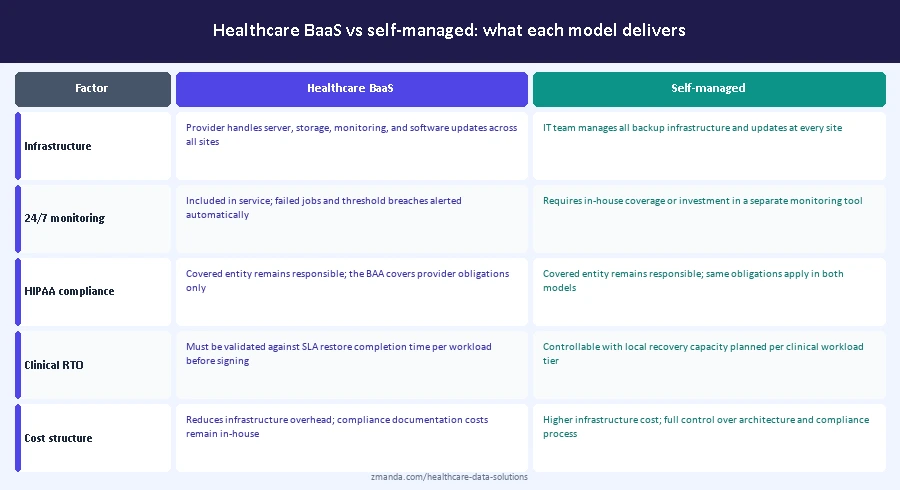
A BaaS provider can manage backup infrastructure. They cannot manage your HIPAA compliance. The covered entity remains responsible for ensuring backup data is encrypted, access controls are enforced, audit logs are retained for six years, and restore testing is documented. A healthcare backup as a service agreement that does not address each of these requirements explicitly does not satisfy HIPAA, regardless of how comprehensive the service description appears.
The BAA with the BaaS provider covers their obligations. It does not transfer yours. If OCR investigates a breach and finds that restore testing was never documented, the finding is against the covered entity, not the BaaS provider. For a detailed treatment of the HIPAA compliance obligations that stay with your organization regardless of deployment model, see the HIPAA compliance guide.
2. Recovery time requirements must be validated against the SLA
A BaaS SLA that guarantees restore initiation within four hours is not the same as a guarantee that a multi-terabyte EHR database will be restored and available within four hours. Clinical RTO requirements for Tier 1 workloads must be mapped against actual restore completion times, not against SLA language about response or initiation times.
Healthcare organizations evaluating data backup and recovery for healthcare providers through a BaaS model often discover this gap during an incident rather than during procurement. Require written confirmation of restore completion time for your largest clinical datasets before signing, and test actual restore times during the evaluation period.
3. Data sovereignty and BAA scope must cover the full data flow
When a BaaS provider manages backup, ePHI may transit provider infrastructure, be stored on provider-managed storage, or flow through provider-managed cloud storage destinations. Each point in that data flow requires BAA coverage. A BAA that covers the management layer but not the storage layer, or that covers primary storage but not archive tiers, has gaps that represent HIPAA exposure.
Request a full data flow diagram from any BaaS provider before signing. Every point where ePHI is handled must be covered by the BAA.
Questions about HIPAA compliance for your backup program?
Zmanda Pro supports the features healthcare organizations need for HIPAA-compliant backup deployments. Talk to our team.
What to evaluate in a healthcare BaaS provider
Six evaluation criteria apply specifically to healthcare backup as a service. Not every BaaS provider offering data backup services for healthcare providers has designed their service for clinical compliance requirements. These criteria identify the ones that have.
BAA scope and data flow coverage. Request the full BAA before evaluating any other criteria. Confirm it covers the complete data flow: backup data in transit, at rest in primary storage, in secondary or archive storage tiers, and in cross-region replication if applicable. A BAA that covers only part of the data flow is a compliance gap, not a minor contract detail.
Clinical RTO guarantee in the SLA. The SLA must specify restore completion time for each workload tier, not just response time or initiation time. Get written confirmation of expected restore completion times for your largest clinical datasets before signing. Test restore times during the evaluation period, not after deployment.
Audit log access and exportability. Confirm you retain access to audit logs independently of the BaaS provider’s platform. Logs must be exportable in a standard format for OCR review and retained for six years. A BaaS arrangement where audit logs are only accessible through the provider’s dashboard creates the same retention and production problem as any vendor-locked log storage.
Restore testing documentation support. HIPAA requires documented restore testing. Confirm whether the BaaS provider includes restore testing as part of the service and whether the documentation they produce satisfies the requirements of HIPAA Security Rule section 164.308(a)(7): dated records, system tested, backup set used, RTO achieved, outcome, responsible party. A BaaS provider that runs restores but produces no exportable documentation is not closing your compliance gap.
Ransomware recovery SLA specifically. General SLA language about recovery times may not apply when both production and backup infrastructure have been compromised. Confirm the SLA explicitly covers ransomware recovery, including recovery from immutable copies, and specifies the recovery time commitment for that scenario. This is the scenario most likely to require BaaS and the one most often excluded from standard SLA language.
Immutable storage configuration. Confirm immutable storage is included in the service and that S3 Object Lock in Compliance Mode is the standard configuration. Confirm the BaaS provider cannot modify or delete backup copies even with administrative access. This is the architectural requirement that makes immutability meaningful in a scenario where provider credentials are compromised.
Red flags in healthcare BaaS contracts
Six conditions that should disqualify a provider from consideration when evaluating backup and recovery solutions for healthcare through a BaaS model:
- BAA is an optional add-on or requires separate negotiation. If the provider treats compliance documentation as an upsell, the service was not designed for regulated healthcare environments.
- SLA recovery time language covers initiation or response but not completion. This gap is almost always deliberate. Require explicit completion time commitments for each clinical workload tier.
- Audit logs are only accessible through the provider’s dashboard with no export capability. This fails the six-year retention requirement and the OCR production requirement simultaneously.
- Restore testing is not included in the standard service or is available only as an additional tier. Restore testing is a HIPAA requirement, not an optional add-on.
- Ransomware recovery is excluded from the standard SLA or subject to separate terms. This exclusion eliminates coverage for the primary scenario where BaaS recovery capability matters most.
- Immutable storage is available only in Governance Mode. Governance Mode allows administrator override and does not provide the same protection as Compliance Mode when provider credentials are compromised.
The BaaS vs self-managed decision framework
Four decision factors specific to healthcare determine whether healthcare backup as a service is the right architectural choice for a given organization.
IT team capacity relative to backup program complexity. If managing backup infrastructure across multiple sites consumes more than 20 percent of the IT team’s available capacity, healthcare backup as a service is worth evaluating seriously. If the team has sufficient capacity to manage backup infrastructure consistently, including monitoring, updates, and restore testing, the operational case for BaaS is weaker and the compliance overhead comparison becomes the deciding factor.
Data residency and deployment requirements. Organizations with strict data residency requirements, air-gap mandates, or EHR vendor contract restrictions on cloud storage may find that BaaS offerings cannot satisfy their deployment requirements. Self-hosted on-premises deployment remains the only viable option for true air-gapped environments. Confirm BaaS deployment options match your requirements before evaluating any provider in depth.
Clinical RTO requirements vs provider SLA capability. If Tier 1 workloads (EHR databases, PACS servers) require sub-1-hour restore completion, validate that at least one BaaS provider in your evaluation can meet that commitment with documented evidence before proceeding. If no provider can meet clinical RTO requirements for your most critical workloads, self-managed backup with local recovery capability is the architecturally correct choice for those workloads regardless of operational preference.
Total cost of ownership including compliance overhead. BaaS pricing must be evaluated against the full compliance overhead it does and does not eliminate. Operational costs (infrastructure, monitoring, updates) may transfer to the provider. Compliance costs (restore test documentation, audit log management, BAA inventory maintenance) remain with the covered entity. A BaaS arrangement that reduces infrastructure cost but requires the same compliance overhead as self-managed may not deliver the total cost reduction the pricing comparison suggests.
For organizations using hybrid architectures in which some workloads remain on-premises and others move to a managed service, the considerations that affect BaaS deployment apply directly to the service’s cloud-connected components.
Next steps for healthcare IT teams evaluating BaaS
The six evaluation criteria above apply before signing any healthcare backup as a service agreement. BAA scope, clinical RTO validation, audit log exportability, and restore testing documentation should be confirmed during the evaluation period, not discovered as gaps after deployment. Healthcare organizations that complete this evaluation before signing avoid the compliance and operational gaps that surface during audits or actual recovery events.
For teams that determine self-managed backup is the right architectural choice, or that want to evaluate specific platforms before deciding.
See how Zmanda Pro supports BaaS and self-hosted deployment options for healthcare, including cloud, on-prem, and air-gapped destinations managed from a single console.
See how Zmanda Pro supports BaaS and self-hosted deployment options for healthcare
Managed service or self-hosted. Cloud, on-prem, or air-gapped. Built for clinical environments.
FAQs