Why do companies with 10x more data than their competitors often perform worse?
It’s the most expensive paradox in business today. You’ve invested millions in data collection. Your data lakes are overflowing. Your dashboards multiply daily. Yet smaller, more nimble competitors are eating your lunch with a fraction of your data resources.
The answer isn’t in the amount of data—it’s in how it moves through your organization. While data-rich companies struggle to connect 976 different applications (the enterprise average), data-smart companies are building unified ecosystems that turn every byte into business value.
The winners aren’t hoarding more data. They’re orchestrating it better. They’ve replaced tool sprawl with unified platforms. They’ve turned compliance from a bottleneck into an accelerator. Most importantly, they’ve made AI work in production, not in silos — generating an average of 23% more revenue per data dollar invested.
This guide reveals the six pillars of modern enterprise data services — from intelligent storage to zero-trust security — that transform data wealth into business results. You’ll discover how JPMorgan cut processing times with data mesh architecture, how Walmart turned 2.5 petabytes per hour into $1 billion in revenue, and get a proven roadmap to evolve from data-rich to data-driven.
Let’s dive in.
What Are Enterprise Data Services?
Enterprise data services are integrated platforms that unify how organizations collect, store, process, govern, and analyze data across their entire technology ecosystem. Instead of managing dozens of disconnected tools, these platforms provide unified data management, real-time integration, AI-powered analytics, automated governance, zero-trust security, and comprehensive backup and recovery.
For companies managing 50-900+ applications, enterprise data services transform fragmented data operations into cohesive systems—reducing costs by 30-50% while enabling real-time insights that drive competitive advantage.
The $123 Billion Opportunity Reshaping Enterprise IT
The enterprise data services market has reached an inflection point. Valued at $123.24 billion in 2025, it’s projected to nearly double to $221.58 billion by 2030, growing at 12.4% annually. This explosive growth reflects a fundamental shift: data has become the primary competitive differentiator across industries.
Three forces drive this transformation:
The AI Imperative: 90% of organizations are modernizing data infrastructure for GenAI. Without proper foundations, they face an “AI cost avalanche”—burning budgets with minimal results. Companies with mature data services report 10x better AI outcomes.
The Multi-Cloud Reality: 90% of large enterprises use multi-cloud strategies. AWS leads with 31% market share, Azure holds 21%, and Google Cloud has 12%. The challenge isn’t choosing platforms—it’s integration.
The Compliance Explosion: GDPR penalties reach €20 million. CCPA fines hit $750 per violation. HIPAA violations cost up to $1.5 million. Modern data services aren’t optional—they’re survival.
Investment patterns confirm the urgency: Cloud infrastructure spending hit $84 billion in Q3 2024 alone, with organizations achieving 348% ROI recognizing that superior data services equal competitive advantage.
Six Pillars of Modern Enterprise Data Services
Today’s enterprise data services encompass far more than traditional data management. According to Gartner’s 2025 framework, modern platforms integrate six core components that work together to create intelligent, autonomous data ecosystems.
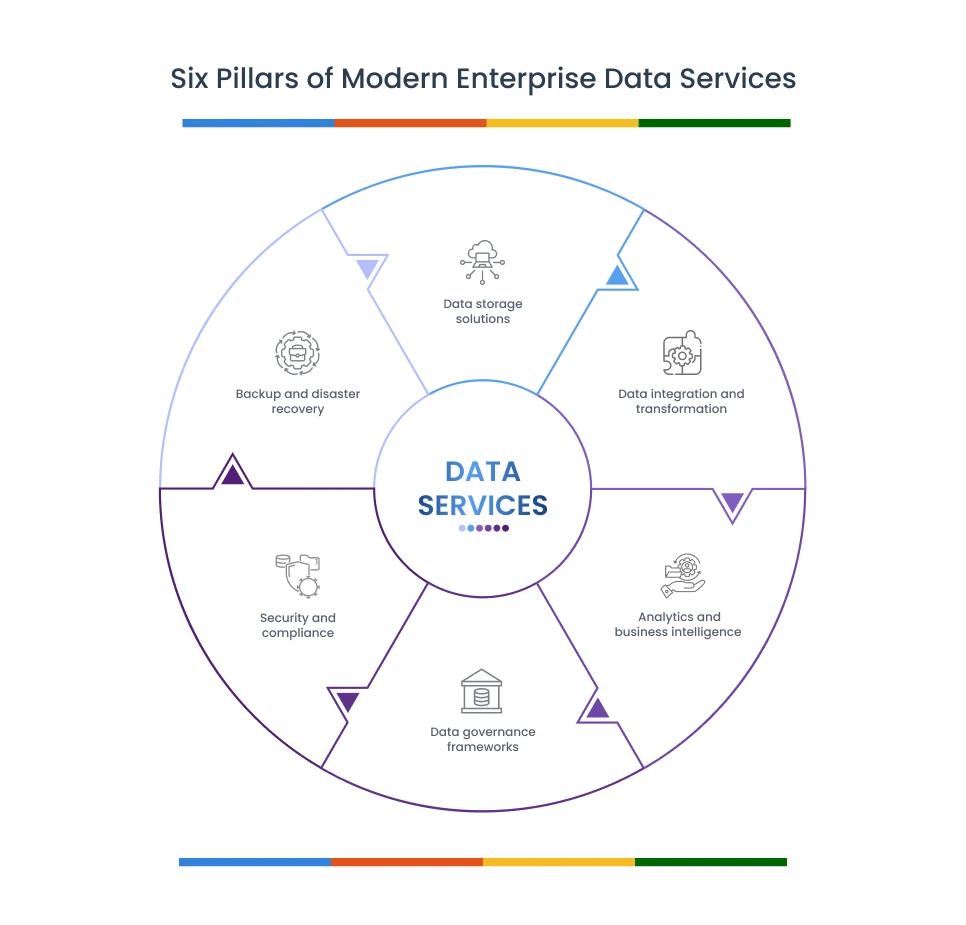
1. Intelligent Data Storage and Management
Modern cloud-native platforms separate compute from storage, enabling elastic scaling and more efficient data management, following best practices in enterprise software development. Architectures like the data Lakehouse combine the flexibility of data lakes with the performance of data warehouses, allowing organizations to manage and process everything from IoT streams to unstructured documents. This evolution is crucial, as 94% of data leaders now prioritize unstructured data for AI initiatives.
2. Real-Time Integration and Orchestration
Modern platforms offer 500+ connectors with AI-powered automation, eliminating the traditional bottlenecks of batch processing. Change data capture (CDC) enables instant synchronization between systems—critical when the average enterprise manages 900+ applications. Advanced integration capabilities prevent new silos while ensuring decision-makers always work with current data.
3. Self-Service Analytics and AI
Natural language processing has democratized data access, letting business users query complex datasets without SQL knowledge. AutoML capabilities transform predictive analytics from a specialized skill to a standard tool. Organizations report 40% reduced IT burden and 300% more active data users when analytics becomes truly self-service.
4. Automated Governance and Compliance
With regulations like GDPR and CCPA carrying massive penalties, governance has evolved from best practice to business necessity. AI-powered tools automatically classify sensitive data, track lineage, and enforce policies across distributed systems. Security services ensure compliance while maintaining the agility teams need to innovate. 85% of organizations will implement AI governance frameworks by 2025.
5. Zero-Trust Security Architecture
In 2024 alone, 5,414 ransomware attacks were reported—an 11% increase—with average demands reaching $2.73 million. Modern security requires continuous authentication, behavioral analytics, and multiple layers of protection. This includes immutable backup strategies and air-gapped backup solutions that ensure data remains recoverable even when primary defenses fail.
6. Intelligent Backup and Recovery
Modern backup platforms have evolved into comprehensive cyber resilience systems. They provide application-aware hot backups without downtime, AI-powered failure prediction, and the 3-2-1-1-0 backup strategy: three copies, two media types, one offsite, one air-gapped, zero recovery errors. These disaster recovery services ensure business continuity with sub-second recovery objectives for critical systems.
Successfully implementing these six pillars requires expertise across multiple domains—from cloud migration and application modernization to infrastructure automation. Organizations that partner with specialists who understand both the technical complexities and business implications achieve faster time-to-value and more resilient data ecosystems.
Need expert guidance to strengthen your data foundation? Book a free 30-minute consultation with our specialists today.
The Real Cost of Getting Enterprise Data Services Wrong
Despite massive investments, most organizations fail to realize their enterprise data services potential:
Data Silos: 90% of IT leaders cite silos as their biggest obstacle. The average enterprise maintains 2,000+ silos across 900 applications, causing employees to waste 25% of their time searching for information.
Quality Issues: Poor data quality costs $12.9 million annually through flawed decisions and missed opportunities. One retailer found 40% duplicate customer records, wasting millions in marketing.
Security Gaps: 43% of businesses failed compliance audits in 2024. Among failures, 31% suffered breaches versus 3% of compliant organizations. Average breach cost: $4.88 million.
Skills Shortage: 87% report critical data and AI skills gaps, forcing expensive consultant dependence or failed implementations. 60% of data platform initiatives fail to deliver expected value.
Legacy Limitations: Traditional systems can’t handle modern data demands. One financial firm’s fraud detection took 5 minutes per query—useless against real-time criminals.
How to Overcome Data Services Challenges
While these challenges seem daunting, organizations can overcome them with the right enterprise data services approach:

Breaking Down Data Silos
Start with a comprehensive data inventory—you can’t fix what you can’t see. Implement modern integration platforms with pre-built connectors that eliminate point-to-point integrations. Create unified governance that incentivizes data sharing over hoarding. Most importantly, establish clear data ownership with accountability for accessibility.
Improving Data Quality
Deploy automated quality monitoring that catches issues before they cascade. Use AI-powered data cleansing to fix problems at scale. Establish a single source of truth for critical data elements. Create quality metrics that matter to business users, not just IT. Make data quality everyone’s responsibility, not just a data team concern.
Strengthening Security Posture
Implement zero-trust architecture that assumes breach and limits blast radius. Deploy continuous monitoring with behavioral analytics to detect anomalies. Encrypt everything—at rest, in transit, and in use. Regular security training transforms employees from vulnerabilities into defenders. Test incident response plans quarterly, not just annually.
Addressing Skills Gaps
Build internal capabilities through structured upskilling programs—it’s more sustainable than consultant dependence. Partner strategically for specialized skills while developing core competencies internally. Implement citizen developer tools that democratize data access. Create centers of excellence that spread knowledge throughout the organization.
Modernizing Legacy Systems
Adopt a phased migration approach—big bang replacements usually fail. The challenge isn’t choosing platforms—it’s integration. As Techimply’s analysis shows, understanding why cloud computing is critical to business success helps organizations make informed decisions about their multi-cloud architecture and integration strategies. Use API wrappers to extend legacy system life while modernizing gradually
The key is recognizing these aren’t technical problems—they’re business transformation challenges requiring strategic thinking, cultural change, and sustained commitment.

Success Stories: How Leaders Transform Data Into Advantage
Leading organizations prove that modern enterprise data services deliver transformational results:
Top-10 US Bank: Replaced fragmented test data management tools with unified enterprise data services, achieving 40% productivity gains and 50% faster software releases while reducing staff requirements by 80%. Their success hinged on establishing a Test Data Management Center of Excellence that unified their approach with comprehensive training programs.
Walmart: Processes 2.5 petabytes of information every hour from 240 million weekly customers. Their “big data democracy” approach enables hundreds of teams to access data simultaneously, generating $1 billion in incremental online revenue through improved personalization and operational efficiency. The key was combining multiple technologies—from their 30-petabyte Teradata warehouse to semantic search capabilities—in a unified architecture.
Mayo Clinic: Their Enterprise Data Trust demonstrates healthcare-specific requirements. Their semantically integrated data warehouse combines patient records, billing systems, and research data using natural language processing. This enables real-time clinical decision support while maintaining strict privacy compliance. The platform’s success required specialized vocabulary management systems and open-source NLP pipelines developed through their OHNLP Consortium.
JPMorgan Chase: Pioneered data mesh architecture in financial services, balancing data sharing needs with regulatory requirements. Their federated approach allows domain experts to manage data products while maintaining enterprise-wide governance. The result: dramatically reduced wait times for data access while enhancing compliance and risk management capabilities.
Common success factors: executive sponsorship, phased delivery with 90-day wins, internal capability building, integration focus, and obsessive business outcome measurement.
Emerging Technologies Transforming Data Services
Key technology trends reshaping enterprise data services:
AI Goes Operational: 65% of organizations use GenAI for data management. AI automates cataloging (80% effort reduction), predicts quality issues, and democratizes access. By 2025, autonomous AI handles 80% of routine tasks.
Cloud-Native Dominates: Kubernetes enables auto-scaling. Serverless eliminates infrastructure overhead. The serverless market will reach $36.8 billion by 2028. As serverless adoption accelerates, organizations must also address serverless security to protect functions, APIs, and event-driven workloads that traditional security tools were not designed to handle.
Real-Time Everything: Event-driven architectures process data instantly. The streaming market grows at 17.5% CAGR as batch processing becomes obsolete.
Edge Intelligence: 55% of deep learning occurs at edge by 2025. 50% of critical applications operate outside data centers by 2027.
Choosing the Right Enterprise Data Services Platform
With hundreds of vendors promising revolutionary capabilities and organizations facing 60% failure rates in data initiatives, selecting the right platform becomes mission-critical. The wrong choice doesn’t just waste budget—it sets your digital transformation back years and hands competitive advantage to rivals who choose wisely.
Key Evaluation Criteria
Before engaging with vendors or starting POCs, establish clear evaluation criteria that go beyond feature checklists:
- Platform Capabilities: Handle current volumes and 5x growth? Support all data types? Integration quality?
- Scalability: Real performance under load, not demos
- Security: Penetration testing results, compliance certifications, incident response
- Total Cost: Include implementation, training, scaling, hidden fees
- Vendor Stability: Financial health, roadmap alignment, acquisition risk
Build vs. Buy vs. Hybrid
The age-old technology decision takes on new complexity with enterprise data services. Here’s how leading organizations approach this critical choice:
- Buy: When proven solutions exist and time-to-market matters
- Build: For truly unique requirements or competitive advantage
- Hybrid (44% choose this): Platform foundation with custom differentiators
Red Flags to Avoid
Learn from others’ expensive mistakes. These warning signs should immediately disqualify vendors from consideration:
- Vendor lock-in with difficult data extraction
- Hidden limitations in “unlimited” claims
- Complex implementations without clear timelines
- Pricing that explodes with scale
Building the Business Case: Four Ways to Prove ROI
Justify enterprise data services investment with tangible outcomes:
Cost Reduction: Organizations implementing enterprise data services typically achieve 30-50% savings through consolidation and automation. Calculate current redundant systems, manual processing, and error correction costs.
Revenue Generation: Quantify the value of 1% better retention, 2% more cross-sell, 5% less inventory cost. Walmart generated $1 billion from better personalization.
Risk Mitigation: With $4.88 million average breach costs and massive compliance fines, enterprise data services represent profitable insurance.
Competitive Advantage: In markets where 50% of decisions will be AI-augmented by 2027, frame investment as survival.
ROI Timeline:
- Month 3: First cost savings (10-15%)
- Month 6: Productivity gains (30%)
- Month 12: Full ROI
- Month 18: Transformational impact
Your Path Forward: From Data Chaos to Data Excellence
Enterprise data services in 2025 separate digital leaders from laggards. The technology is proven. The ROI is compelling. The risks of inaction escalate daily.
Success requires recognizing that this is business transformation, not IT implementation. All six pillars must work together. Start with good-enough solutions rather than waiting for perfection.
Your competitors are already transforming their enterprise data services—reducing costs 90%, generating billions in new revenue, building tomorrow’s foundations today.
Take action now:
- Assess your current state and calculate data chaos costs
- Identify your greatest pain point
- Build business-IT leadership coalition
- Choose a 90-day quick win
- Start moving—momentum matters more than perfect plans
In a data-driven economy, organizations that master their data, master their markets. The path is clear, proven, and profitable. The only question is whether you’ll lead the transformation or follow competitors who do.
If your organization hasn’t yet modernized its data services, now is the time to act.

FAQs