Auditors are finding backup systems in the gap. Not firewalls. Not identity systems. Backups. Across recent ransomware and breach disclosures, backup infrastructure keeps surfacing as a contributing factor.
It’s because attackers have learnt something that compliance frameworks are only now catching up to: if you can corrupt or exfiltrate backup data, the encryption on live systems becomes irrelevant. Your recovery path is gone.
For CISOs, IT Directors, compliance officers, and procurement teams in regulated industries, this creates a specific problem. SOC 2 Type II audits are increasingly scrutinizing backup architecture, not just whether backups exist, but whether the systems managing them meet the same security controls as the rest of the stack. Most organizations haven’t closed that gap. Many don’t know how wide it is.
This article breaks down what SOC 2 Type II actually demands from a backup vendor, why backup systems have become a hidden compliance liability, and what a vendor certification actually means for your security posture.
See How Zmanda Pro Meets SOC 2 Type II Standards
What Is SOC 2 Type II — and Why Does It Matter?
SOC 2 (Service Organization Control 2) is an auditing standard developed by the AICPA. It evaluates whether a service organization’s controls meet defined criteria for security, availability, processing integrity, confidentiality, and privacy — collectively called the Trust Service Criteria.
The distinction between Type I and Type II is not semantic. It is fundamental to what the certification actually proves.
- SOC 2 Type I is a point-in-time assessment. An auditor reviews your documented controls and confirms they are designed appropriately. It answers: does this organization say it does the right things?
- SOC 2 Type II is a period-of-time assessment — typically six to twelve months of continuous auditing. The auditor tests whether controls are operating effectively across real transactions, logs, and incidents. It answers: does this organization actually do what it says, consistently, over time?
For a regulated enterprise selecting a backup vendor, the gap between Type I and Type II is the gap between a vendor’s marketing claims and verified operational evidence. A backup solution that cannot produce a Type II report is not just a risk — it is an audit finding waiting to happen.
| Aspect | SOC 2 Type I | SOC 2 Type II |
|---|---|---|
| Assessment window | Point-in-time snapshot | 6–12 months of continuous auditing |
| What it proves | Controls are designed appropriately | Controls operated effectively over time |
| Evidence reviewed | Documentation and design only | Real transactions, logs, and incidents |
| Auditor testing method | Design review only | Operational effectiveness testing |
| What it answers | “Does this org say it does the right things?” | “Does this org actually do what it says, consistently?” |
| Value for regulated buyers | Baseline signal — often insufficient | Verified operational evidence auditors accept |
The Five Trust Service Criteria — and What They Mean for Backup
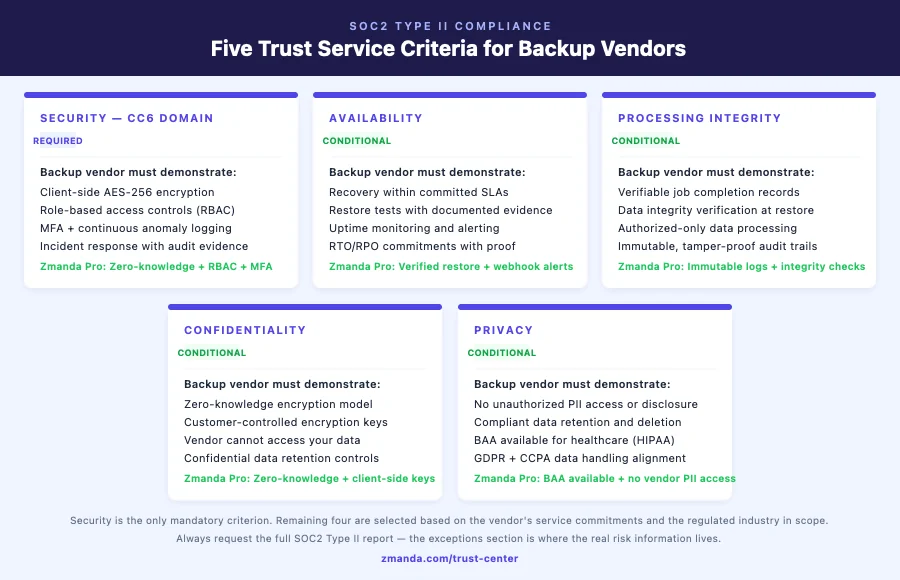
SOC 2 Type II evaluates service organizations against up to five Trust Service Criteria. Security is mandatory. For backup vendors, each criterion maps directly to specific architectural and operational requirements.
- Security (Common Criteria, including the CC6 access-control domain). Covers logical and physical access controls, system operations, change management, and risk mitigation. For backup: how is data protected in transit and at rest? Who can access what?
- Availability. The system must be available for operation as committed. For backup: can the vendor demonstrate restoration processes work within defined timeframes, with evidence?
- Processing Integrity. Data processing must be complete, accurate, and authorized. For backup: verifiable job completion, data integrity verification at restore, and audit trails.
- Confidentiality. Information designated as confidential must be protected as committed. For backup vendors: this is where encryption architecture matters most — specifically, whether the vendor can access your data.
- Privacy. Personal information must be collected, used, retained, and disclosed per the organization’s privacy notice. Directly relevant for healthcare, financial services, GDPR, CCPA, and HIPAA.
When evaluating a backup vendor’s report, request the full report — not a summary attestation letter. The exceptions section is where the real information lives.
| Trust Service Criterion | Mandatory? | What Backup Vendors Must Demonstrate |
|---|---|---|
| Security (CC6 domain) | Yes — all audits | Encryption in transit and at rest, RBAC, MFA, incident response with audit evidence |
| Availability | Conditional | Restore SLAs with documented evidence, uptime monitoring, RTO/RPO commitments |
| Processing Integrity | Conditional | Verifiable job completion records, data integrity verification at restore, full audit trails |
| Confidentiality | Conditional | Zero-knowledge architecture, customer-controlled encryption keys, no vendor data access |
| Privacy | Conditional | HIPAA/GDPR/CCPA alignment, BAA availability, compliant data retention and deletion |
What SOC 2 Type II Actually Requires from a Backup Vendor
Certification is not a box vendors check once and move on from. SOC 2 Type II demands ongoing operational evidence across every control domain.
Access controls must be demonstrably enforced. The auditor will test whether access provisioning, de-provisioning, and privilege escalation follow documented procedures — and whether exceptions were handled correctly during the audit period.
Encryption must be verifiable, not just claimed. The audit will scrutinize encryption key management: where keys are stored, who has access to them, and whether the vendor itself could theoretically decrypt customer data. Zero-knowledge architectures are increasingly the standard that regulated organizations require.
- Monitoring and alerting must be continuous. The auditor will look for evidence of real-time anomaly detection, logging completeness, and incident response processes that were actually exercised during the audit period.
- Change management must be controlled. Every significant change to the backup platform must follow documented change management processes with approval trails.
- Vendor management must extend to subprocessors. If your backup vendor uses third-party cloud infrastructure, their controls for managing those relationships are in scope.
What to Ask a Backup Vendor About Their SOC 2 Type II Report
Buying a SOC 2 compliant backup vendor is not the same as buying a backup vendor that hands you a badge. When evaluating SOC 2 data backup requirements, the right questions separate marketing claims from audit-ready evidence. Before you sign, get written answers to these seven questions:
- What Trust Service Criteria were in scope? Security is mandatory; Confidentiality, Availability, and Privacy often are not. If your data is regulated, Confidentiality and Privacy must be in scope.
- What was the audit period? A 3-month window is not a Type II audit. Look for 6–12 months of continuous coverage.
- Were there any exceptions noted? Request the full report, not the attestation letter. Exceptions sit in Section IV — that’s where the risk lives.
- Can the vendor technically decrypt your data? Server-side encryption means yes. Client-side / zero-knowledge means no. This is the single most important architectural question.
- How are encryption keys managed, and who holds them? Customer-managed keys eliminate an entire class of insider risk.
- What subprocessors are in scope? If the vendor uses AWS, Azure, or third-party infrastructure, their controls cascade to you.
- How is immutability enforced at the storage layer? Object Lock in Compliance Mode is the standard — anything softer is reversible.
A backup vendor that cannot answer these with documented evidence is selling you marketing, not compliance.
Why Backup Systems Are a Hidden Compliance Risk
Here’s the compliance gap that most security audits don’t surface until it’s too late: backup systems are often excluded from the same security controls applied to primary infrastructure. The reasoning, historically, was that backup data is offline, internal, and not customer-facing. That reasoning is wrong, and regulators increasingly treat it as such.
Legacy backup vendors and often predate modern zero-knowledge architectures — which is why auditors are now scrutinizing them more carefully than ever.
Backup repositories contain the complete history of your environment — every file, every database record, often including data that has since been deleted from primary systems. In a healthcare context, that means years of protected health information. In financial services, it means transaction records and PII. The backup repository is not a secondary asset. It is frequently the richest target in the environment.
Ransomware operators figured this out years before most compliance frameworks did. The evolution from “encrypt and ransom” to “encrypt, steal, and extort” runs directly through backup systems. Attackers who compromise backup infrastructure first can then trigger ransomware on production systems with confidence that recovery is impossible.
The audit implications are direct. Under SOC 2, HIPAA, and PCI DSS, backup systems that handle in-scope data are in scope. Full stop. A backup vendor that cannot demonstrate equivalent security controls to your primary systems is a compliance gap — one that auditors are increasingly trained to find.
Unsure how your backup stack maps to SOC 2 Type II?
Book a 30-minute expert call — we'll walk you through your specific audit requirements.
How Zmanda Pro Meets SOC 2 Type II Standards
Zmanda Pro is SOC 2 Type II certified — not as a baseline qualification, but as a reflection of how the platform was architected from the ground up.
Zero-Knowledge Encryption Architecture
Zmanda Pro uses AES-256-CTR with Poly1305 AEAD encryption, with the AES-256 implementation FIPS 140-2 compliant. Encryption is client-side: data is encrypted before it leaves the source machine. Zmanda’s servers cannot decrypt your data. This is a zero-knowledge model, not a marketing claim — it is enforced at the architectural level.
Direct-to-Storage Architecture
Backup data never flows through Zmanda’s servers. Data transfers directly from the client to your chosen storage destination — whether that’s AWS S3, Wasabi, Azure Blob, local NAS, or any other target. Your data is not aggregated, processed, or buffered on Zmanda’s infrastructure.
Immutable Storage That Holds Under Attack
Zmanda Pro supports immutable backup storage via AWS S3 Object Lock (Governance and Compliance modes), Wasabi Object Lock, and ZFS-level immutability for local storage. The critical element is Compliance Mode: once a backup is locked, even admin credentials cannot override it. This is enforced at the storage layer.
Access Controls Built for Audit Evidence
Role-based access control (RBAC) is granular and policy-based. Multi-factor authentication supports TOTP and FIDO2 hardware keys. Single sign-on integrates via OpenID Connect and Microsoft Entra ID. Webhook monitoring provides real-time alerting on backup events, failures, and access changes — feeding into the audit trails SOC 2 Type II auditors review.
Air-Gapped Deployment for Classified Environments
For organizations where network-connected backup is not an option, Zmanda Pro supports fully air-gapped offline deployment. No internet connection required.
This is the deployment model used by one of our customers, who is a national government cybersecurity authority managing 7 data centers and 500+ physical and virtual servers across classified sites — where it passed the customer’s security and code audits. Read case study
Fortune 50 Validation
Zmanda Pro is only the second backup solution in history to pass Fortune 50 certification — testing functional performance, scalability across 100,000+ workloads, replication, disaster recovery, failover, data integrity, and full automation at enterprise scale. The result: 80%+ savings on licensing costs for the certifying organization. See Zmanda’s full compliance posture at the Trust Center.
Beyond SOC 2: The Full Compliance Stack
Zmanda Pro is built to address the full regulated enterprise compliance stack:
- ISO 27001 — Information security management system certification.
- ISO 9001 — Quality management system certification.
- HIPAA — Compliant with Business Associate Agreement available.
- PCI DSS — Aligned to Requirement 3.4. FIPS 140-2 compliant AES-256 encryption satisfies the technical controls at the core of PCI data protection.
- GDPR and CCPA — The zero-knowledge model and client-controlled encryption keys mean Zmanda has no access to personal data to disclose.
- FIPS 140-2 — The AES-256-CTR with Poly1305 AEAD cipher implementation is FIPS 140-2 compliant.
| Framework | Scope | Zmanda Pro Status |
|---|---|---|
| SOC2 Type II | General enterprise security trust | Certified |
| ISO 27001 | Information security management | Certified |
| ISO 9001 | Quality management system | Certified |
| HIPAA | Healthcare data protection | Compliant — BAA available |
| PCI DSS | Payment card data protection | AES-256 meets Req. 3.4; FIPS 140-2 aligned |
| GDPR / CCPA | Personal data privacy | Zero-knowledge model — no vendor access to PII |
| FIPS 140-2 | Cryptographic standards | AES-256-CTR with Poly1305 AEAD compliant |
| NIST CSF | Cyber resilience framework | Immutable storage + air-gap + RBAC aligned |
The ransomware resilience architecture — immutable storage, air-gap capability, zero-knowledge encryption, and RBAC — also aligns directly with NIST CSF recovery controls and emerging cyber insurance underwriting requirements. Zmanda Pro’s NPS of 78 — twice the industry average — reflects a vendor that actually delivers on operational commitments over time.
The Compliance Requirement Your Backup Vendor Must Pass
SOC 2 Type II certification is not a differentiator anymore. For regulated mid-market enterprises, it is a baseline requirement. The question isn’t whether your backup vendor is certified — it’s whether the architecture behind the certification actually eliminates the risks your auditors are testing for.
Zmanda Pro’s zero-knowledge encryption, direct-to-storage architecture, Compliance Mode immutability, and air-gapped deployment capability are architectural answers to the threats that compliance frameworks were designed to address. The SOC 2 Type II certification, ISO 27001, HIPAA alignment, and Fortune 50 validation provide the documented evidence your auditors need.
Consult with a Zmanda security expert to walk through how Zmanda Pro’s architecture maps to your specific compliance framework — and what your auditors will ask for.
Ready to close your backup compliance gap?
Book a free assessment — our experts will map Zmanda Pro to your audit requirements.
FAQs