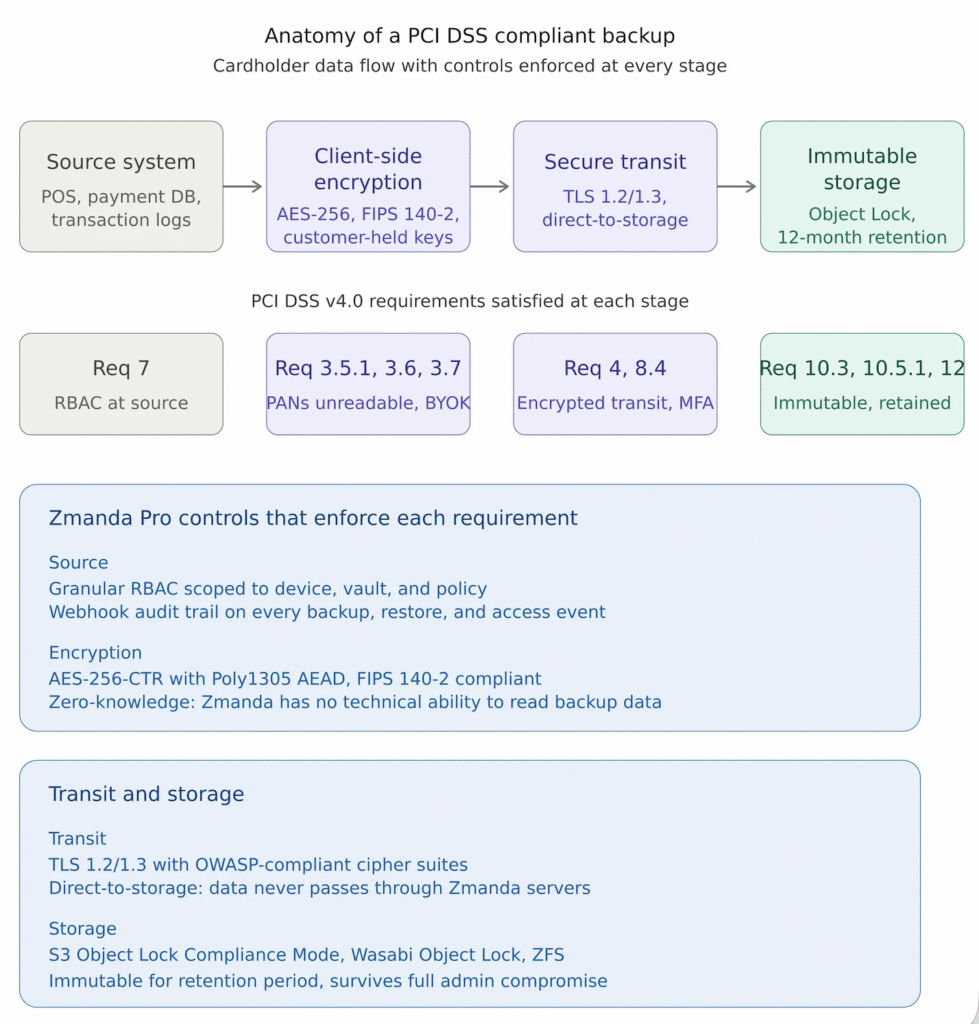
A PCI DSS compliant backup is one that encrypts cardholder data at the source using FIPS 140-2 validated cryptography, restricts access with MFA and role-based controls, and stores audit logs in tamper-resistant immutable storage for a minimum of 12 months.
Under PCI DSS v4.0, any backup repository containing Primary Account Numbers (PANs) is in scope for the cardholder data environment.
If companies don’t adhere to PCI DSS compliance, non-compliance fines can reach $100,000 per month — and that’s before a breach event triggers per-record penalties, card brand fines, and potential loss of payment processing privileges.
Yet most organizations spend their compliance budget hardening firewalls, patching applications, and segmenting networks, while leaving a significant gap wide open: a PCI-compliant backup infrastructure.
For retail IT leaders running POS fleets and e-commerce platforms, and for financial services teams managing transaction systems and issuer environments, PCI DSS backup requirements are a direct, auditable obligation under v4.0.
This post maps the PCI DSS backup and recovery requirements that most directly impact your compliance posture, explains exactly what a PCI-compliant backup solution must deliver, and shows how Zmanda Pro satisfies each requirement with verifiable technical controls.
See How Zmanda Pro Satisfies PCI DSS Backup Requirements
PCI DSS Backup Requirements: Why Your Backup Is a Compliance Asset (or Liability)
PCI DSS v4.0 expanded the scope of “cardholder data environment” (CDE) in ways that many IT teams are still catching up to. Any system that stores, processes, or transmits cardholder data — including backup repositories that contain snapshots of payment databases, POS systems, or transaction logs — is explicitly within scope.
The practical implication: if your backup destination contains unencrypted cardholder data, or if access to that destination is not properly controlled and logged, you have a PCI DSS finding. Assessors are looking at backup systems with increased scrutiny in v4.0 audits.
The inverse is also true. A backup solution with the right controls turns compliance from a reactive checkbox exercise into a continuously demonstrable security posture. The goal is to make your backup infrastructure a proof point in your audit, not the weak link the auditor finds.
The PCI DSS Requirements That Directly Impact Backup
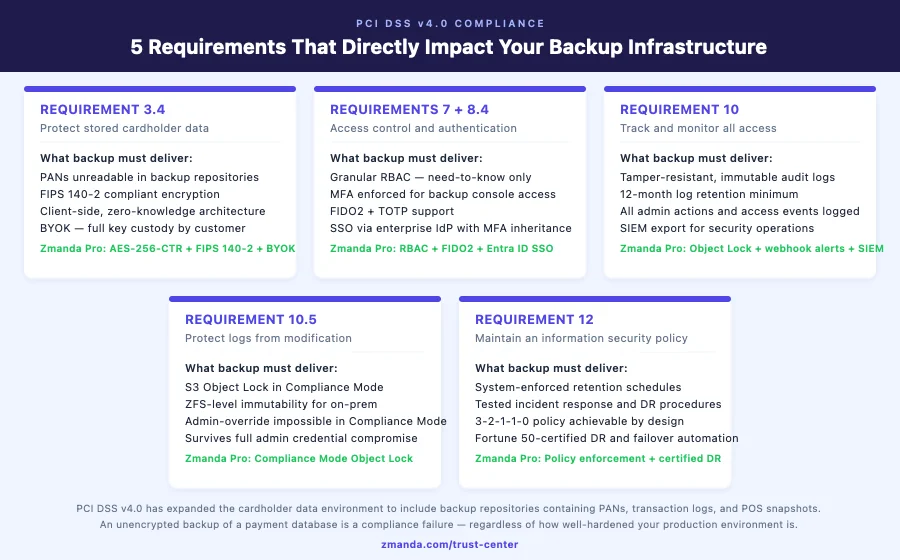
Requirement 3: Protect Stored Cardholder Data
PCI DSS v4.0 Requirement 3.5.1 mandates that PANs must be rendered unreadable anywhere they are stored — including backup repositories. The standard accepts strong cryptography as the mechanism, and Requirements 3.6 and 3.7 specify that if cryptographic keys are compromised, the data is effectively compromised. This means key management matters as much as the algorithm itself.
Requirement 7: Restrict Access by Need-to-Know
Requirement 7 mandates that access to system components and cardholder data must be limited to only those individuals whose job requires it. For backup, this means role-based access control with granular permissions at the protected item level is required, not optional.
Requirement 8: Identify Users and Authenticate Access
PCI DSS v4.0 Requirement 8.4 requires multi-factor authentication for all access into the CDE. That includes your backup management console. Password-only access to a backup console is a direct v4.0 finding.
Requirement 10: Track and Monitor All Access
PCI DSS v4.0 Requirement 10.2 mandates that all access to system components and cardholder data must be logged. Requirement 10.3 requires that those logs be protected from destruction and unauthorized modification, and Requirement 10.5.1 requires they be retained for at least 12 months. Logs that can be modified or deleted by the same administrators who generate them do not satisfy these requirements.
Requirement 12: Maintain an Information Security Policy
Requirement 12 requires a documented PCI DSS data backup policy covering retention schedules, recovery procedures, and access control matrices — all of which must be enforced by the backup system itself, not just described in a document that no one verifies.
| Requirement | Topic | What It Demands from Your Backup Solution |
|---|---|---|
| Req 3.5.1 | Stored cardholder data | PANs in backup repositories must be rendered unreadable using strong cryptography (FIPS 140-2 validated) |
| Req 3.6 / 3.7 | Key management | Encryption keys must be protected; key compromise is treated as equivalent to data compromise |
| Req 7 | Access by need-to-know | Granular RBAC required — access limited to job-specific necessity, not broad admin rights across all backup data |
| Req 8.4 | MFA for all CDE access | Multi-factor authentication for backup console access is mandatory — password-only is a direct v4.0 finding |
| Req 10.2 | Audit log generation | All access to backup systems containing CDE data must be logged with timestamps, user identities, and source |
| Req 10.3 / 10.5.1 | Log integrity and retention | Logs retained 12+ months; tamper-resistant — cannot be modified or deleted by the admins who generate them |
| Req 12.3 | Policy enforcement | Backup retention schedules and access control matrices must be system-enforced, not just documented |
| Req 12.10 | Incident response | Recovery procedures must be documented, tested, and demonstrably executable under audit conditions |
PCI DSS Backup Compliance — Quick Self-Audit
- Are backups encrypted at the source with FIPS 140-2 validated cryptography?
- Is MFA enforced on every backup console login?
- Are backup storage destinations using Object Lock in Compliance Mode?
- Are audit logs retained for 12+ months and tamper-resistant?
- Is RBAC scoped to job function, not blanket admin?
- Is your DR procedure documented and tested annually?
Encryption: The Non-Negotiable Foundation
PCI DSS v4.0 Requirement 3.5.1 is unambiguous: cardholder data stored anywhere must be rendered unreadable using strong cryptography. The standard and its supporting guidance point to FIPS 140-2 validated cryptographic modules as the reference standard.
Zmanda Pro uses AES-256-CTR with Poly1305 AEAD, with the AES-256 implementation FIPS 140-2 compliant. The authenticated encryption design provides both confidentiality and integrity: if backup data is modified at rest, the authentication tag will fail on restore.
The architecture is equally important as the algorithm. Zmanda Pro encrypts data client-side, before it leaves the source device. Backup data flows directly from the client to the customer’s chosen storage destination — it never passes through Zmanda’s servers. This direct-to-storage architecture means Zmanda has zero technical ability to access your backup data.
- BYOK (Bring Your Own Key) is supported, giving organizations full custody of encryption keys — directly addressing the key management dimension of Requirement 3.4.
- Zero-trust mode: administrators cannot reset backup user passwords. For organizations where admin-accessible backup data is unacceptable from a PCI perspective, this is the right architectural choice.
- TLS 1.2/1.3 in transit with OWASP-compliant cipher suites ensures that cardholder data is protected during transmission as well as at rest.
Requirement 9: Physical Access to Backup Media
PCI DSS Requirement 9 restricts physical access to systems and media containing cardholder data. For organizations still running tape backups, local NAS, or on-premises backup appliances, this requirement applies directly to every physical copy of a backup.
Zmanda Pro addresses Requirement 9 in two ways. First, encrypted-at-source backup means that even if physical media is stolen or improperly disposed of, the data on it is cryptographically unreadable — which the PCI Council treats as equivalent to physical protection for cardholder data.
Second, for air-gapped deployments, the same client-side encryption applies to offline and vaulted media, with key custody remaining with the customer.
For organizations that still require physical-access controls on backup media (tape vaults, off-site storage rotations), Zmanda Pro integrates with those workflows rather than replacing them — encryption travels with the backup regardless of where it is physically stored.
Immutability to Ensure Backup Data Can’t Be Altered or Deleted
PCI DSS Requirement 10.5 requires that audit logs be protected from modification or destruction. Requirement 12 requires that backup retention schedules be enforced. Both requirements point toward the same technical control: immutable storage that cannot be overridden by any account, including administrative accounts.
- AWS S3 Object Lock in Compliance Mode — once a backup object is written and the retention lock is applied, even the AWS root account cannot delete or modify it before the retention period expires. This survives a full compromise of Zmanda credentials.
- Wasabi Object Lock — the same guarantee on a cost-optimized storage platform, relevant for organizations managing large backup datasets.
- ZFS-level immutability — for organizations using local or on-premises storage, without requiring cloud infrastructure.
For technical review of immutable backup architecture, see Zmanda’s immutable backup solution. For ransomware-specific threat modeling, see the ransomware protection overview.
Access Controls, MFA, and Audit Trails
PCI DSS v4.0 Requirement 8.4 is one of the most commonly cited findings in recent assessments: MFA is now required for all access into the CDE. The backup management console is in scope. Password-only access is a finding.
Zmanda Pro enforces MFA through two industry-standard protocols:
- TOTP (Time-based One-Time Password) — compatible with any authenticator app including Google Authenticator, Microsoft Authenticator, and hardware tokens.
- FIDO2 — hardware security key support (YubiKey and equivalents), satisfying the highest MFA assurance levels in regulated environments.
- SSO via OpenID Connect integrates with Microsoft Entra ID, Google Workspace, and generic OIDC providers — backup authentication inherits your existing identity governance.
- RBAC enforces need-to-know at a granular level — administrators can be scoped to specific devices, storage destinations, or policy objects.
- Webhook monitoring and policy-based access restrictions provide real-time alerting on access events, policy changes, and backup failures — feeding directly into SIEM pipelines.
Not sure which PCI DSS requirements apply to your backup?
Book a 30-minute call — we'll map your backup architecture to PCI obligations directly.
Air-Gapped Backup for the Most Sensitive Cardholder Environments
Some PCI environments — large issuers, payment processors, organizations with classified adjacencies — require backup infrastructure with no internet connectivity at all.
Zmanda Pro supports fully air-gapped deployment: completely offline, no internet requirement, no phone-home calls, no proprietary hardware dependency. Software-only deployment on standard infrastructure eliminates hardware lock-in and supply chain risk.
A national government cybersecurity organization has been running Zmanda across 7 data centers and 500+ physical and virtual servers in a classified, air-gapped configuration since 2019 — passing independent security and code audits. Read the case study.
How Zmanda Pro Maps to PCI DSS Backup Requirements
| PCI DSS Requirement | Requirement Summary | Zmanda Pro Capability |
|---|---|---|
| Req 3.5.1 | Render stored PANs unreadable using strong cryptography | AES-256-CTR with Poly1305 AEAD (FIPS 140-2 compliant); client-side encryption; zero-knowledge architecture; BYOK supported |
| Req 3.6 / 3.7 | Protect cryptographic keys used for cardholder data | PBKDF2-SHA512 key derivation; layered key hierarchy (R-key → E-key → A-key); zero-trust mode prevents admin key reset |
| Req 6.4 | Protect management interfaces | TLS 1.2/1.3 in transit; OWASP-compliant cipher suites; OpenID Connect SSO with IdP-enforced session policies |
| Req 7 | Restrict access by need-to-know | Granular RBAC — admins scoped to specific devices, vaults, and policies |
| Req 8.4 | MFA required for all CDE access | TOTP and FIDO2 MFA; SSO via OpenID Connect inherits IdP MFA policies |
| Req 8.6 | Manage system/application accounts and authentication | Zero-trust mode: admin password reset disabled; service accounts scoped via RBAC |
| Req 10.2 | Implement audit logs to support detection of anomalies | Webhook monitoring; policy-based alerting; job-level audit trail for all backup, restore, and access events |
| Req 10.3 / 10.5.1 | Retain audit logs for at least 12 months; protect from modification | Immutable storage via AWS S3 Object Lock (Compliance Mode), Wasabi Object Lock, ZFS — cannot be modified or deleted by any account |
| Req 12.3 | Protect all cardholder data with defined policies and controls | 3-2-1-1-0 backup policy achievable in 2 clicks via Zmanda Cloud Storage; policy enforcement at system level |
| Req 12.10 | Implement an incident response plan | Automated DR failover; point-in-time recovery; Fortune 50-certified DR and failover automation; air-gapped deployment for classified recovery scenarios |
Full certification documentation is available at the Zmanda Trust Center.
The 3-2-1-1-0 Standard — Operationalizing PCI DSS Backup Requirements
The 3-2-1-1-0 rule — three copies of data, on two media types, with one offsite, one air-gapped or immutable, and zero unverified backups — is increasingly cited by PCI assessors as the baseline expectation for resilient cardholder data protection.
While not explicitly named in PCI DSS v4.0, the rule operationally satisfies Requirements 10.3 (tamper-resistant audit logs), 10.5.1 (12-month log retention), and 12.10 (tested recovery procedures) in a single architectural pattern.
Zmanda Pro is built to deliver this configuration without custom engineering. Zmanda Cloud Storage enables a full 3-2-1-1-0 deployment in two clicks, with immutability and offsite storage built into the default architecture. For organizations running their own object storage, the same immutability guarantees apply via AWS S3 Object Lock, Wasabi Object Lock, or ZFS-level immutability on-premises.
The architectural takeaway: a PCI-compliant backup posture does not require separate tools for encryption, immutability, audit logging, and offsite replication. When these controls are layered into a single backup platform, the compliance overhead drops — and so does the audit-prep burden on your security team.
The Bottom Line: PCI DSS Backup Requirements Are Not Optional
PCI DSS v4.0 has closed the gap that let organizations treat backup as outside the compliance boundary. Backup repositories containing cardholder data are in scope. The encryption, access control, authentication, audit logging, and retention requirements that govern your production CDE apply equally to every backup copy of that data.
Zmanda Pro was built for exactly this posture. FIPS 140-2 compliant client-side encryption, immutable storage that survives admin compromise, MFA and SSO integration, granular RBAC, real-time webhook monitoring, and true air-gapped deployment. It is Fortune 50 certified — only the second backup vendor in history to pass that certification — with an NPS of 78. And it delivers this at 50%+ lower TCO than Veeam or Acronis.
Choosing a PCI DSS compliant backup vendor is a compliance control, not a procurement preference.
Consult with a Zmanda expert — bring your current backup architecture, your compliance requirements, and your hard questions. We will show you exactly where Zmanda Pro maps to your PCI DSS obligations and what it takes to close the gaps.
Ready to close your PCI DSS backup compliance gaps?
Book a free assessment — we'll show exactly where Zmanda Pro maps to your obligations.
FAQs