Grandfather Father Son backup (GFS) is one of the popular and older backup schemes. It allows you to save data in two different places with three repeating frequencies.
This post covers the GFS backup scheme and how you can implement it in your organization.
Background
Every organization relies on its computer networks to store and retrieve critical data from databases. Backup tapes, cloud storage services, and external hard drives are the data backup services that companies use for data protection. Once you implement a GFS backup rotation, your organization gains multiple recovery points and enhanced data protection.
It is better if you have a disaster recovery plan ready, as disasters occur unplanned. In case you don’t have one, then a virus breach or a catastrophic event can bring your business down and result in critical data loss. With the rise of sophisticated ransomware attacks that can encrypt entire networks, having an air-gapped backup strategy like GFS has become more critical than ever. Smart companies are aware that they need a disaster recovery plan for business continuity, so to prevent the damaging effects of loss of data, they will already have one handy.
Although cloud storage and robust backup solutions are becoming more cost-effective, there are still businesses that stick with off-site tape storage and rotation. Major cloud providers like AWS Glacier and Azure Archive Storage use tape technology behind the scenes for their cold storage tiers. Magnetic tape is an ideal storage medium for backing up individual workstations or small networks, as it can store high volumes of information in minimal storage space and storage cost. Also, during an event of theft, natural disaster, or fire, tape backups allow companies to restore and recover data immediately.
Key advantages of tape storage:
- Air-gapped security: Physical disconnection prevents ransomware access
- Cost efficiency: Lowest cost per terabyte for long-term storage usage
- Longevity: Properly stored tapes can last 20-30 years
- Regulatory compliance: Meets strict data retention requirements
Larger companies look for vendors who specialize in off-site storage, as they deal with confidential information and ensure the information is secure.
Modern GFS Applications Beyond Tape
While this guide focuses on tape rotation, the GFS backup strategy adapts perfectly to modern data protection environments:
Cloud-Based GFS Implementation
- Daily Son Backup: Hot cloud storage for immediate access
- Weekly Father Backup: Warm cloud storage for regular retrieval
- Monthly Grandfather Backup: Cold storage or glacier-class services for archival
Hybrid GFS Backup Approach
Many organizations now combine the best of both worlds:
- Local disk storage for “Son” backups (fastest recovery)
- Cloud storage for “Father” backups (accessible but cost-effective)
- Tape storage for “Grandfather” backups (maximum security and compliance)
The Importance of Tape Rotation for Disaster Recovery
An efficient data recovery plan with off-site magnetic tape storage is incomplete without rotation. Companies need to rotate their tape cartridges to keep their backup data up-to-date.
Beyond storing recent data, proper rotation serves additional critical purposes:
- Prevents single points of failure: Multiple copies across different media
- Ensures media reliability: Regular testing identifies failing tapes before data loss
- Supports compliance requirements: Many industries require specific retention periods
- Provides ransomware recovery options: Historical backups remain unaffected by current attacks so you can restore data when needed.
There are several different strategies and rotations organizations use to ensure all data is adequately backed up and secure. Let’s have a look at some insights on tape rotation strategies and how often you should rotate them.
Backup Strategy for Tape Storage Rotation
A company can access data without fail with a good rotation strategy. It protects the tape from excessive wear and tear, which can make retrieving data impossible while optimizing storage space usage. Tape rotation needs a regular schedule, often with added expenses that offer greater security against disaster. This is where the Grandfather Father Son backup schedule comes into play.
Grandfather Father Son Backup’s Tape Rotation Frequency
The frequency of tape rotation depends on the company’s reliance on data storage and retrieval. Companies with high volumes of sensitive data require a sophisticated and secure rotation schedule. At the same time, small businesses need to implement something cost-effective and straightforward.
Most companies go for one of these three backup rotation options: six-tape, Grandfather Father Son backup, and the Tower of Hanoi scheme. Out of the three Grandfather Father Son backup schedule is the most widely used scheme for tape backup rotation. It is a combination of security with ease of implementation.
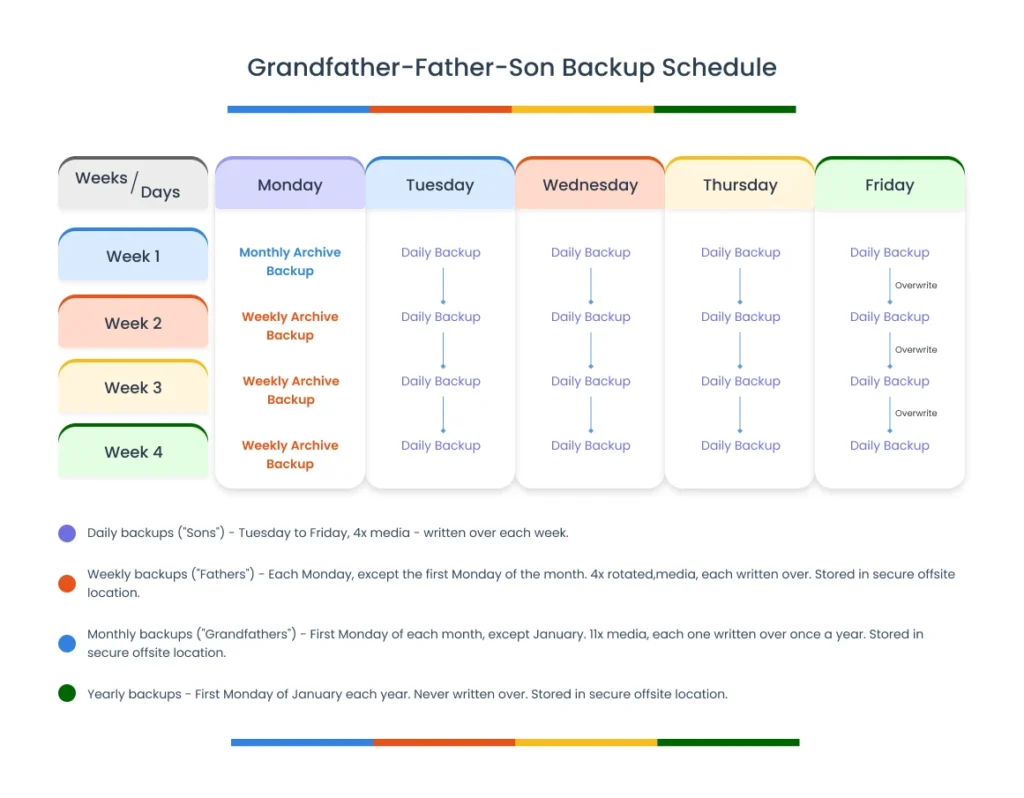
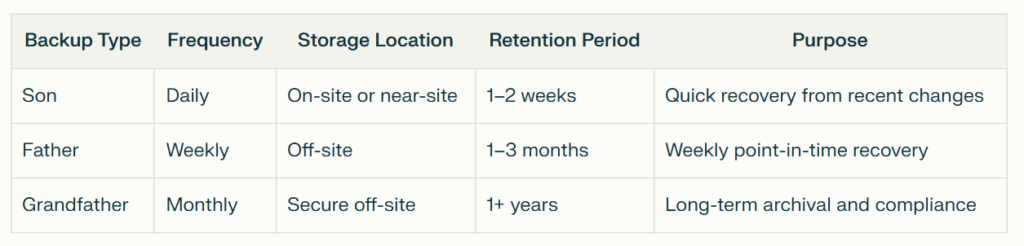
Grandfather Father Son backup is as simple as it runs on a traditional calendar. A full backup performed on the last day of every month is ‘Grandfather’, and this tape is stored permanently offsite. A full backup done on the last day of every week is the ‘Father’ and is stored off-site. Then, subsequent incremental backups or synthetic backups done daily are the ‘Son’. Son tapes can be stored onsite or offsite, depending on the volume of data changes.
Understanding the GFS backup rotation scheme
Calculating your tape requirements:
- Daily operations: 4-5 Son tapes
- Weekly cycles: 4-5 Father tapes
- Monthly archives: 12+ Grandfather tapes
- Total minimum: 20-22 tapes for a complete annual cycle
The primary purpose of the Grandfather Father Son backup or GFS tape rotation scheme is to establish a minimum standard and consistent interval for rotating and retiring the media. GFS rotation schemes allow you to back up your servers for an entire year using a minimum number of media.
Data Protection and Compliance of the GFS backup scheme
Ransomware Protection
The GFS strategy provides multiple layers of data protection against ransomware:
- Air-gapped storage: Offline tapes cannot be encrypted by ransomware
- Historical recovery points: An Attack discovered weeks later can still be recovered from
- Geographic distribution: Off-site storage survives local disasters
Regulatory Compliance
GFS naturally supports various compliance requirements:
- HIPAA: Healthcare data retention for 6+ years
- SOX: Financial records for 7+ years
- GDPR: Structured data lifecycle management
- Industry-specific: Banking, legal, and government retention policies
Amanda’s Grandfather Father Son Backup
Amanda can be used to implement the GFS backup method for tape rotation schedule. Users can perform three backup sets for daily, weekly, and monthly schedules.
Below is an example of backup strategy for a 5-day GFS backup rotation below:
- Daily full/ incremental backup on Mon-Thu, weekly full backup on Fridays, and a monthly full backup on the first Friday of the month.
- Schedule a daily backup set to run on weekdays (M-Thu). Set the Amanda strategy to “inconly” (incremental only) with a tape rotation cycle of 4.
- Schedule a weekly backup set to do a backup on all Fridays except the first one in the month. The Amanda strategy sets to “noinc” and a tape rotation cycle of 5.
- Schedule a monthly backup set to backup on the first Friday of the month. The Amanda strategy sets to “noinc” and a tape rotation cycle of 13.
Wrapping up
Amanda Enterprise Management Console allows the administrator to identify the media volume used for the backup and the one that will be useful for the next backup. It also gives information about the client and media backup failures.
Users can move tapes from a daily backup set to a weekly backup set, and from a weekly backup set to a monthly backup set. This will reduce the wear/tear on the media.
Key Takeaways for Business Continuity with GFS Implementation
- GFS backup remains highly relevant: The GFS backup system adapts well to modern threats and technologies.
- Flexibility is key: Combine tape, disk, and cloud storage based on your specific needs
- Security first: Air-gapped backups are your best defense against ransomware
- Plan for compliance: Understand your industry’s retention requirements upfront
- Test regularly: Backups are only as good as your ability to restore data from them
- Consider hybrid approaches: Modern GFS doesn’t have to be tape-only
Whether you stick with traditional tape rotation or evolve to hybrid cloud solutions, the Grandfather Father Son backup strategy provides a time-tested data protection framework for protecting your organization’s most valuable asset: its data. The key is adapting the core GFS backup principles to your specific environment, budget, and risk tolerance while maintaining the fundamental goal of reliable, recoverable backups across multiple time horizons.
, and from a weekly backup set to a monthly backup set. This will reduce the wear/ tear on the media.