Your security team detected the breach in 6 minutes. Automated response triggered at minute 7. Systems isolated by minute 12. Operations were restored with less than one hour of data loss.
This isn’t luck—it’s cyber resilience in action.
While traditional cybersecurity tries to build higher walls, cyber resilience accepts a brutal truth: breaches are inevitable. The companies that survive and the 23% that actually thrive post-breach have mastered the frameworks that transform catastrophic incidents into manageable disruptions.
This comprehensive guide answers, “What is Cyber Resilience?” and cuts through vendor hype to deliver what IT leaders need: proven frameworks that reduce incident impact by 70-90%, recovery strategies that slash downtime by 80%, and the metrics that prove ROI to your CFO. Based on real implementations across 500+ enterprises, you’ll discover why cyber resilience has become the defining factor between organizations that thrive through attacks and those that merely survive them.

What is Cyber Resilience vs Traditional Cybersecurity?
Traditional cybersecurity focused on prevention—building walls to keep threats out. But what is cyber resilience? Cyber resilience embraces a fundamentally different philosophy: accepting that breaches are inevitable while ensuring organizations can anticipate, withstand, recover from, and adapt to attacks. NIST defines cyber resilience as “the ability to anticipate, withstand, recover from, and adapt to adverse conditions, stresses, attacks, or compromises on systems that use or are enabled by cyber resources.”
Understanding what is cyber resilience means recognizing the practical difference in measurement approaches. Traditional security counted success by attacks prevented. Cyber resilience measures success by recovery speed and operational continuity. Where traditional approaches created binary outcomes (secure or compromised), resilience provides graduated responses maintaining degrees of functionality even during active incidents.
This evolution accelerated during 2020-2021 when pandemic-driven digital transformation exposed critical vulnerabilities. IBM data showed 50% of organizations experiencing cybersecurity incidents that disrupted IT and business processes, with average breach costs reaching $4.24 million. The wake-up call drove widespread adoption of resilience frameworks, with 81% of organizations now implementing or planning Zero Trust architectures by 2026.
What Changed in 2025 That Makes Traditional Security Obsolete?
CrowdStrike documented the fastest breakout time at just 51 seconds—the time from initial compromise to lateral movement. Average breakout times hover at 48 minutes. CrowdStrike demands real-time detection and response capabilities that traditional security approaches cannot deliver.
Ransomware remains the dominant threat, present in 44% of all breaches with median payments of $115,000. However, the attack methodology has evolved. Rather than simple encryption, 18% of attacks now focus solely on data exfiltration and extortion. Small and medium businesses face disproportionate risk, with 88% of SMB breaches involving ransomware compared to 39% for large enterprises.
Supply chain attacks represent the fastest-growing threat vector, increasing 431% from 2021-2023 with projected costs reaching $60 billion in 2025. The Blue Yonder incident demonstrated cascading impacts when ransomware hit the supply chain software provider, disrupting operations for thousands of retailers globally including major UK supermarket chains.
AI-powered attacks have emerged as a game-changer. Vishing attacks leveraging voice cloning technology increased 442% in just six months. AI-generated phishing emails achieve 54% click-through rates compared to 12% for human-written attempts. Security teams now face adversaries using generative AI for automated malware creation, sophisticated social engineering, and real-time attack adaptation. Defending against domain spoofing in this environment requires strict email authentication, a properly configured dmarc generator is one practical way IT teams publish policies that block unauthorized senders from impersonating their domain. This makes it increasingly important for organizations to use an AI checker, many of which now integrate directly into email platforms like Gmail via browser extension, to flag potentially AI-generated messages and identify suspicious content for review.
How Do You Build Cyber Resilience? The 6-Step Framework
Modern cyber resilience rests on six foundational pillars that work synergistically to create comprehensive protection. Understanding these components enables organizations to build systematic defenses rather than deploying disconnected point solutions.
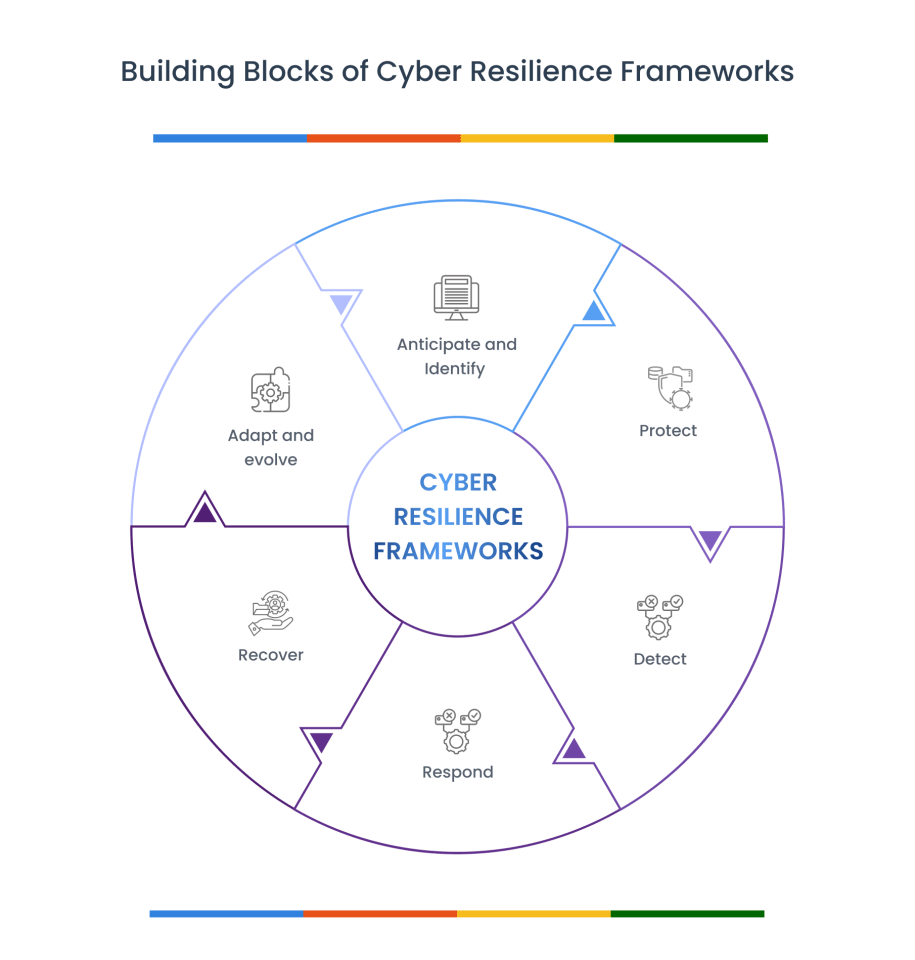
- Anticipate and Identify forms the foundation through continuous threat intelligence, comprehensive asset inventory, and proactive risk assessment. Organizations must understand their attack surface, identify critical assets, and model potential threat scenarios. This pillar includes vulnerability management, business impact analysis, and scenario planning that prepares organizations for likely attack patterns.
- Protect implements appropriate safeguards ensuring delivery of critical services. This encompasses access controls, data encryption, security awareness training, and protective technology deployment. Modern protection strategies emphasize defense-in-depth with multiple layers preventing single points of failure.
- Detect develops capabilities to identify cybersecurity events quickly. With average detection times at 241 days globally, organizations implementing advanced detection reduce this to hours or minutes. Continuous monitoring, behavioral analytics, and AI-powered anomaly detection enable rapid threat identification before significant damage occurs.
- Respond ensures organizations can contain and mitigate detected incidents effectively. This requires documented incident response plans, clear communication protocols, and practiced procedures. Leading organizations maintain dedicated response teams with defined roles, automated playbooks, and integrated crisis management capabilities.
- Recover maintains business continuity through rapid restoration of capabilities and services. This extends beyond simple backup restoration to include prioritized recovery sequences, alternative operational modes, and validated recovery procedures. Organizations with mature recovery capabilities report 40% faster restoration times.
- Adapt and Evolve closes the resilience loop through continuous improvement. Every incident provides learning opportunities to strengthen defenses. This includes updating threat models, refining response procedures, and evolving security architectures based on real-world attack patterns.
Solutions like Zmanda Pro offer less than 1-hour Recovery Point Objective (RPO) and quick Recovery Time Objective (RTO), ensuring minimal data loss and fast restoration to maintain business continuity.
Reality Check: What Makes Resilience Hard (And What to Do About It)
Organizations pursuing cyber resilience face predictable obstacles that can derail even well-intentioned programs. Understanding these challenges—and their solutions—accelerates successful implementation.
- Budget Constraints Challenge: 67% of organizations cite insufficient budget as their primary cyber resilience barrier. Limited resources force difficult trade-offs between competing security priorities.
Solution: Implement a phased approach prioritizing high-impact, low-cost improvements. Multi-factor authentication costs just $5-15 per user monthly while blocking 99.9% of account compromises. Leverage open-source tools and cloud-based security services to maximize protection within budget constraints. Build the business case through documented ROI metrics showing 184-323% returns on resilience investments. - Lack of Executive Buy-in Challenge: Without C-suite support, cyber resilience initiatives struggle for resources and organizational priority. Many executives view security as a cost center rather than business enabler.
Solution: Frame cyber resilience in business terms focusing on operational continuity, revenue protection, and competitive advantage. Present metrics showing 50-80% faster recovery times and 70-90% vulnerability reduction. Share peer company breach impacts and regulatory penalties to illustrate risks. Engage executives through tabletop exercises demonstrating potential business disruption scenarios. - Skills Gaps Challenge: The cybersecurity workforce shortage reaches 4.8 million professionals globally. Organizations cannot find or afford specialized talent for comprehensive resilience programs.
Solution: Augment human capabilities with AI-powered security tools that automate routine tasks. Invest in training existing staff through structured CISSP training and hands-on exercises. Partner with managed security service providers (MSSPs) offering customizable cybersecurity services for 24/7 monitoring and specialized expertise tailored to your specific industry requirements. Create security champions within business units to distribute security responsibilities - Legacy System Integration Challenge: Aging infrastructure lacks modern security capabilities while remaining critical for operations. Replacement costs and operational risks prevent wholesale modernization.
Solution: Implement compensating controls including network segmentation, enhanced monitoring, and restricted access. Deploy virtual patching solutions protecting vulnerable systems without modifications. Create isolated recovery environments for critical legacy applications. Develop migration roadmaps prioritizing highest-risk systems while maintaining operational stability. - Balancing Security with User Experience Challenge: Excessive security controls frustrate users, leading to workarounds that create new vulnerabilities. Finding the right balance remains challenging.
Solution: Adopt zero-trust principles with adaptive authentication, adjusting security requirements based on risk context. Implement single sign-on (SSO), reducing password fatigue while improving security. For teams managing multiple credentials, a Dashlane alternative can offer equivalent enterprise password management at a lower cost while keeping the user experience smooth. Involve users in security design, ensuring controls align with workflows. Measure and optimize security friction points through user feedback and behavioral analytics.
Tech That’s Actually Making a Difference
Let’s cut through the vendor hype and focus on the technologies delivering measurable results in real organizations.
AI and machine learning have become indispensable for cyber resilience. Defensive AI systems analyze vast datasets in real-time, identifying subtle anomalies that human analysts miss. CrowdStrike’s Falcon platform demonstrates AI’s impact, processing trillions of events daily to achieve sub-minute threat detection. Organizations using extensive AI security save an average $2.2 million on breach costs while reducing incident lifecycles by 108 days.
Security Orchestration, Automation, and Response (SOAR) platforms address the overwhelming volume of security alerts. Leading solutions like Palo Alto Networks Cortex XSOAR, IBM QRadar SOAR, and Splunk SOAR automate routine tasks while orchestrating complex response workflows. With the SOAR market projected to reach $5.5 billion by 2032, these platforms deliver 20% reduction in incident response times through automated playbooks and integrated tool orchestration.
Zero Trust Architecture represents the future of network security. Moving beyond perimeter-based defenses, Zero Trust continuously verifies every user, device, and transaction. Microsoft Azure Entra ID, Netskope, and Okta lead the market with comprehensive identity-centric platforms.
Extended Detection and Response (XDR) unifies security visibility across endpoints, networks, cloud, and email. CrowdStrike Falcon XDR, SentinelOne Singularity, and Microsoft Defender XDR lead the market by correlating threats across domains. XDR platforms achieve 50% reduction in security incidents through enhanced automation and unified threat intelligence.
Cloud-Native Application Protection Platforms (CNAPP) secure modern cloud workloads. Wiz dominates with 25.7% market share, followed by Prisma Cloud and SentinelOne. These platforms provide integrated cloud security posture management, workload protection, and infrastructure entitlement management. Organizations report 35% improvement in cloud visibility gaps through CNAPP deployment.
Is Your Resilience Program Working? Here’s How to Tell
Mean Time to Detect (MTTD) and Mean Time to Respond (MTTR) serve as primary operational metrics. Industry benchmarks show 258-day average detection times, but leading organizations achieve sub-6 minute detection for critical threats. Every hour of reduced MTTR saves $100,000-$5 million in downtime costs.
Financial metrics prove cyber resilience ROI through documented cost avoidance and operational efficiency. Annual Loss Expectancy (ALE) calculations quantify risk reduction value by comparing potential losses before and after control implementation.
The formula ALE = Single Loss Expectancy × Annual Rate of Occurrence provides clear investment justification.
Organizations should track both technical and business metrics. Technical indicators include vulnerability remediation timelines, security training completion rates, and successful recovery test percentages. Business metrics encompass cyber insurance premium changes, compliance audit results, customer trust scores, and operational uptime. This dual measurement approach ensures security investments align with business objectives while demonstrating tangible value.
Future-Proofing: What’s Coming in 2026 And Beyond
The path forward demands executive leadership, sustained investment, and recognition that perfect security remains impossible while effective resilience is achievable. Organizations beginning comprehensive resilience programs now position themselves to thrive in an increasingly dangerous digital landscape. Those delaying face escalating costs, regulatory penalties, and potential business failure when inevitable breaches occur.
The evidence is clear: cyber resilience delivers measurable ROI, enables business growth, and protects stakeholder value. IT decision-makers must champion resilience transformation, securing resources and support for this critical journey. The question is not whether to invest in cyber resilience, but how quickly organizations can build these essential capabilities before adversaries exploit their vulnerabilities.
Ready to Build Unbreakable Recovery? Here’s How Zmanda Helps
While building a comprehensive cyber resilience strategy requires multiple components, data backup and recovery form the critical foundation. This is where Zmanda Pro delivers enterprise-grade protection without the complexity typically associated with enterprise-level solutions.
Why Zmanda Pro for Cyber Resilience
Zmanda Pro addresses the core recovery pillar of cyber resilience through advanced backup capabilities designed for modern threats. With ransomware attacks present in 44% of breaches, Zmanda’s immutable backup ensures your data remains protected even if primary systems are compromised.
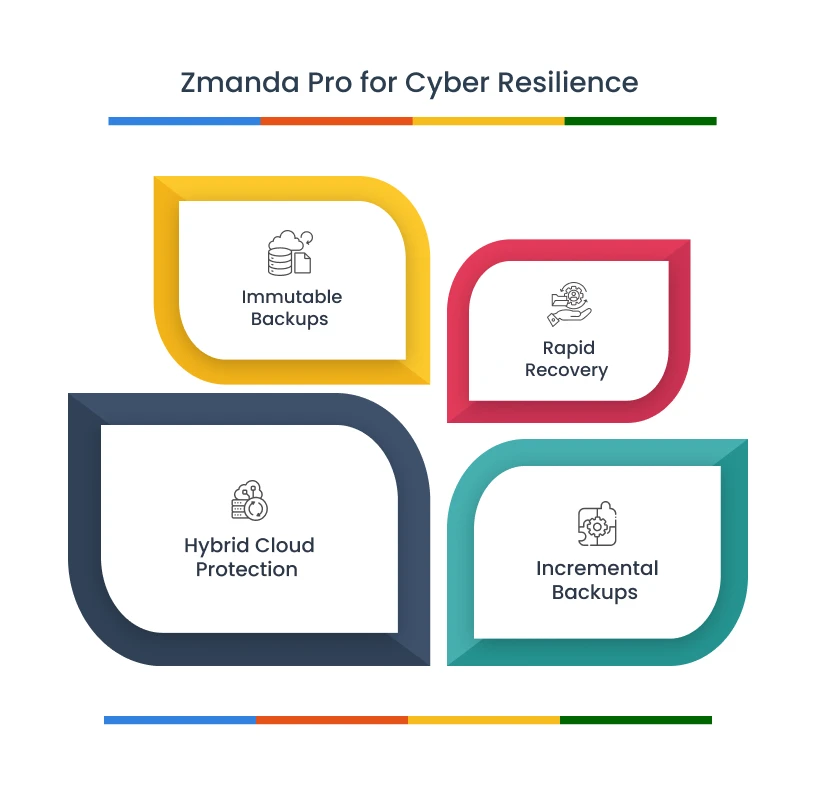
- Immutable Backups Prevent ransomware and malicious actors from corrupting your backup data. Zmanda’s immutable storage ensures that once data is written, it cannot be modified or deleted until the retention period expires—providing an unbreachable last line of defense.
- Rapid Recovery Minimize downtime with swift restoration capabilities that support the MTTR metrics critical to cyber resilience. Zmanda Pro’s intelligent recovery options allow granular restoration from file-level to full system recovery, ensuring you meet aggressive recovery time objectives.
- Hybrid Cloud Protection Seamlessly protect data across on-premises, cloud, and SaaS environments from a single platform. Whether your data resides in AWS, Azure, Google Cloud, or traditional data centers, Zmanda provides unified protection without complexity.
- Incremental Backups Efficiently capture changes without redundant full backups, ensuring both newest and historical data remain protected. This approach reduces storage costs by up to 80% while maintaining comprehensive recovery capabilities.
Comprehensive Workload Protection
Zmanda Pro extends beyond traditional backup, protecting:
- Major operating systems (Windows, Mac, Linux)
- Database systems and applications (MySQL, PostgreSQL, Oracle, SQL Server)
- Virtualization platforms (Hyper-V, VMware)
- Microsoft 365 environments
- Local and cloud storage systems
For organizations serious about cyber resilience, Zmanda Pro provides the robust disaster recovery foundation that ensures business continuity when incidents occur. With flexible deployment options and scalable architecture, it grows with your cyber resilience maturity.