HIPAA sets a clear expectation for healthcare organizations: electronic protected health information (ePHI) must be secured at every stage: during backup, in transit at rest, and your systems must be able to restore it reliably after any disruption. Meeting these standards requires a platform built with the specific technical controls HIPAA demands.
Zmanda Pro is designed to support HIPAA-regulated environments. This post covers exactly how we meets these requirements with the technical specifics healthcare IT teams require when evaluating an enterprise-grade HIPAA compliant backup solution.
What HIPAA Compliant Backup Requirements Actually Demand
The HIPAA Security Rule centers on protecting the confidentiality, integrity, and availability of PHI. Practically, that translates into a Contingency Plan with five documented components: a data backup plan, a disaster recovery plan, an emergency mode operation plan, testing and revision procedures, and an applications and data criticality analysis.
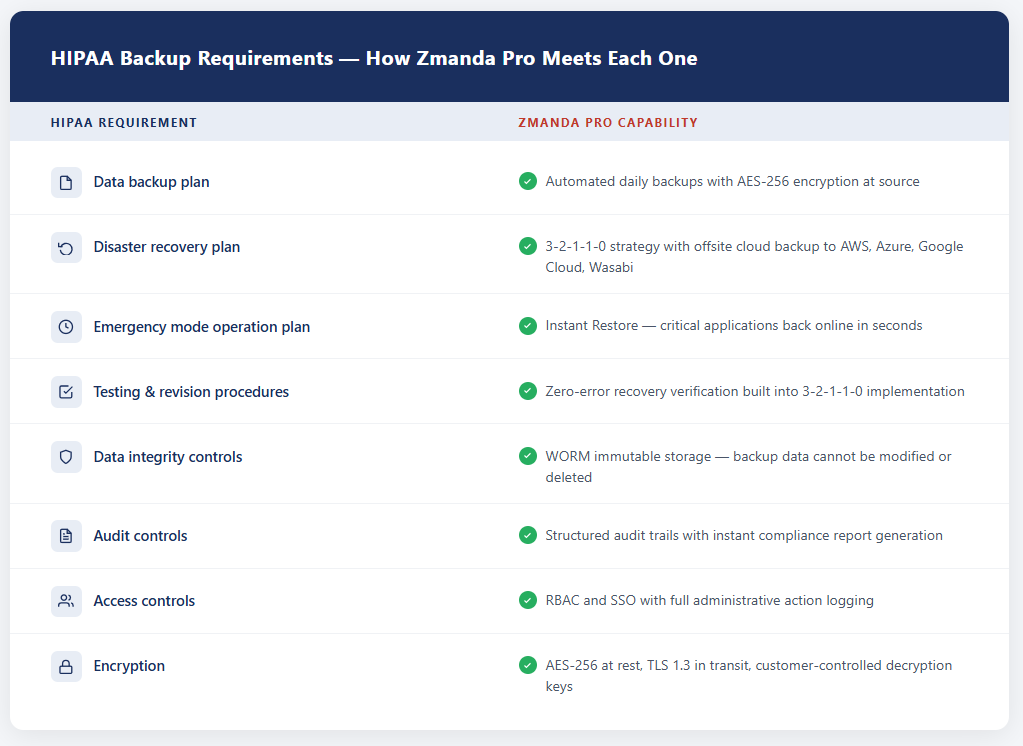
Beyond the Contingency Plan itself, HIPAA’s administrative and technical safeguards require that access to ePHI is controlled and accountable, that audit controls are in place to track what happens to PHI across systems, and that data integrity mechanisms confirm ePHI hasn’t been altered or destroyed without authorization.
For IT teams responsible for data backup and recovery in healthcare, this framework defines the minimum bar. A backup platform either supports these controls or it doesn’t. The question to ask of any solution, including your current one, is whether it delivers on each of these requirements technically, not just on paper. The next section maps Zmanda Pro’s capabilities to those requirements directly.
How Zmanda Pro Delivers HIPAA Compliant Backup
1. Encryption: AES-256 Across Every Stage of Backup
Encryption is the first and most fundamental requirement for any HIPAA compliant backup environment. The HITECH Act’s mandate that PHI be rendered unreadable to unauthorized parties makes AES-256 encryption the practical standard, and it’s exactly what Zmanda Pro implements throughout the entire backup lifecycle.
Zmanda Pro encrypts all data before it is sent or stored, using AES-256 with high-entropy random keys. This is not a post-processing step applied after data reaches a destination; encryption happens at the source, before the data moves anywhere. During backup, authentication credentials are securely hashed and stored. Encryption keys never leave the client in unencrypted form, and all sensitive key material is protected using industry-standard cryptographic practices. When Zmanda Pro sets up a backup destination for the first time, it generates high-entropy random encryption keys specific to that destination. All backup data written there is encrypted using AES-256 and authenticated to ensure integrity.
The most important aspect of Zmanda Pro’s encryption architecture is key ownership. The only party holding decryption keys is your organization or your designated backup administrator — not Zmanda. This zero-trust model ensures total privacy of ePHI in storage, regardless of whether that storage is on-premises, on a NAS, or with a cloud provider. For data in transit, Zmanda Pro uses TLS 1.3, protecting backup traffic across networks against interception at every point in the transfer chain.
For healthcare organizations evaluating HIPAA compliant backup software, this end-to-end encryption posture is the technical standard.
2. Access Controls: Who Gets Into Your Backup Environment (RBAC & SSO)
HIPAA’s administrative safeguards require that access to ePHI be limited to authorized personnel, that access be accountable, and that the principle of least privilege be enforced across systems handling protected data. Zmanda Pro addresses this through two integrated controls: Role-Based Access Control (RBAC) and Single Sign-On (SSO).
RBAC allows healthcare IT administrators to define precisely who can access backup data, modify policies, or initiate restore jobs. Permissions are granted based on role, not on individual administrator discretion, which systematically enforces least-privilege access across your backup infrastructure. Every action taken within the system is logged and attributable to a specific user, giving you a complete record of who accessed what and when. This level of granularity is what HIPAA’s audit control requirements are designed to capture, and it’s what OCR investigators look for when reviewing breach incidents.
SSO integration takes access governance a step further by centralizing identity management across backup systems. Rather than maintaining separate credentials for backup infrastructure, administrators authenticate through your organization’s existing identity provider. This eliminates credential sprawl, reduces the attack surface associated with standalone backup accounts, and simplifies the access governance process that HIPAA compliance reviews require.
3. Immutable Backups: Ransomware Protection for Healthcare Data
HIPAA’s Security Rule requires that covered entities protect the integrity and availability of ePHI. Immutable backups are the technical mechanism that makes that requirement operationally meaningful in environments where backup infrastructure itself is a target.
Every backup stored through Zmanda Pro can be secured using WORM (write once, read many) technology. Once written, backup data cannot be modified, deleted, or encrypted by any subsequent process. This is a software-enforced control, not a policy setting subject to override. The air-gapped storage configurations Zmanda Pro supports take this a step further, isolating backup copies from the primary network entirely.
Pairing immutable backups with air-gapped storage also addresses a pattern that has become standard in ransomware attacks on healthcare: attackers targeting backup infrastructure specifically to eliminate recovery options before executing encryption. WORM technology ensures that even if attackers reach backup storage, the data cannot be touched.
4. Recovery: Meeting HIPAA’s Emergency Mode Operation Requirements
One of HIPAA’s five Contingency Plan requirements is an Emergency Mode Operation Plan — a documented and tested process for maintaining access to ePHI and sustaining critical operations during a system disruption. This requirement has a direct implication for backup solutions: protecting data isn’t enough. You have to be able to restore it fast enough to keep clinical systems running.
Zmanda Pro’s instant restore technology brings critical applications back online in minutes rather than hours, with industry-leading RTOs that minimize the operational impact of any disruption. For healthcare backup environments where EHR availability is directly tied to patient care delivery, that recovery speed is the difference between a manageable incident and an extended outage. Recovery is also granular; Zmanda Pro supports both full system restores and individual file or object recovery, so IT teams can restore exactly what is needed without having to pull an entire backup chain.
5. The 3-2-1-1-0 Strategy: Built Into Every Zmanda Pro Deployment
The 3-2-1-1-0 backup strategy — three copies of data, on two different media types, with one offsite copy, one offline or air-gapped copy, and zero errors verified through recovery testing maps directly to HIPAA’s Contingency Plan structure and represents the architectural standard for healthcare environments.
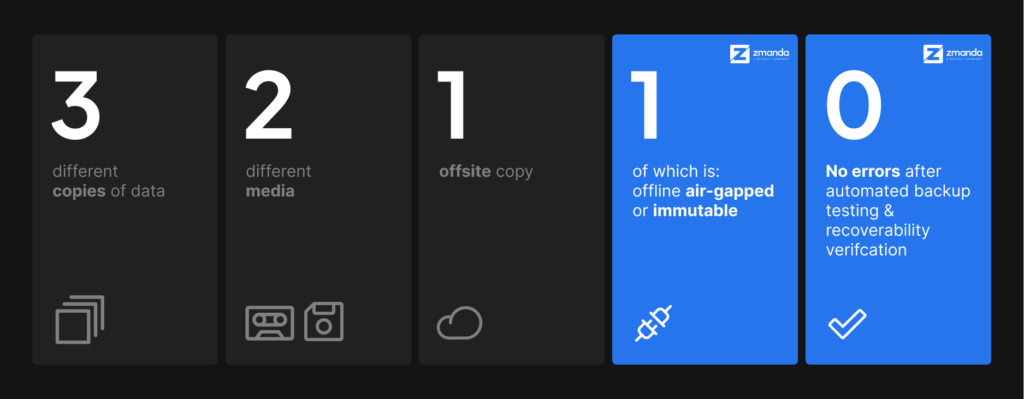
Zmanda Pro implements the full 3-2-1-1-0 strategy in two clicks. The three-copy redundancy satisfies the data backup plan requirement. The two-media-type requirement protects against media-specific failures. The offsite copy addresses geographic or facility-level disruptions supported through Zmanda Pro’s integrations with leading HIPAA compliant backup platforms, including AWS S3, Azure, Google Cloud, and Wasabi. The offline or air-gapped copy ensures availability when network-connected infrastructure is inaccessible. And the zero-error verification requirement aligns with HIPAA’s mandate to test and validate recovery procedures.
6. Audit Trails: Documenting HIPAA Compliance When It’s Tested
HIPAA requires that covered entities be able to demonstrate what happened to ePHI — who accessed it, when it was backed up, when it was restored, and whether any modifications occurred. This documentation requirement becomes critical during breach investigations and OCR enforcement actions, where the ability to produce a clear, time-stamped record of data handling can determine the scope of an organization’s liability.
Zmanda Pro maintains detailed logs of every data access, modification, backup job, and recovery operation across your environment. These are structured audit trails built to satisfy HIPAA’s documentation requirements. Every administrative action taken through Zmanda Pro’s centralized management console is captured, timestamped, and attributed to a specific authenticated user. When a compliance review or investigation requires evidence, Zmanda Pro allows you to generate reports instantly, covering the full chain of custody for ePHI across your backup environment. For healthcare IT leaders managing HIPAA compliant backup across large or distributed infrastructure, this matters operationally.
7. Cloud Backup and the BAA: What Healthcare Organizations Need to Know
Zmanda Pro supports backup to a range of HIPAA compliant cloud storage providers — including AWS S3, Microsoft Azure, Google Cloud Storage, Wasabi, and other S3-compatible platforms. Each of these providers offers Business Associate Agreements (BAAs), which is the contractual requirement HIPAA imposes when a vendor creates, receives, maintains, or transmits ePHI on behalf of a covered entity.
One of the most common questions healthcare IT teams have when evaluating HIPAA compliant cloud backup solutions is whether they need a BAA with Zmanda itself. For self-hosted Zmanda Pro deployments, the answer is no. When your organization runs and hosts the Zmanda Pro backup server on your own infrastructure and backs up to your own selected storage provider, Zmanda does not store or transmit your ePHI. Only you and the parties you nominate have access to your deployment. The BAA obligation in this model sits with your cloud storage provider — AWS, Azure, Wasabi, or whichever platform you select — and those providers are well-equipped to execute BAAs.

Why Healthcare IT Teams Choose Zmanda Pro for HIPAA Compliant Backup
Beyond meeting individual HIPAA requirements, Zmanda Pro is designed to reduce the operational burden on healthcare IT teams managing compliance alongside complex, day-to-day infrastructure responsibilities. The platform combines enterprise-grade security controls with the operational simplicity that lean IT teams need to maintain consistent compliance without adding headcount.
- Broad workload coverage across the full healthcare stack. Zmanda Pro protects 30+ workload types through a single centralized management console — including Windows and Linux servers, VMware and Hyper-V virtual machines, Microsoft SQL Server, Oracle databases, file systems, and endpoint devices. ePHI doesn’t live in one place, and comprehensive HIPAA compliant data backup requires coverage across every system that handles it, not just the most visible ones.
- Flexible hybrid-cloud deployment. Zmanda Pro’s flexible deployment options support on-premises, cloud, and hybrid environments without requiring infrastructure changes. Backup schedules can be configured to run during off-peak hours, ensuring zero disruption to EHR systems or clinical workflows. For organizations with strict data residency requirements, self-hosted deployment keeps ePHI entirely within your controlled environment.
- Independent security certifications. Zmanda Pro’s security architecture is built to meet the demands of environments requiring SOC 2 Type II, ISO 27001, ISO 9001, and PCI DSS compliance — independently verified controls that provide documented evidence of security diligence for auditors, executive leadership, and OCR.
- Simplified compliance management. Automated backup policies, centralized audit logging, and instant compliance report generation reduce the manual effort involved in maintaining and demonstrating a HIPAA compliant backup posture. For healthcare IT teams already stretched across infrastructure management, clinical system support, and security responsibilities, that operational efficiency translates directly into fewer compliance gaps and more time for higher-priority work.
Zmanda Pro for Healthcare: Use Cases by Organization Type
Zmanda Pro’s capabilities align with the range of environments healthcare organizations operate across, from large hospital systems to distributed outpatient networks.
- Hospitals and health systems running EHRs, PACS, and critical clinical applications across large, distributed infrastructure benefit from Zmanda Pro’s broad workload support, centralized management, and Instant Restore capabilities. In environments where every minute of downtime has a direct impact on patient care, recovery speed and backup reliability aren’t operational preferences; they’re patient safety requirements.
- Clinics and outpatient centers with smaller IT teams benefit from the automation and simplicity Zmanda Pro brings to HIPAA compliant backup management. Automated daily backup policies, structured audit trails, and instant compliance report generation mean that maintaining a documented HIPAA posture doesn’t require dedicated compliance staff. Smaller organizations face the same HIPAA obligations as large health systems. Zmanda Pro makes it operationally feasible to meet them without scaling the IT team proportionally.
- Pharmacies and insurance providers handling PHI across distributed or multi-site environments can use Zmanda Pro’s HIPAA compliant offsite backup capabilities and immutable WORM storage to protect PHI integrity and availability across locations. With RBAC and SSO enforcing access governance across distributed teams, and AES-256 encryption protecting data whether it’s stored locally or in the cloud, these organizations can maintain consistent compliance controls across their entire footprint — not just at headquarters.
From HIPAA Backup Requirements to Verified Controls
HIPAA’s backup requirements are specific about what needs to be protected, how it needs to be secured, and how quickly it needs to be recoverable after a disruption. What varies is whether the backup solution in place actually delivers on those requirements technically. AES-256 encryption with customer-controlled keys, immutable WORM storage, granular RBAC and SSO, comprehensive audit trails, instant restore, and automated 3-2-1-1-0 implementation are the controls that determine whether a backup platform genuinely supports a HIPAA-regulated environment or simply claims to.
Zmanda Pro is built to deliver each of these controls within a single, centrally managed platform. Its deployment flexibility fits healthcare environments ranging from large hospital systems to lean clinic IT teams.
Explore Zmanda Pro’s HIPAA capabilities in detail, start a free trial, or book a consultation to work through the right deployment model for your environment.

FAQs