Backup systems multiply as organisations grow. Finance runs one solution, HR runs another, and regional offices run their own. Each team sets different backup retention policies based on what feels right—until an auditor asks who’s accountable for meeting data backup compliance requirements across the organisation.
That’s when enterprises realise informal backup approaches don’t scale.
Enterprise backup governance establishes the framework that distributed backup operations require clear ownership, consistent policies, and automated enforcement that survives audits.
Here’s a quick reference summary of everything covered in this blog:
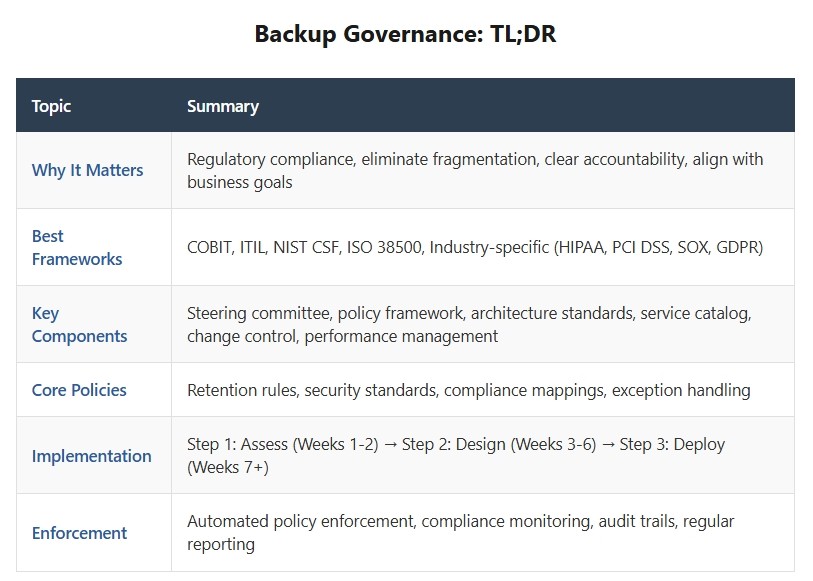
In this guide, we’ll cover:
- Why large organisations need formal backup governance
- Essential governance structure components (steering committees, policy frameworks, service catalogs)
- How to establish policies for retention, security, and compliance
- Service management processes that standardize backup delivery
- Decision rights and accountability frameworks
- Enforcement mechanisms and compliance monitoring approaches
Which Governance Frameworks Should You Use for Backup?
A backup governance framework is the structured approach organisations use to establish accountability, define policies, and enforce standards across distributed backup operations. Unlike individual policies or procedures, frameworks provide the complete organisational architecture connecting strategic oversight to operational execution.
Enterprise backup governance frameworks typically align with established IT governance standards that large organisations already use, such as COBIT, ITIL, NIST Cybersecurity Framework, and ISO 38500. These frameworks provide structured approaches to define policies, enforce standards, and ensure compliance.
1. COBIT (Control Objectives for Information and Related Technologies) provides comprehensive IT governance process models that enterprises adapt for backup operations. Organisations use COBIT to align backup retention policy decisions with business objectives, establish risk management controls for backup systems, and demonstrate compliance with regulatory requirements. COBIT’s strength lies in connecting backup governance to enterprise governance frameworks executives already understand.
2. ITIL (Information Technology Infrastructure Library) offers IT service management best practices that structure how organisations deliver backup services operationally. Enterprises leverage ITIL frameworks for backup service catalogues, incident management when backup failures occur, change management for backup system modifications, and service continuity planning. ITIL 4 specifically addresses backup as part of service value streams, ensuring backup capabilities support business outcomes.
3. NIST Cybersecurity Framework provides risk-based approaches to cybersecurity that directly address backup through the “Protect” and “Recover” functions. The framework’s PR. IP-4 control specifically requires “backups of information are conducted, maintained, and tested,” establishing backup governance as a cybersecurity imperative. Organisations in critical infrastructure sectors or government agencies frequently map backup governance to NIST CSF requirements.
4. ISO/IEC 38500 establishes corporate governance principles for IT that backup frameworks must satisfy, particularly around accountability (who owns backup decisions), transparency (how backup governance operates), and conformance (meeting data backup compliance requirements). Boards and executive leadership use ISO 38500 principles to evaluate whether backup governance provides adequate oversight.
5. Industry-specific compliance frameworks impose additional backup governance requirements based on regulatory mandates:
- HIPAA Security Rule for Healthcare Backup Protection: The HIPAA Security Rule requires healthcare organisations to maintain retrievable exact copies of electronic protected health information, dictating specific backup retention policies and testing requirements.
- PCI DSS Backup Procedures for Payment Card Industry: PCI DSS mandates payment card industry organisations to maintain backup procedures and test restoration capabilities quarterly.
- SOX Compliance: Seven-Year Financial Data Retention: SOX (Sarbanes-Oxley) requires financial data retention for seven years, directly impacting backup retention policy frameworks.
- GDPR/CCPA Data Protection and Backup Security Controls: GDPR/CCPA establish data protection requirements, including backup security controls and retention limitation principles.
6. SOC 2 Type II trust services criteria provide another framework that technology companies use to demonstrate backup governance maturity to customers and auditors, particularly around availability and confidentiality commitments.
Organisations rarely adopt these standards wholesale for backup operations. Instead, they extract relevant components—accountability structures from COBIT, service management from ITIL, risk controls from NIST CSF, compliance mappings from industry regulations—creating custom frameworks addressing specific backup challenges their environment presents.
The framework components detailed in this guide—steering committees, policy engines, service catalogs, enforcement mechanisms—represent the practical implementation of governance principles regardless of which standard frameworks inform your approach. Modern backup platforms like Zmanda Pro support multiple framework requirements through built-in capabilities including automated policy enforcement, comprehensive audit trails, and flexible deployment models.

Understanding these frameworks is essential—but why do large organisations need formal backup governance in the first place? The answer lies in three critical challenges that emerge as enterprises scale.
Why Do Large Organisations Need Backup Governance?
Three critical challenges emerge as enterprises scale back up operations without formal governance frameworks.

1. Regulatory Compliance and Cost Justification
Without formal backup retention policies and clear data backup compliance requirements, organisations struggle to demonstrate regulatory adherence or justify backup investments to stakeholders.
2. Managing Fragmentation Across Business Units
Without formal governance, enterprise backup approaches become fragmented as different business units, IT teams, or geographic regions implement independent solutions optimized for local needs but creating organizational complexity. This fragmentation increases costs through duplicated infrastructure and licensing, complicates compliance by creating gaps in policy enforcement, and reduces operational efficiency through inconsistent practices.
3. Establishing Clear Accountability
Accountability requirements demand clear ownership for backup capabilities, service levels, and compliance obligations. Governance frameworks establish who makes decisions about backup technologies, who approves backup policies, and who bears responsibility when backups fail or compliance violations occur. Clear accountability prevents situations where everyone assumes someone else owns critical responsibilities.
4. Aligning Backup Strategy with Business Objectives
Strategic alignment ensures backup investments support business priorities rather than pursuing technology for its own sake. Governance processes connect backup strategy to enterprise architecture, business continuity planning, and digital transformation initiatives. This alignment prevents backup systems from becoming technical debt, hindering rather than enabling business objectives.
Recognising the need for governance is only the starting point. The next step is understanding which structural components transform governance from concept into operational reality.
What Governance Structure Components Are Essential?
The following table outlines key components of enterprise backup governance frameworks:
| Governance Component | Purpose | Key Elements | Typical Ownership |
|---|---|---|---|
| Steering Committee | Strategic direction and oversight | Charter, membership, meeting cadence, decision authority | IT leadership, business stakeholders |
| Policy Framework | Standards and requirements | Retention policies, security standards, compliance requirements | Governance office, compliance team |
| Architecture Standards | Technical consistency | Approved technologies, integration patterns, deployment models | Enterprise architecture team |
| Service Catalog | Service offerings definition | Service tiers, SLAs, pricing models, request processes | Backup operations management |
| Change Control | Controlled modifications | Change approval processes, testing requirements, rollback procedures | Change advisory board |
| Performance Management | Monitoring and reporting | KPIs, dashboards, reporting cadence, escalation procedures | Backup operations team |
Enterprise backup governance framework components showing organizational structures, their purposes, and typical ownership for comprehensive governance.
These governance components don’t exist in isolation—they require organisational structures staffed with the right people making the right decisions. Here’s how leading enterprises organise their governance bodies.
What Backup Retention Policies and Standards Should Governance Address?
Retention policy frameworks establish data retention requirements across the organisation, balancing business needs, regulatory mandates, and storage costs. Governance bodies define retention tiers for different data classifications, approval processes for retention exceptions, and automated enforcement mechanisms. Clear retention policies prevent both premature deletions, creating compliance risks and excessive retention, which inflates storage costs.
Security standards specify encryption requirements, access controls, and audit capabilities for backup systems. Policies address data protection both in transit and at rest, privileged access management, multi-factor authentication requirements, and security event logging. Security-focused backup solutions support policy enforcement through built-in capabilities, including immutable backups and comprehensive access controls.
Compliance mappings connect backup capabilities to regulatory requirements, demonstrating how backup systems satisfy compliance obligations. Organisations document which backup features address specific regulatory requirements, how policies enforce compliance mandates, and what evidence backup systems generate for auditors. Explicit compliance mappings simplify audits while ensuring backup governance addresses all applicable regulations.
What Decision Rights and Accountability Should Governance Define?
Technology selection authority establishes who can approve backup technologies for enterprise deployment. Centralized approval prevents proliferation of incompatible backup solutions while enabling standards-based approaches. Governance frameworks typically grant technology selection authority to enterprise architecture or technical working groups with steering committee oversight for major platform decisions.
Policy exception processes handle situations where standard policies cannot accommodate legitimate business requirements. Organisations establish formal exception request and approval workflows requiring business justification, risk assessment, and compensating controls. Exception processes balance policy consistency with business flexibility while maintaining visibility into non-standard arrangements.
Budget and funding models clarify how backup services are funded including centralized funding, business unit chargebacks, or hybrid approaches. Clear funding models align costs with beneficiaries while enabling appropriate investment levels. Many organisations implement chargeback models increasing business stakeholder engagement and cost consciousness.
How Do You Enforce Backup Retention Policies and Ensure Compliance?
Automated policy enforcement implements governance requirements through technical controls reducing reliance on manual compliance. Organisations configure backup systems to automatically enforce retention policies, encryption requirements, and access controls. Enterprise backup platforms support policy automation through comprehensive management capabilities and policy engines.
Compliance monitoring tracks adherence to governance policies identifying violations requiring remediation. Organisations implement automated scanning detecting policy deviations, generating compliance reports, and alerting governance teams to issues. Regular compliance reporting to steering committees demonstrates governance effectiveness while identifying areas requiring attention.
Audit support processes ensure backup governance withstands regulatory audits and internal reviews. Organisations maintain comprehensive documentation of governance frameworks, policy decisions, compliance evidence, and audit trails. Documented governance demonstrates organizational maturity while simplifying audit responses.
Now that you understand what governance looks like, here’s how to build it.
Getting Started: Your 3-Step Governance Implementation Roadmap
Establishing governance sounds complex, but enterprises typically follow this sequence:
Step 1: Assess Current State (Weeks 1-2)
- Document existing backup solutions across all business units
- Map current policies against regulatory requirements
- Identify compliance gaps and policy conflicts
- Establish baseline costs and service levels
Step 2: Design Governance Framework (Weeks 3-6)
- Select framework alignment (COBIT, ITIL, or hybrid approach)
- Form steering committee with IT and business stakeholders
- Draft retention policies, security standards, and compliance mappings
- Define decision rights and exception processes
Step 3: Implement and Enforce (Weeks 7+)
- Deploy centralized backup platform with policy engines
- Configure automated enforcement for retention and security policies
- Roll out governance to business units with training
- Establish compliance monitoring and reporting cadence
Timeline expectation: Most mid-market enterprises complete governance rollout within 90-120 days with adequate resources.
Strengthen Backup Operations Through Effective Governance
Enterprise backup governance establishes the organisational framework, ensuring backup operations deliver business value, maintain compliance, and align with strategic objectives. Zmanda Pro supports governance requirements through comprehensive policy engines, detailed audit trails, and flexible deployment models accommodating diverse organisational needs.
Whether establishing new governance frameworks or enhancing existing structures, Zmanda Pro provides the capabilities that well-governed backup operations demand. Start your Zmanda Pro free trial to experience enterprise backup with governance capabilities built in.