When discussing business continuity plans, it’s important to understand the concepts of high availability (HA) and seven tiers of disaster recovery. High availability is a system’s ability to remain resilient against single points of failure, ensuring consistent performance and uptime. However, HA alone is not sufficient. Organizations must also have a robust disaster recovery strategy to quickly restore infrastructure and critical data with minimal data loss in the event of a disruption.
In this blog, I will provide an overview of disaster recovery and introduce the 7 tiers of disaster recovery, setting the stage for a deeper exploration in future blogs.
To understand the disaster recovery tiers, first, we need to understand the basic concept of Disaster Recovery and why it’s needed for business continuity. Let’s jump in
What is Disaster Recovery?
Disaster recovery is a crucial aspect of maintaining or re-establishing vital IT infrastructure and systems following natural disasters or human error incidents, such as storms or cyberattacks. It’s essential for keeping all critical systems of a business functioning despite significant disruptive events. Effective disaster recovery requires well-thought-out policies, procedures, and tools to ensure business continuity.
How to Measure Data Loss and Recovery Time?
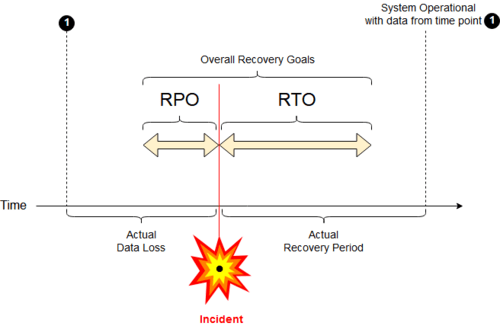
In the event of a disaster, an organization’s primary goal is to restore all systems rapidly while minimizing data loss. These objectives are quantified as the Recovery Time Objective (RTO) and Recovery Point Objective (RPO):
- Recovery Time Objective (RTO): This point in time recovery refers to the duration required to restore IT equipment and data to resume business operations.
- Recovery Point Objective (RPO): This represents the acceptable amount of data loss, measured in time, from the point of the disaster.
Why are Secondary Sites and Disaster Recovery Sites Crucial in a Disaster Recovery Plan?
A secondary location equipped with comparable infrastructure—like computing resources, storage devices, and networking—is necessary, particularly when the primary site is not immediately recoverable. The backed up data restored at this secondary site is crucial for continuing business processes.
How Do States of Infrastructure and Data Layers Play A Role?
The secondary site can be either active or passive. For instance, while the computing, network, and storage might be active, data recovery is needed if the site lacks the necessary data (or state) to function as the primary site. In this scenario, the data layer is in a passive state, which impacts the RTO during the recovery process.
What to Consider When Creating a Disaster Recovery Plan for Business Continuity?
To effectively establish a Disaster Recovery Plan, businesses must discuss their domain-specific needs to determine appropriate RPO and RTO requirements for their disaster recovery strategy. For example, banks typically require very low RPO and RTO, aiming for minimal downtime and zero data loss, whereas a university or research organization might tolerate some data loss and a longer recovery period.
From Backups to Continuous Data Replication: The Seven Tiers of Disaster Recovery
Achieving desired RPO and RTO goals involves understanding the disaster recovery service levels, ranging from level 0 to level 6. Each level offers varying degrees of critical data protection and recovery time speed, with increasing cost and complexity. From basic data backup solutions to advanced replication, organizations must choose the appropriate tier for their disaster recovery plan.
Here are Seven Tiers of Disaster Recovery:
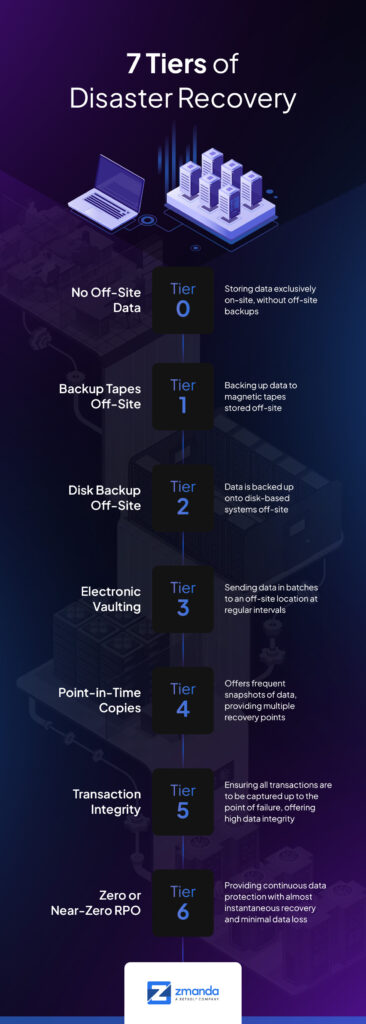
Tier 0 Disaster Recovery: No Off-Site Data
This first tier involves storing data exclusively on-site, without offsite data backup. It’s the most cost-effective but carries the highest risk of total data loss in the case of on-site disasters. Ideal for small, non-critical setups with minimal associated risks.
Tier 1 Disaster Recovery: Backup Tapes Off-Site
This involves backing up data to magnetic tapes stored off-site as a form of physical backup. It’s a more secure option than Level 0, but it can be slow in data recovery. It is suitable for institutions where data recovery time speed is not a critical factor.
Tier 2 Disaster Recovery: Disk Backup Off-Site
Faster recovery is possible as data is backed up onto disk-based systems off-site. It’s more expensive than tape backups, but it allows for more frequent data backup and improved backup data processes. Suitable for medium-sized businesses prioritizing recovery speed.
Tier 3 Disaster Recovery: Electronic Vaulting
This fourth tier includes sending data in batches to an off-site location at regular intervals. It strikes a balance between backup data frequency and costs, which is ideal for organizations with moderate data-change rates.
Tier 4 Disaster Recovery: Point-in-Time Copies
Offers frequent snapshots of data, providing multiple recovery points. This level is storage-intensive and ideal for businesses with high transaction rates or those maintaining critical systems.
Tier 5 Disaster Recovery: Transaction Integrity
This sixth tier includes ensuring all transactions are captured up to the point of failure, offering high data integrity. In case of hardware failure, data consistency is maintained through continuously transmitted updates to a remote server. It’s technically complex and ideal for setups where transaction integrity consistency is crucial, like financial institutions.
Tier 6 Disaster Recovery: Zero or Near-Zero RPO
This last tier of disaster recovery provides continuous data protection with almost instantaneous recovery and minimal data loss. It utilizes advanced cloud storage technology and remote server capabilities, often incorporating hot site configurations. It’s the most sophisticated and costly recovery solution, suitable for large enterprises or critical government systems requiring minimal disruption.
Seven Tiers of Disaster Recovery: A Careful Balance of Cost and Capabilities
In disaster recovery planning, accurately defining the Recovery Point Objective (RPO) and Recovery Time Objective (RTO) is crucial for business resilience. These objectives dictate how quickly and effectively a company can bounce back from disruptions. However, implementing these objectives through appropriate tiers of disaster recovery involves carefully balancing costs and capabilities.
A successful DR plan may utilize various disaster recovery solutions, from cold site configurations to advanced remote data center setups. The plan should align with the organization’s risk tolerance and budget, ensuring that the level of investment is proportional to the potential risks and impacts.
In essence, a well-crafted DR plan not only protects critical business functions but also aligns with the organization’s financial strategy, ensuring long-term stability and growth through comprehensive recovery solutions.