After steering dozens of recovery operations and evaluating the major DRaaS solutions on the market, one thing stands out: when systems are down, theory matters far less than actual recovery performance.
IT leaders face mounting pressure to guarantee business continuity despite increasingly sophisticated threats. Ransomware attacks can encrypt entire environments in minutes. Infrastructure failures cascade quickly. And every minute of downtime translates to revenue loss and reputational damage.
What makes choosing a DRaaS provider particularly challenging is that you can’t truly test their capabilities until disaster strikes – yet that’s precisely when you need flawless execution. The technical details matter: replication frequency, automated failover reliability, cross-platform support, and the expertise of the team managing your recovery.
For 2025, we’ve evaluated DRaaS providers based on practical criteria that determine success during actual recovery scenarios. This analysis focuses on demonstrated capabilities rather than marketing claims, with particular attention to recovery speed, data currency, implementation complexity, and real-world performance under pressure.
Evaluation Criteria for DRaaS Providers
Before diving into the rankings, let’s establish the key benchmarks that separate leading disaster recovery services from the rest. While every organization has unique needs, these core criteria remain crucial across environments:
- Recovery Performance (RTO/RPO): How quickly can critical systems be brought back online (Recovery Time Objective) and how current will the recovered data be (Recovery Point Objective)? Leaders in this space deliver RTOs measured in minutes rather than hours, ensuring business continuity with minimal data loss during recovery.
- Security Architecture: Strong data security is non-negotiable, including encryption for data in transit and at rest, robust access controls, and ransomware protection measures like immutable backups that ensure data integrity.
- Implementation Complexity: Solutions that require significant architectural changes or specialized expertise create additional risk. The best providers offer straightforward deployment with minimal disruption to your physical infrastructure.
- Testing Capabilities: Regular, non-disruptive testing is essential. Providers offering automated validation without impacting production environments have a significant advantage.
- Multi-environment Support: Few organizations run on homogeneous infrastructure. Support for diverse physical servers and virtual servers across on-premises and cloud environment platforms is increasingly important. This includes virtual machines and legacy operating systems.
- Cost Structure: Beyond base pricing, examine factors like bandwidth charges, storage fees, and testing costs. The most competitive offerings provide predictable pricing without surprise expenses during actual recovery. Many offer pay-as-you-go models to reduce DR costs.
- Support Quality: When disaster strikes, immediate access to technical disaster recovery experts familiar with your environment can make the difference between quick recovery and extended downtime.
These criteria form the foundation for our evaluation of the top service DRaaS providers for 2025. Now, let’s examine how each provider measures up against these standards.
Top 10 DRaaS Providers of 2025
1. Zmanda
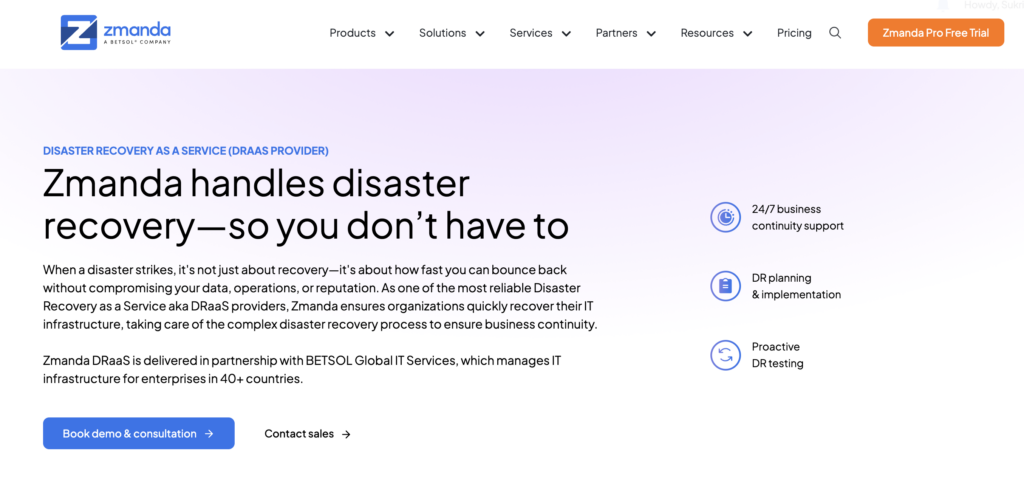
Overview: Zmanda has emerged as one of the prominent DRaaS providers, delivering enterprise-level recovery solutions that are both efficient and user-friendly. Leveraging its established backup technology, Zmanda DRaaS is delivered in partnership with BETSOL Global IT Services for a seamless disaster recovery experience tailored to diverse business needs.
Key Strengths:
- Rapid Recovery Objectives: Zmanda emphasizes swift Recovery Time Objectives (RTO) and Recovery Point Objectives (RPO), aiming for minimal downtime and data loss.
- Continuous Data Protection: The service incorporates continuous data protection mechanisms, ensuring that critical systems and data are consistently backed up and readily available for recovery.
- Transparent Pricing: Zmanda offers a flat-fee pricing model without hidden charges, making disaster recovery accessible and cost-effective for organizations of varying sizes.
- Automated Failover and Failback: The platform supports automated failover and failback processes, reducing manual intervention and streamlining recovery operations.
- Regular Testing and Drills: Zmanda facilitates routine testing and recovery drills to ensure the disaster recovery plan remains effective and aligned with organizational objectives, supporting integrated business continuity across the enterprise. full recovery dr plan
- Robust Security Measures: With end-to-end AES-256 encryption and compliance with standards such as PCI DSS, GDPR, and HIPAA, Zmanda ensures data security and regulatory adherence.
Considerations:
- More focused on mid-market enterprises, potentially less tailored for very small businesses with minimal infrastructure
- Requires initial assessment period for optimal configuration, which may extend implementation timeline compared to pure self-service options
- While multi-environment support is excellent, organizations with highly specialized legacy systems may need additional configuration
- Professional services engagement recommended for complex environments to maximize recovery capabilities
Ideal For: Mid-market enterprises seeking a reliable and straightforward disaster recovery solution without the need for specialized in-house DR expertise.
2. Microsoft

Overview: Microsoft Azure’s Azure Site Recovery (ASR) is another prominent service provider offering a comprehensive DRaaS solution that utilizes Azure’s global infrastructure to provide business continuity. It supports both native disaster recovery for Azure-hosted workloads and hybrid recovery for on-premises environments, integrating seamlessly with other Microsoft products, including unified communications platforms.
Key Strengths:
- Integration with Azure Services: ASR integrates deeply with Azure services, facilitating seamless recovery workflows with Microsoft products like Active Directory, SQL Server, and SharePoint.
- Global Reach: With over 60 Azure regions, ASR offers exceptional geographic flexibility for recovery sites, aiding compliance with data residency requirements.
- Broad Replication Support: ASR supports replication across diverse environments, including Hyper-V, VMware, physical servers, and native Azure VMs.
- User-Friendly Interface: The intuitive Azure portal provides strong self-service configuration and testing capabilities.
- Automated Recovery Plans: ASR offers automated recovery plan orchestration with sequencing capabilities for complex application dependencies.
- Security and Compliance: Regular compliance and security updates leverage Microsoft’s enterprise security framework and certifications.
- Cost-Effective Storage: ASR provides cost-effective storage options, including lower-cost Azure Blob Storage for infrequently accessed recovery data.
Considerations:
- Cost Efficiency: ASR is most cost-effective when recovering to Azure environments; maintaining hybrid configurations may incur higher costs.
- Networking Complexity: Complex networking configurations may require significant expertise to configure and test properly.
- Azure Expertise Required: Optimizing performance and managing costs effectively may require substantial Azure expertise.
- Learning Curve: While documentation is extensive, the depth of options can create a steeper learning curve for teams without Azure experience.
Ideal For: Organizations already invested in the Microsoft ecosystem looking to leverage existing Azure skills and infrastructure for disaster recovery.
3. IBM
Overview: IBM’s enterprise-focused DRaaS solution combines decades of disaster recovery expertise with modern cloud environment infrastructure, creating a solution designed for complex enterprise environments. As a service provider, IBM’s offering stands out for its comprehensive consultative approach and ability to support specialized infrastructure alongside standard virtualized workloads. and ability to support specialized infrastructure alongside standard virtualized workloads.
Key Strengths:
- Tiered Service Offerings: IBM offers tiered service offerings ranging from self-managed to fully-managed recovery, allowing organizations to select the appropriate level of support based on internal capabilities.
- Legacy System Support: IBM provides exceptional support for legacy systems, mainframe environments, and AIX/Power systems that many cloud-native providers cannot accommodate.
- Global Presence: With recovery data centers across six continents, IBM offers extensive geographic flexibility.
- Consultative Approach: IBM’s consulting team performs in-depth business impact analysis and recovery planning services, leveraging decades of collective disaster recovery experience.
- Sophisticated Orchestration: IBM provides sophisticated orchestration for complex, interdependent application recovery with detailed dependency mapping.
- Comprehensive Testing: IBM offers comprehensive testing regimens, including full-scale simulations and regular validation exercises.
- Enterprise-Grade Security: IBM’s enterprise-grade security architecture includes ISO 27001, SOC2, and industry-specific certifications, supporting regulated industries.
- Dedicated Support: IBM provides 24/7 recovery support with dedicated teams familiar with specific environments and recovery requirements.
Considerations:
- Premium Pricing: IBM’s premium pricing structure positions this solution primarily for large enterprises.
- Implementation Time: Implementation typically involves professional services engagement, extending time-to-value.
- Contract Flexibility: Service contracts tend to be less flexible than those of newer cloud-native providers.
- Management Interface: While comprehensive, the management interface lacks some of the intuitive design of newer platforms.
Ideal For: Large enterprises with complex or heterogeneous environments requiring specialized expertise and comprehensive managed disaster recovery services.
4. Acronis

Overview: Acronis Cyber Disaster Recovery stands out by integrating cyber protection directly into its recovery as a service platform. Unlike traditional DRaaS providers that focus solely on infrastructure failures, Acronis prioritizes cyber threats—ransomware, malware, and data breaches—making security a core part of disaster recovery. This approach combines cloud backup, disaster recovery, and active protection within a unified, AI-driven solution.
Key Strengths
- Integrated Cyber Protection: Integrated Cyber Protection: AI-powered anti-malware, ransomware defense, and vulnerability assessments actively safeguard critical data and backup information before recovery
- Near-Zero RPO & Rapid RTO: Continuous monitoring and full-image recovery help achieve minimal data loss and fast recovery times.
- Immutable Backup Storage: Prevents tampering, even from compromised admin credentials, protecting against human error.
- Automated Failover & Testing: On-demand virtualization and non-disruptive testing ensure recovery readiness.
- Unified Management Console: Provides centralized visibility across backup, security, and recovery operations.
- Hybrid Cloud Architecture: Supports physical, virtual, on-prem, and cloud environments with a broad compatibility range.
- Flexible Recovery Options: Includes file-level, bare-metal, and full VM recovery.
- Cost-Effective Subscription Model: Predictable per-workload pricing, ideal for Managed Service Providers (MSPs).
Considerations
- Enterprise-Scale Orchestration: Lacks advanced application dependency mapping seen in high-end DR solutions.
- Limited Customization: Acronis follows a standardized recovery model, reducing flexibility for complex environments.
- Platform Focus: Strongest on Windows and VMware; support for alternative hypervisors is less extensive.
- Recovery Site Options: More limited compared to hyperscale cloud providers like AWS or Azure.
Ideal For: Organizations prioritizing cybersecurity as part of disaster recovery, particularly those vulnerable to ransomware attacks. Well-suited for MSPs and SMBs needing an all-in-one DRaaS platform.
5. Zerto
Overview: Since its acquisition by Hewlett Packard Enterprise (HPE), Zerto has continued to lead in continuous data protection (CDP). Its journal-based architecture enables recovery at any point in time, offering near-instant failover with minimal data loss. Designed for enterprises with a low tolerance for downtime, Zerto’s multi-cloud mobility and hypervisor-level integration make it one of the most advanced recovery as a service solutions available.
Key Strengths
- Industry-Leading RPOs & RTOs: Continuous data protection achieves second-level RPOs and sub-minute RTOs.
- Journal-Based Recovery: Enables rollback to precise moments before a cyberattack or failure.
- Cyber Resilience Vault: Air-gapped, immutable data storage enhances ransomware protection.
- Application-Aware Replication: Maintains consistency across multi-VM workloads and databases.
- Advanced Orchestration & Failover Automation: Simplifies disaster recovery processes, reducing downtime.
- Multi-Cloud & Hybrid Mobility: Seamlessly replicates workloads across on-premises, private, and public cloud environments.
- Non-Disruptive Testing: Enables frequent recovery validation without impacting production systems.
- Strong Hypervisor-Level Integration: Minimizes performance overhead and optimizes resource usage.
Considerations
- Premium Pricing: Advanced continuous data protection features come at a higher cost, making it more suitable for enterprises.
- Infrastructure Requirements: CDP-based replication is resource-intensive and requires proper infrastructure planning.
- Post-Acquisition Evolution: Some roadmap uncertainties following the HPE acquisition.
- Physical Server Protection: Primarily designed for virtualized environments, with less emphasis on physical workloads.
Ideal For: Enterprises with mission-critical applications that demand near-zero data loss, particularly in industries like finance, healthcare, and e-commerce. Perfect for organizations seeking robust ransomware protection and seamless multi-cloud recovery.
6. Sungard AS Recovery Services
Overview: With over four decades of disaster recovery experience, Sungard AS is a trusted leader in business continuity among all DRaaS providers. Their DRaaS solutions leverage this deep expertise while incorporating modern cloud capabilities. Sungard AS offers a comprehensive recovery approach, spanning traditional and cloud-native systems, with a strong focus on regulated industries requiring stringent compliance.
Key Strengths
- Tiered RTO SLAs: Offers recovery time objectives ranging from minutes to eight hours, backed by financial guarantees.
- Cyber Resilience & Security: Features air-gapped, immutable backups, encryption, identity management, and clean-room recovery environments for cyberattack mitigation.
- Comprehensive Testing & Automation: DRVerify Automated Testing and Recovery Execution System (RES) streamline validation and execution.
- Diverse Platform Support: Protects x86 servers, UNIX (AIX, Solaris, HP-UX), IBM iSeries, zSeries mainframes, and hybrid cloud environments.
- Regulatory Expertise: Proven track record in finance, healthcare, and government sectors with strong compliance frameworks.
- Full-Service Business Continuity: Consulting services help organizations develop end-to-end resilience strategies.
- Geographically Distributed Recovery Sites: Multi-site redundancy enhances disaster tolerance.
Considerations
- Premium Pricing: Costs are higher compared to cloud-native providers, reflecting the white-glove service model.
- Implementation Complexity: Fully managed service requires structured deployment, leading to longer setup times.
- Evolving Support Quality: Customer feedback indicates occasional inconsistencies in post-sales support.
Ideal For: Organizations in highly regulated industries, those with complex hybrid IT environments, and enterprises seeking a fully managed, high-reliability DRaaS solution.
7. Recovery Point

Overview: Recovery Point differentiates itself with a boutique, high-touch DRaaS approach tailored for complex IT and compliance-driven environments. Unlike standardized DR solutions, Recovery Point provides customized recovery strategies, particularly for enterprises with legacy systems and intricate regulatory needs.
Key Strengths
- Personalized Service Model: Dedicated technical account managers provide hands-on guidance.
- Regulatory & Security Expertise: Extensive compliance support for HIPAA, PCI, GDPR, and FedRAMP.
- Broad Workload Support: Covers mainframes, IBM Power Systems, x86, and cloud-native applications.
- Cyber Resilience Measures: Includes air-gapped and immutable backups for ransomware protection.
- Flexible RTO/RPO Alignment: Customizable SLAs tailored to business needs.
- Comprehensive Testing & Validation: Offers remote, on-demand, and full-scale DR testing.
- Onshore, High-Quality Support: 100% North America-based customer support with strong industry recognition.
Considerations
- Limited Self-Service Capabilities: Prioritizes managed services over automated, user-driven recovery.
- Smaller Geographic Footprint: Fewer data centers than hyperscale providers, though strategic partnerships extend coverage.
- High Minimum Engagement: Best suited for mid-to-large enterprises rather than SMBs.
Ideal For: Organizations with stringent compliance requirements, legacy-modern hybrid infrastructures, or those valuing a consultative, hands-on DRaaS approach.
8. iland
Overview: iland specializes in cloud-based disaster recovery with a focus on VMware environments. Unlike hyperscale cloud providers, iland concentrates on infrastructure services, including disaster recovery, backup, and cloud hosting. This focus enables deep expertise in migration and recovery workflows while simplifying management.
Key Strengths
- Optimized Cloud Infrastructure: Purpose-built for disaster recovery, ensuring high performance.
- Fast RTO/RPO: Achieves sub-15-minute recovery objectives using Veeam and Zerto.
- Security & Compliance: Offers secure, isolated virtual data centers, encryption, SSL VPNs, and compliance with SOC 2, HIPAA, ISO 27001, and GDPR.
- Transparent Pricing: Consumption-based model with predictable costs.
- Comprehensive Testing: Automated, non-disruptive recovery testing at no extra cost.
- VMware Expertise: Deep integration with VMware and vCloud Director.
- Dedicated Recovery Support: 24/7 availability with VMware-certified experts.
Considerations
- VMware-Centric: Limited support for non-VMware environments.
- Physical Server Limitations: Not as robust as providers with broader platform coverage.
- Standardized Approach: Fewer self-service customization options.
Ideal For: Organizations heavily invested in VMware seeking a straightforward, high-performance disaster recovery solution with strong compliance support.
9. TierPoint
Overview: TierPoint’s disaster recovery offerings include hybrid recovery as a service solutions leveraging cloud computing across colocation, private cloud, and public cloud environment. With 40+ data centers across 20 U.S. markets, it provides strong regional recovery capabilities for businesses needing in-country solutions.
Key Strengths
- Hybrid Recovery Solutions: Supports colocation, private cloud, and public cloud failover.
- Extensive U.S. Coverage: 40+ data centers ensure strong geographic redundancy.
- Customizable RTO/RPO SLAs: Financially backed recovery guarantees with near-instant failover.
- Security & Compliance: Meets HIPAA, PCI DSS, and SOC certifications.
- Flexible Service Models: Ranges from self-managed to fully managed DR.
- Cloud-to-Cloud Recovery: Supports private, multitenant, and public cloud replication.
Considerations
- U.S.-Centric Focus: Limited international recovery capabilities.
- Customization Complexity: Requires more configuration compared to standardized providers.
- Varied Management Interfaces: Service experience may differ across products.
Ideal For: Organizations needing regional U.S.-based recovery with hybrid infrastructure spanning physical and virtual environments.
10. Expedient

Overview: Expedient differentiates itself with its “Push Button DR” platform, combining cloud-based disaster recovery with on-premises appliances. This dual approach offers both local recovery capabilities and cloud failover, simplifying disaster recovery while maintaining control.
Key Strengths
- Push Button DR: Simplifies failover activation with an intuitive interface for quick recovery.
- On-Premises Appliance Option: Enables local recovery with cloud-like management.
- Fast Recovery: Demonstrated RTO as low as 8 minutes.
- Network Resilience: SD-WAN integration maintains connectivity during failover.
- Compliance & Security: Meets HIPAA, PCI DSS, SOC 1/2/3 standards with strong security measures.
- Dedicated Infrastructure: Non-shared recovery environments for critical workloads.
- Unlimited Testing: Self-service and assisted recovery tests without disrupting production.
Considerations
- Regional Focus: Data centers concentrated in Eastern and Central U.S.
- Limited Public Cloud Integration: Less seamless for AWS/Azure-native workloads.
- Higher Pricing: Reflects premium features and managed service model.
Ideal For: This DRaaS Provider is for mid-market organizations prioritizing easy disaster recovery activation with flexible deployment options, particularly those in Eastern and Central U.S. regions.
Comparative Analysis of Top DRaaS Providers
When evaluating disaster recovery service providers, providers, organizations need to consider how each solution aligns with their specific recovery requirements, technical environment, and budget constraints. The following comparison table highlights key differences across the top providers to facilitate more informed decision-making:
| Provider | RTO | RPO | Hybrid-Environment Support | Implementation Complexity | Storage Integration | Automated Testing | Air-Gap Support | Pricing Model | Compliance Support |
| Zmanda | < 1 hour | Fast | Excellent (physical, virtual, cloud) | Low-Medium | Connect to any storage (on-prem, private cloud, S3-compatible) | Automated, non-disruptive | Comprehensive; purposely designed for air-gapped environments | Pay-as-you-go | HIPAA, GDPR with full/full+ options for air-gapped deployment |
| Microsoft Azure | Minutes to Seconds | Seconds to Minutes | Good (Microsoft-centric) | Medium | Azure storage focus with resilience options | Self-service | Not specifically designed for air-gapped environments | Instance-based, Usage | HIPAA, ISO 27001, SOC 1/2/3, GDPR compliance |
| IBM | 6 Hours – 72 Hours | 15 Minutes – 24 Hours | Excellent (includes legacy) | High | Multiple storage considerations for recovery | Comprehensive | Supports resilience planning; no specific air-gap mention | Pay-as-you-go | Comprehensive compliance framework including HIPAA, GDPR, PCI-DSS, and ISO certifications |
| Acronis | Minutes | Near-Zero | Good (emphasis on Windows) | Low | Proprietary storage and protection | Automated with verification | Specialized solution for air-gapped networks | Quote-based | Enhanced protection for regulated industries; HIPAA and GDPR compliant |
| Zerto | Minutes | Seconds | Good (virtualization focus) | Medium | Leveraging HPE Alletra Storage MP | Automated orchestration | True physical and logical air gaps using Zerto Cyber Resilience Vault | Potentially Higher | Supports industry-leading hardware from HPE with compliance certifications |
| Sungard AS (11:11 Systems) | 5 Minutes – 4 Hours | Near Real-Time | Excellent (physical to cloud) | High | Supports VMware workloads and Veeam integration | Automated testing in isolated clean rooms | Air-gapped immutable backups with RBAC and MFA | Consumption-based | Comprehensive compliance certifications including HIPAA, GDPR, PCI-DSS, SOC 1/2/3 |
| Recovery Point | Minutes to Hours | Medium-High | No specific information found | Customized program | No detailed storage info | No specific details available | No specific details available | Contract-based | No specific details available |
Strengths and Limitations Assessment in DRaaS Providers
1. For Organizations Prioritizing Simplicity and Cost-Effectiveness
Best Options: Zmanda DRaaS, Acronis, and iland stand out for their straightforward implementation and management. Zmanda particularly excels by combining enterprise capabilities with simplified management and predictable pricing.
Limitation to Consider: Simplified solutions sometimes offer less customization for highly specialized environments.
2. For Organizations with Complex, Heterogeneous Environments
Best Options: IBM, Sungard AS, and Recovery Point offer the strongest capabilities for environments spanning legacy systems, specialized applications, and modern infrastructure.
Limitation to Consider: These comprehensive solutions typically come with higher price points and implementation complexity.
3. For Organizations Requiring Minimal Data Loss
Best Options: Zerto leads with its seconds-level RPO through continuous data protection, while Zmanda and Azure Site Recovery offer strong near-zero RPO options for critical workloads.
Limitation to Consider: Achieving near-zero RPO typically requires more bandwidth and resources for continuous replication.
4. For Organizations with Strict Compliance Requirements
Best Options: Recovery Point, IBM, and Zmanda provide exceptional compliance capabilities with comprehensive documentation and regulatory support.
Limitation to Consider: Compliance-focused solutions may include additional controls that add some management overhead.
5. For Organizations Leveraging Multi-Cloud Strategies
Best Options: Zmanda DRaaS offers excellent multi-cloud flexibility, while TierPoint and iland provide solid options for specific infrastructure combinations.
Limitation to Consider: Multi-cloud recovery requires careful planning for consistent performance across environments.
This analysis demonstrates that while each provider has distinctive strengths, Zmanda DRaaS consistently delivers across the most critical evaluation criteria while maintaining the simplicity and cost-effectiveness that organizations increasingly demand from their disaster recovery solutions.
Conclusion
As cyber threats and natural disasters continue to evolve, and business dependency on digital infrastructure grows, having a tested reliable disaster recovery capability is no longer optional—it’s essential for organizational resilience. Choosing the right DRaaS provider and solution not only protects against data loss and system downtime but also provides peace of mind that your organization can weather unexpected disruptions without significant business impact.
About Zmanda DRaaS
Zmanda’s position as the leading DRaaS provider stems from its unique approach to disaster recovery that addresses the fundamental challenges many organizations face in implementing effective DR solutions. Here’s a deeper look at what distinguishes Zmanda DRaaS in this competitive landscape:
Comprehensive Six-Step Recovery Methodology
Zmanda DRaaS follows a methodical approach to disaster recovery that ensures complete protection and reliable recovery:
- Initial Assessment & Customization: Rather than offering one-size-fits-all solutions, Zmanda begins with a tailored assessment of your infrastructure to establish clear recovery objectives. This foundational step ensures that your disaster recovery plan aligns perfectly with your business requirements.
- Continuous Backup & Replication: Zmanda implements real-time backup and secure data replication to protect your data offsite, ensuring it’s always ready for rapid recovery when needed. This continuous protection minimizes data loss during recovery scenarios.
- Proactive Monitoring & Alerts: The 24/7 monitoring system provides instant alerts for disruptions, allowing for immediate response before problems escalate. This proactive approach often prevents minor issues from becoming full disaster scenarios.
- Automated Failover & Failback: When disasters occur, Zmanda’s system automatically redirects workloads to the cloud or secondary sites, maintaining operational continuity. When the primary site becomes available again, the system manages the transition back to normal operations with minimal disruption.
- Regular Testing & Recovery Drills: Unlike many DRaaS solutions where testing is an afterthought, Zmanda incorporates routine recovery drills to ensure your disaster recovery plan remains viable as your environment evolves. These tests validate that your recovery time and recovery point objectives can be consistently met.
- Fast, Secure Restore: When recovery is needed, Zmanda’s secure data restore process brings applications and data back swiftly, minimizing downtime while ensuring compliance with industry standards and regulations.
What to Do Next
If you’re evaluating disaster recovery options for your organization, we recommend these practical next steps:
- Schedule a personalized Zmanda DRaaS demonstration to see how the solution addresses your specific recovery requirements
- Book a consultation with a disaster recovery expert who can assess your current environment and recommend the optimal protection strategy
- Request a customized recovery assessment to identify potential gaps in your existing disaster recovery capabilities
To get started with any of these options, book a free consultation with our disaster recovery specialists today. Our team will help you develop a clear understanding of how Zmanda DRaaS can strengthen your organization’s resilience against disruptions of all kinds.