Imagine this: It’s a holiday weekend, and your production environment fails catastrophically.
Your team is scrambling, knowing that every passing minute costs your organization $$$$ in lost productivity and revenue, while the IT team is rebuilding the production environment from scratch.
This scenario isn’t hypothetical – it’s a reality that IT directors and system administrators face more frequently than they’d like to admit. In fact, Splunk says 40% of enterprises experienced unplanned system downtime in the past year, with recovery times averaging 4+ hours using traditional restore methods.
That’s potentially millions in losses that could have been prevented with Bare Metal Restore capabilities.

While most IT leaders understand the importance of data backup, many overlook the crucial difference between having your data backed up and being able to restore entire systems quickly. Traditional file-level backups might protect your data, but they can’t help you rebuild a server from the ground up—and that’s where bare metal restore becomes your organization’s lifeline.
This comprehensive guide explores bare metal restore technology, breaking down its critical role in modern disaster recovery strategies, a cost-benefit analysis, and why it’s becoming an essential tool in every IT leader’s business continuity arsenal.
What is Bare Metal Recovery (BMR)?
Bare metal recovery or bare metal restore refers to the capability that enables IT teams to perform bare metal recovery operations, restoring a system from scratch (“bare metal”) to its previous state, including:
- The operating system and all its configurations
- System state and security settings
- Installed applications and their settings
- User data and file structures
- Network configurations and system preferences
- Custom configurations and registry settings
Think of it as creating a complete system image through bare metal backup – not just the data, but every single component that makes your server uniquely yours.
Why “Bare Metal”?
The term “bare metal” comes from the ability to restore compromised systems to completely new, unconfigured hardware – literally starting with nothing but the bare metal components and rebuilding the entire system disk from scratch. This capability is crucial because:
- Hardware failures often require replacement with newer, different models that may need updated hardware drivers and system configurations
- System migrations need flexibility in target hardware
- Organizations need the ability to recover to dissimilar hardware in disaster scenarios
- Virtual-to-physical (V2P) or physical-to-virtual (P2V) conversions are increasingly common requirements
But, why not just try the traditional recovery method? Why go through the trouble of bare metal recovery?
Understanding the True Cost of Traditional Recovery vs. Bare Metal Restore
Traditional backup solutions focus primarily on file-level recovery, like saving the furniture in your house but not the house itself. When disaster strikes, you need more than just your data – you need the entire infrastructure that makes that data useful. At $5,600 per minute in downtime costs, understanding this difference becomes crucial for your bottom line.
Let’s break down the real-world impact through a scenario every IT director dreads: An e-commerce company’s primary database server experiences catastrophic failure during peak shopping season.
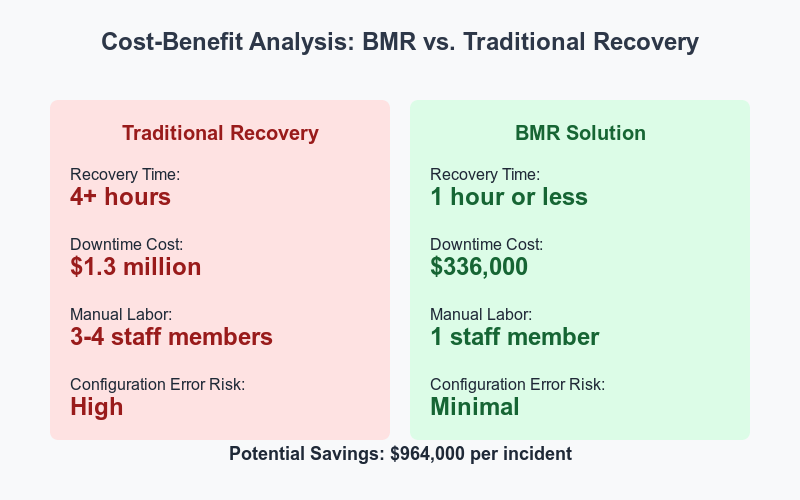
Traditional Recovery Method (4+ hours, ~$1.3M in downtime costs):
- Source new hardware (30-45 minutes)
- Install the operating system (45-60 minutes)
- Configure system settings (30-45 minutes)
- Reinstall all applications (90-120 minutes)
- Restore data from backups (60-90 minutes)
- Reconfigure all applications (30-45 minutes)
- Test and verify everything works (30-45 minutes)
Bare Metal Recovery Method (1 hour or less, ~$336K in downtime costs):
- Source new hardware (30 minutes)
- Deploy system image through bare metal recovery (20-25 minutes)
- Verify system functionality (5-10 minutes)
With BMR, you eliminate manual OS installation, automate application restoration, preserve all system configurations, and streamline the entire recovery workflow.

For enterprise environments managing comprehensive disaster recovery programs, this distinction becomes particularly crucial when:
- Managing complex application stacks with interdependencies
- Operating in regulated industries with strict compliance requirements
- Supporting remote or branch office recovery needs
- Meeting aggressive RTO/RPO requirements
- Maintaining business continuity during peak periods
- Operating with limited IT staff resources
- Supporting hybrid infrastructure environments
- Dealing with ransomware recovery scenarios
This stark contrast in recovery times and costs demonstrates why more organizations are moving away from traditional backup methods and implementing comprehensive BMR solutions. When you consider that the average enterprise faces 2-3 major recovery scenarios annually, the ROI becomes even more compelling.
Key Benefits of Modern Bare Metal Recovery Solutions
Modern bare metal recovery solutions deliver strategic advantages that extend far beyond simple backup and restore capabilities. Bare metal recovery provides:
1. Unmatched Recovery Flexibility
Think of bare metal restore as your IT department’s Swiss Army knife for system recovery. Whether you’re dealing with hardware failures, performing system upgrades, or executing a cloud migration strategy, modern bare metal recovery solutions offer unprecedented flexibility:
“We used to maintain spare hardware identical to our production systems – a massive capital expense,” shares Michael Roberts, CTO of a mid-sized healthcare provider. “With our current BMR solution, we can restore to virtually any hardware platform, including systems with different redundant array configurations, saving us nearly $200,000 in redundant equipment costs.”
This system image flexibility extends across your entire infrastructure, allowing you to deploy the same across different environments:
- Restore physical servers to different hardware models
- Convert physical systems to virtual server environments
- Migrate virtual machines back to physical hardware
- Move workloads between different hypervisors
- Enable cloud mobility without vendor lock-in
2. Comprehensive System Protection
Modern BMR solutions take a holistic approach to system protection through comprehensive image-based backups that capture entire system configurations rather than individual files. Instead of managing multiple-point solutions, you get:
Application-Aware Backup
- Automated consistency checks for databases
- Transaction log integration
- Application state preservation
- Configuration retention
- Recovery of locked or encrypted files during active use
Infrastructure-Level Protection
- Operating system backup
- System state preservation
- Driver and hardware configurations
- Installation language and regional settings preservation
- Network settings maintenance
This comprehensive system image approach means you’re not just protecting data – you’re preserving your entire operational environment.
3. Cost-Effective Implementation
Here’s where the business case for BMR becomes compelling. Consider these efficiency gains:
Recovery Time Optimization:
- Traditional Recovery: 4-6 hours average
- BMR Recovery: 45-60 minutes average
- Cost Savings: $1.2M per major incident (at $5,600/minute downtime)
Resource Utilization:
- 60% reduction in storage costs through intelligent deduplication
- 75% decrease in recovery-related IT staff hours
- 80% lower training and maintenance costs compared to HA solutions
- Eliminates dependency on basic Windows Server Backup utilities that lack enterprise-grade features
Risk Mitigation Benefits:
- 90% reduction in configuration errors during recovery through automated backup recovery point validation
- Automated data testing and validation
- Simplified compliance reporting
- Enhanced audit readiness
4. The Human Factor
Often overlooked but crucial: bare metal restore solutions significantly reduce the stress on IT teams during critical recovery scenarios. Instead of marathon recovery sessions and complex manual processes, your team can:
- Execute recoveries with confidence
- Follow standardized procedures
- Reduce human error risk
- Maintain work-life balance during crises
Future-Proofing Your Infrastructure
Perhaps most importantly, modern BMR solutions help future-proof your infrastructure by:
- Supporting emerging technologies and platforms
- Enabling hybrid-cloud strategies
- Facilitating digital transformation initiatives
- Providing scalability for growth
This adaptability ensures your investment continues to deliver value as your organization evolves.
Implementing Bare Metal Restore in Your Organization

Transitioning from understanding the robust capabilities of modern BMR solutions to executing an effective implementation in your organization is a critical step towards safeguarding your operations against unexpected disruptions. The integration of bare metal recovery should be viewed not just as a technical upgrade but as a strategic enhancement to your overall business resilience. Here’s how to ensure that the transition is both smooth and effective:
- Identify Critical Systems Requiring Rapid Recovery: Begin by conducting a thorough audit of your IT infrastructure to pinpoint systems that are crucial for your daily operations. These might include servers hosting your ERP systems, customer databases, domain controller services or proprietary applications. The goal is to prioritize recovery for systems that would cause the most significant business impact if they were down.
- Establish RTO/RPO Requirements: Recovery Time Objective (RTO) and Recovery Point Objective (RPO) are not just metrics but are foundational to crafting a recovery strategy that aligns with your business needs, ensuring each backup recovery point meets your specific data protection requirements. Determine how quickly you need systems to be back online (RTO) and how much data you can afford to lose (RPO). These benchmarks will guide the configuration of your BMR solutions, ensuring they meet the specific continuity requirements of your enterprise.
- Test Recovery Procedures Regularly: The efficacy of any BMR plan is only as reliable as its last test. Regular testing under varied scenarios helps identify potential failures and provides your IT team with the confidence to handle real-world disruptions. These drills should simulate actual disaster conditions to ensure that every aspect of the BMR process—from initiation to system restoration and validation—is effective and efficient.
- Document Recovery Processes: Comprehensive documentation is crucial, especially when quick decisions are needed during a disaster. Detailed recovery procedures, escalation paths, and contact lists should be readily accessible. This documentation should be regularly updated to reflect any changes in your IT environment or BMR technology.
- Train IT Staff on BMR Procedures: Training goes beyond mere familiarity with the recovery steps. It involves empowering your IT staff with deep insights into the architecture of BMR solutions, understanding their role in rapid recovery, and ensuring they are proficient in troubleshooting unexpected issues during the recovery process.
Looking for the Perfect Bare Metal Restore Solution
Bare metal recovery solutions can save organizations nearly $1 million per recovery incident while reducing recovery times by 75%. But, the value of BMR extends beyond pure cost savings:
- Your IT teams can focus on innovation rather than recovery procedures
- Your business maintains compliance with increasingly strict regulatory requirements
- Your organization builds resilience against emerging threats like ransomware
- Your infrastructure becomes more adaptable to change and growth
As you evaluate your organization’s disaster recovery capabilities and recovery readiness, ask yourself:
- Can your current solution restore entire systems in under an hour?
- Are you confident in your ability to recover to different hardware?
- Does your recovery process scale across your entire infrastructure?
- Have you tested your recovery procedures recently?
If you answered “no” to any of these questions, your organization may be exposed to unnecessary risk and cost.
Introducing Zmanda Pro’s Advanced Bare Metal Restore Capabilities
When considering a bare metal restore solution, it’s essential to explore options that not only meet but exceed these criteria. Zmanda Pro’s bare metal recovery capabilities are designed to provide not just rapid and reliable recovery but also a seamless, flexible adaptation to your evolving business landscape:
- Fast, Flexible Recovery: Zmanda Pro enables organizations to perform full system recoveries in less than an hour. This dramatically cuts down the typical recovery times and ensures that your business operations are swiftly restored with minimal downtime.
- Disk-Image Backups: Creates complete bare metal backup image that captures everything – OS, applications, configurations, and data, ensuring a comprehensive and exact restoration of your system.
- Universal Restore Capability: Supports physical-to-physical, physical-to-virtual, and virtual-to-physical recoveries, enhancing flexibility and ensuring business continuity across diverse environments.
- Simple Recovery Options: Offers recovery via a simple bootable USB or .iso file, making the restoration process straightforward and user-friendly.
- Cloud and Virtual Support: With VMDK and VHD support, Zmanda Pro seamlessly recovers to and from cloud or virtual instances, ensuring adaptability in hybrid IT landscapes.
- Enhanced Efficiency: Delivers recovery times that are 60% faster than traditional backup methods, minimizing downtime and operational disruption.
- Cost-Effective: Offers a 50% lower total cost of ownership compared to competing enterprise solutions, providing significant cost savings without compromising on quality or capabilities.
Zmanda BMR is priced at just $3/month/workload, making your ROI straightforward in the long run
Organizations should evaluate their current recovery capabilities and consider implementing Zmanda Pro’s BMR solutions to protect critical systems. The investment in Zmanda Pro typically pays for itself many times over during the first serious recovery incident.
Don’t let system recovery be your organization’s Achilles’ heel. Our experts can help you evaluate your current DR strategy and identify where bare metal recovery can deliver the most value for your business. Set up a free backup consultation with one of our experts today.
Ready to protect your organization from costly downtime? Learn more about implementing BMR in your environment and start a free trial today.