Government IT teams operate under a fundamentally different set of constraints than their private-sector counterparts. Federal, state, and local agencies must satisfy compliance frameworks including FISMA, FedRAMP, and agency-specific security controls—and those frameworks increasingly specify requirements for backup isolation that cloud-connected solutions cannot satisfy. Air-gapped backup for government agencies isn’t a preference; in many cases, it’s a compliance mandate.
The challenge is that government IT Directors and procurement officers face this mandate alongside the same resource constraints as any other IT organization: limited staff, aging hardware budgets, and pressure to demonstrate cost efficiency to oversight bodies.
This guide addresses the specific compliance requirements that drive government backup solution decisions, the procurement considerations unique to public sector IT, and how to implement isolated backup without creating an unmanageable operational burden.
Government Backup Requirements by Compliance Framework
| Framework | Applicable Agencies | Key Backup Requirements | Air-Gap Required? |
|---|---|---|---|
| FISMA / NIST 800-53 | All federal agencies | CP-9 system backups, offsite storage, alternate site transfer | Yes, for High-impact systems |
| FedRAMP | Federal agencies using cloud | Data protection, backup frequency, recovery testing | Depends on data classification |
| CJIS Security Policy | Law enforcement, criminal justice | Advanced authentication, media protection, audit controls | Yes, for CJIS data environments |
| ITAR | Defense, aerospace, export-controlled | Data residency, access controls, no foreign person access | Yes (eliminates multi-tenant cloud) |
| HIPAA | Government healthcare agencies | Contingency plan, data backup, disaster recovery | No, but isolation strongly recommended |
Why Government Agencies Require Air-Gapped Backup
The case for air-gapped backup in government environments rests on three pillars: regulatory requirements, threat environment, and data classification obligations. Each independently justifies isolated backup; together, they make it non-negotiable for most agencies handling sensitive data.
FISMA and NIST SP 800-53 Requirements
The Federal Information Security Modernization Act (FISMA) requires agencies to implement information security programs that include contingency planning and data protection controls. NIST SP 800-53, the primary control catalog for FISMA compliance, includes specific controls under the Contingency Planning (CP) family that govern backup operations. CP-9 (System Backup) requires agencies to conduct user-level and system-level information backups at defined frequencies and protect backup information at storage locations—which for many system categorizations means physical isolation from the primary network.
The CP-9(5) enhancement explicitly requires transfer of backup information to an alternate storage site at defined intervals. For systems categorized at the moderate or high impact level under FIPS 199, these controls effectively mandate air-gapped or physically isolated government backup solution architectures when the primary environment handles sensitive federal information.
FedRAMP and the Limits of Cloud Backup Authorization
FedRAMP authorization covers cloud services used by federal agencies, but a cloud backup provider’s FedRAMP authorization does not automatically make cloud backup appropriate for all government use cases. Systems handling Controlled Unclassified Information (CUI) at higher sensitivity levels, systems operated in network-restricted environments, and systems supporting national security functions may not be eligible for FedRAMP-authorized cloud backup regardless of the provider’s status. IT Directors must evaluate the specific data classification and system categorization, not simply the vendor’s compliance posture.
State and Local Government Requirements
State and local government agencies operate under a patchwork of requirements that often mirror federal frameworks while adding state-specific mandates. Many states have adopted NIST-aligned security frameworks as baseline requirements for agency IT systems. Agencies handling law enforcement data (subject to CJIS Security Policy), criminal justice information, or healthcare data (subject to HIPAA) must satisfy those frameworks’ backup requirements, which frequently require physically isolated government backup solution.
Procurement Considerations for Government Air-Gapped Backup
Government procurement adds complexity that private-sector IT Directors don’t face. Purchasing cycles are longer, vendor qualification requirements are more extensive, and budget authority for capital purchases versus operating expenses is often governed by separate approval processes. Selecting the right government backup solution requires navigating these constraints while meeting technical compliance requirements.
Software-Only vs. Appliance Procurement
A critical decision is whether to purchase a proprietary backup appliance (hardware and software bundled from a single vendor) or deploy software-only backup on government-owned or separately sourced hardware. Appliance solutions from vendors like Cohesity and Commvault offer simplified deployment but create vendor lock-in and typically carry price tags that require additional budget justification. Software-only solutions can be deployed on existing government hardware or commodity servers, separating hardware procurement from software acquisition and offering greater flexibility.
For government agencies evaluating procurement options, the total cost comparison between appliance and software-only air-gapped backup typically favors software-only approaches significantly over the 3–5 year periods that align with government budget cycles.
Contract Vehicles and Procurement Pathways
Federal agencies can often procure backup software through existing contract vehicles that simplify the acquisition process. GSA Multiple Award Schedules, agency-specific IDIQ contracts, and cooperative purchasing agreements allow agencies to acquire software without a full competitive procurement process. When evaluating these options, procurement officers should verify that the specific software configuration required—including offline licensing and air-gapped deployment support—is available under the contract vehicle terms, as not all vendors offer their full feature set through schedule pricing.
Offline Licensing for Government Environments
Air-gapped environments require a government backup solution with offline licensing models—solutions that do not require internet connectivity to validate licenses or maintain functionality. Many commercial backup vendors offer software that technically supports air-gapped deployment but requires periodic license validation calls to vendor servers. In truly isolated environments, these calls fail silently and can cause backup operations to degrade or halt. Procurement specifications for government air-gapped backup should explicitly require offline license activation and operation without any mandatory vendor connectivity.
Implementing Air-Gapped Backup Without Operational Complexity
The legitimate concern about air-gapped backup in government environments is operational complexity. Isolated backup systems require manual processes for software updates, a disciplined approach to capacity management, and recovery testing procedures that account for the physical access requirements of isolated storage. These are real challenges — but they’re manageable with the right government backup solution architecture and procedures in place.
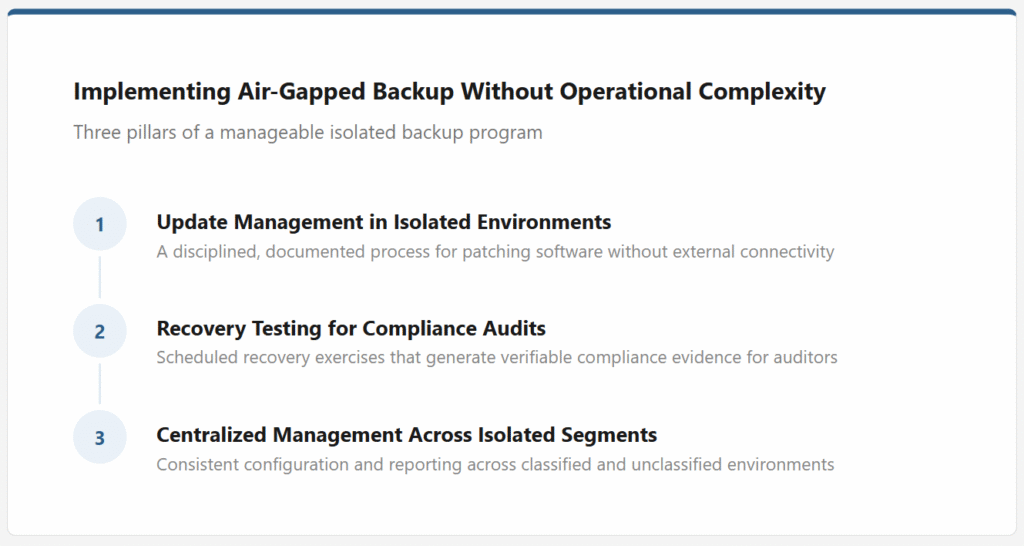
Update Management in Isolated Environments
Software patching in air-gapped environments requires a disciplined process: download updates on a connected system, verify cryptographic integrity of the update package, transfer via approved media to the isolated environment, and apply updates during a maintenance window. This process adds overhead compared to automatic cloud updates, but it also gives IT teams explicit control over what software versions are running in their backup environment—a control that many compliance frameworks require. Documenting this process and making it a scheduled maintenance activity eliminates the ad-hoc burden that makes unmanaged air-gapped environments problematic.
Recovery Testing for Compliance Audits
FISMA and most government compliance frameworks require documented recovery testing at defined intervals. For air-gapped backup, this means scheduling recovery exercises that include the physical access procedures specific to isolated storage—not just verifying backup job completion. Recovery tests should document actual recovery time, the specific procedures followed, and any gaps identified. This documentation becomes compliance evidence during audits and drives ongoing improvements to recovery procedures.
Centralized Management Across Isolated Segments
Agencies with multiple isolated network segments—common in organizations with both classified and unclassified environments—need a government backup solution that can be managed consistently across segments without creating cross-segment connectivity. Software-only backup platforms that deploy separate server instances per segment, with consistent configuration templates and reporting, are better suited to this architecture than appliances designed for single-environment deployment.
Zmanda Pro for Government Air-Gapped Backup
Zmanda Pro’s software-only architecture and offline licensing model make it well-suited for government air-gapped deployments. The solution deploys on standard hardware, supports fully isolated operation without vendor connectivity requirements, and provides the centralized management capabilities that government IT teams need to maintain backup operations across complex, segmented environments. Zmanda also offers dedicated government data protection resources and understands the specific procurement and compliance requirements that public sector organizations face.
Building a Compliant Government Backup Program
Government agencies that approach air-gapped backup as a compliance checkbox rather than an operational capability typically end up with backup systems that satisfy auditors but fail when needed most. The most effective government backup programs treat compliance requirements as the floor, not the ceiling—designing for actual recovery capability while ensuring that every documented control is verifiable and tested.
Start with a clear inventory of which systems require air-gapped backup based on their FIPS 199 categorization and applicable compliance frameworks. Then design backup architecture that meets those requirements with minimal operational overhead—focusing on software-only solutions that reduce hardware complexity, offline licensing that eliminates connectivity dependencies, and recovery procedures that can be executed reliably by your available staff. The goal is a backup program that auditors can verify and IT teams can actually sustain.
To discuss how Zmanda Pro addresses your agency’s specific compliance requirements and procurement constraints, contact our government sales team for a consultation tailored to public sector needs.