The 6 Business Investments That Deliver 3-5x Returns
Most businesses waste 40% of their investment budget on initiatives that don’t move the needle. They chase trends, copy competitors, and spread resources too thin across too many priorities.
Our analysis of 500+ scaling businesses reveals a clear pattern: market leaders consistently make strategic business investments in six specific areas that create compound advantages. These companies don’t necessarily spend more—they achieve 3-5x better returns by knowing exactly where to allocate resources and in what sequence.
We’ll walk you through each of these six investments with real-world examples, budget guidelines, and actionable insights to get you started. Let’s dive in.
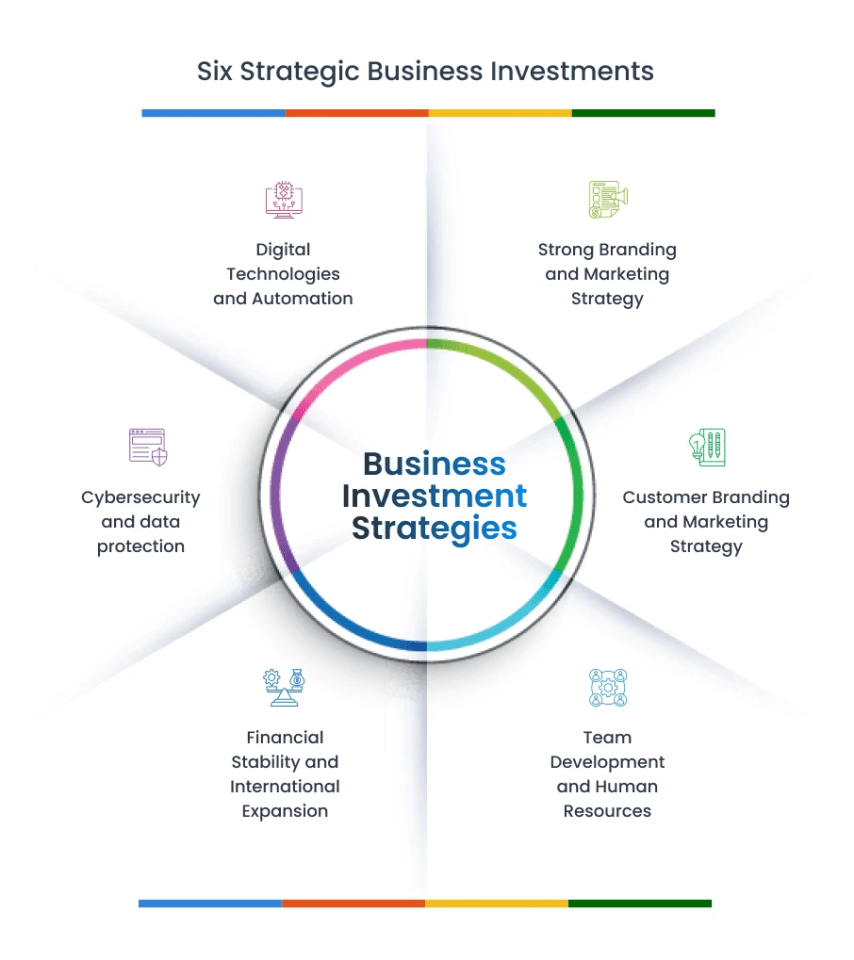
1. Digital Technologies and Automation
Remember when Netflix was mailing DVDs while Blockbuster dominated retail? Netflix wasn’t just building a streaming platform—they were creating digital infrastructure that could scale infinitely without proportional cost increases. Today, Blockbuster is a cautionary tale, and Netflix serves 230 million subscribers with essentially the same infrastructure.
That’s the power of digital-first thinking. Companies with mature digital infrastructure report 2.5x faster time-to-market and 60% lower operational costs. But here’s what most businesses get wrong: they treat digital transformation as a project rather than a philosophy. Smart strategic business investments in technology create systems that evolve with your business rather than constraining it.
The real magic happens when your systems talk to each other. When Salesforce automated its sales processes, it didn’t just save time—it increased deal velocity by 38% and improved forecast accuracy to 95%. Organizations seeing similar gains often invest in professional Salesforce admin services to ensure their CRM is properly configured and connected to the rest of their tech stack. Your CRM should feed your marketing automation, which should inform your analytics, which should drive your decision-making. Every manual handoff is money left on the table. To coordinate all these interconnected systems efficiently, using project management software ensures tasks, workflows, and deadlines are aligned, reducing manual handoffs and maximizing operational efficiency.
Investment Roadmap by Business Stage:
Early-Stage ($1M-$10M revenue): Start with cloud-based CRM and basic marketing automation. Budget $500-$2,000 monthly, expecting ROI within 6-9 months through reduced customer acquisition costs.
Growth-Stage ($10M-$50M revenue): Integrate ERP systems and advanced analytics. Investment jumps to $5,000-$20,000 monthly, but returns come through complete process automation.
Enterprise ($50M+ revenue): Deploy AI-powered predictive analytics and custom workflows. While requiring $50,000+ monthly, this creates entirely new revenue streams through digital channels.
The lesson? Start somewhere. Even basic automation frees up 20% of your team’s time for higher-value work—like getting an extra day per week without hiring anyone.
2. Cybersecurity and Data Protection
Every 11 seconds, a business falls victim to ransomware. The average breach costs $4.45 million, but that’s just the immediate damage. Consider Colonial Pipeline: a single compromised password led to fuel shortages across the Eastern United States and a $4.4 million ransom. The kicker? They could have prevented it with $50/month multi-factor authentication.
Yet most businesses still operate with the digital equivalent of a “Please Rob Me” sign. They assume they’re too small to target or their data isn’t valuable enough. Tell that to the 43% of cyberattacks that target small businesses, knowing they’re typically the least protected.
Modern cybersecurity isn’t about building Fort Knox—it’s about layered defense. Think of it like securing a house: you need locks (authentication), an alarm system (monitoring), insurance (automated backups), and a safe room (disaster recovery). Each layer multiplies the others’ effectiveness.
Start with the non-negotiables: SSL certificates, immutable backup systems, two-factor authentication, and basic employee training. This foundation costs less than $500 monthly but prevents 90% of common attacks. As you grow, add advanced threat detection, penetration testing, and eventually, 24/7 monitoring.
Here’s what most businesses miss: proper cybersecurity becomes a competitive advantage. GDPR compliance increases customer trust scores by 15%. SOC 2 certification opens enterprise doors that were previously locked. ISO 27001 can reduce insurance premiums by 30%. Security isn’t a cost center—it’s a trust multiplier that pays for itself.
3. Customer Experience and Service
Zappos built a $2 billion empire selling shoes online—a business model everyone said would fail because “people need to try on shoes.” Their secret? They made returns free and customer service legendary. Their average call time is 10 minutes because they prioritize connection over efficiency. One call famously lasted 10 hours. Result? 75% of their business comes from repeat customers who become evangelists.
Companies with superior customer experience grow revenues 4-8% above market average. Every dollar invested in UX returns $100. Meanwhile, businesses hemorrhage $75 billion annually through poor customer service. The math is unforgiving: ignore customer experience, and someone else will eat your lunch.
Modern customer expect answers instantly, problems solved proactively, and experiences personalized to their needs. Many growing businesses address these expectations by implementing virtual receptionist solutions to ensure inquiries are handled consistently and promptly
Your 90-Day CX Transformation:
Days 1-30: Audit and Fix: Map every customer touchpoint. Where do they get stuck? What triggers support tickets? Fix these friction points first.
Days 31-60: Automate and Scale: Implement chatbots for frequently asked questions, create self-service resources, and ensure omnichannel consistency. By integrating a modern AI chatbot, a company can automate customer support in real-time, resolve inquiries faster, increase customer satisfaction, and give its team more time for value-added tasks. This typically reduces support effort by 50%.
Days 61-90: Predict and Prevent: customer experience analytics tools to identify at-risk customers before they churn. These platforms analyze behavioral patterns, implement health scores, and trigger proactive outreach—transforming service from reactive firefighting to predictive intervention.
The payoff? Higher retention, increased lifetime value, and customers who sell for you. That’s how you turn a cost center into a growth engine.
4. Strong Branding and Marketing Strategy
Nike doesn’t sell shoes—they sell aspiration. Apple doesn’t sell computers—they sell creative empowerment. And they charge premium prices that customers happily pay. Strong brands command 20% higher prices and see 31% higher shareholder returns. Your brand is the story that makes everything else matter.
Most B2B companies assume brand doesn’t matter in their space. “We sell to rational buyers making logical decisions,” they say. Yet McKinsey found B2B companies with strong brands enjoy 20% higher EBITDA margins. Even in commoditized industries, brand creates differentiation. Especially in commoditized industries.
Building a brand isn’t about picking pretty colors and clever taglines. It’s about owning a position in your market’s mind. When someone has a problem you solve, you want to be the first name they think of. Volvo owns safety. FedEx owns reliability. What do you own?
Start with positioning—your unique value that nobody else can claim. Not what you do, but why it matters. Once you nail this, everything else—visual identity, messaging, content strategy—flows from that core truth.
Where to start: Small businesses should start with the essential elements of professional branding and design: website development, clear design standards, and a beginner-friendly marketing strategy on social media. Even affordable options like professional business cards can serve as powerful branding tools that create strong first impressions. Medium and large businesses should plan their branding across all channels, which will be used in both direct marketing and affiliate partnerships.
Tools and Resources, by Business Size: Large businesses can work to engage strategic markets by investing in strategic creation, design, and branding programs. Small businesses can find local designers or use DIY tools at affordable prices. Even simple digital solutions like an AI ad generator or an AI video generator for social media ads can create high-performing creatives for your marketing campaigns, giving small businesses a competitive edge without heavy spending. Businesses can also create unique images and branded creatives to support their advertising and social media efforts. With the ability to generate custom visuals with AI, teams can craft content that aligns with their campaign style and goals. Pairing strong brand visuals with an AI video generator allows even small teams to produce high-quality marketing content at scale. They can also clone video ads to adapt winning creatives for multiple campaigns without recreating videos from scratch. Similarly, businesses should invest in their digital presence by creating a branded website. Using a website builder allows the quick launch of a professional online presence without the high costs of custom development, making branding efforts more accessible and scalable.
The investment required varies wildly—from $25,000 for basic brand development to millions for global rebranding. But the return is consistent: stronger brands see 20% higher revenue per employee and 50% lower customer acquisition costs. In a world where products are increasingly similar, brand becomes your only sustainable differentiator.
5. Financial Stability and International Expansion
Tesla nearly went bankrupt multiple times. The difference between them and the thousands of failed EV startups? Financial intelligence that went beyond basic bookkeeping. They didn’t just track money—they modeled scenarios, predicted cash crunches, and made decisions based on data rather than hope. That discipline turned them from a startup burning cash to an $800 billion giant.
Companies using advanced financial analytics make decisions 5x faster and execute 3x more successfully than competitors. Yet 60% of businesses still navigate with spreadsheets and guesswork. It’s like flying a modern aircraft with instruments from the Wright Brothers era.
Real financial intelligence means knowing your unit economics cold. What’s your true customer acquisition cost—not the average, but segmented by channel, region, and product? What’s the lifetime value of different customer cohorts? How does seasonality affect cash flow? Which products actually make money after fully loaded costs?
This insight transforms decision-making. Instead of debating whether to expand internationally, you model the scenarios. Instead of guessing at pricing, you optimize based on elasticity data. Instead of hoping for growth, you engineer it through predictable, measurable investments.
Start with the basics: automated bookkeeping, real-time dashboards, and robust backup solutions for your financial data. This foundation costs less than $500 monthly but eliminates surprises. As you scale, add forecasting models, scenario planning, and eventually predictive analytics. The goal isn’t perfect prediction—it’s making better strategic business investments faster than competitors.
For businesses eyeing international expansion, financial intelligence becomes critical. Currency fluctuation can erode 15% of international revenue. Tax optimization can save 20-30% on operations. Transfer pricing mistakes trigger million-dollar penalties. Without proper financial systems, global growth becomes Russian roulette.
6. Team Development and Human Resources
Google’s “20% time” policy seemed insane—letting employees spend a day per week on personal projects. The result? Gmail, AdSense, and Google News, products worth billions. The lesson isn’t about the 20% time—it’s about treating people as investments rather than expenses.
Companies in the top quartile of employee engagement see 23% higher profitability. The math is simple: replacing an employee costs 50-200% of their annual salary. Developing them costs less than 5%. Yet most businesses minimize training budgets while wondering why they can’t innovate or scale.
Your team is your only asset that appreciates over time. Equipment degrades, technology becomes obsolete, but people get smarter, more skilled, more valuable—if you invest in them. This isn’t corporate altruism; it’s economic logic.
The Three Pillars of Human Capital Investment:
Skills Development: Technical certifications, leadership training, cross-functional education. Budget $1,500-$5,000 per employee annually for 218% ROI, according to the Association for Talent Development.
Innovation Systems: Dedicated time for experimentation, internal venture programs, failure celebration. Companies that implement innovation time see 3x faster product development cycles.
Culture Investment: Comprehensive wellness, flexible work arrangements, transparent career paths. This reduces turnover by 50%, saving hundreds of thousands in replacement costs.
The key is viewing talent holistically. The designer who understands marketing, the developer who grasps business strategy—these hybrid talents become force multipliers. When people feel ownership over outcomes, productivity doesn’t just increase; it transforms.
The Integration Imperative: Making It All Work Together
Here’s what separates good companies from great ones: these investments multiply each other. Digital infrastructure makes customer experience scalable. Strong brands attract better talent. Financial intelligence guides security investments. When these work together—your customer service platform feeding product development, protected by security, executed by engaged teams—that’s when you become unstoppable.
The question isn’t whether to make these strategic business investments—it’s which one to prioritize. Look at your biggest constraint. Losing deals? Focus on customer experience and brand. Can’t scale? Digital infrastructure. Regulated industry? Security becomes your competitive advantage.
Remember: compound advantages take time to build but become nearly impossible to overcome. The companies that win don’t just spend money—they make strategic business investments in capabilities that compound over time. That’s how markets are won—not with one brilliant move, but with consistent, strategic investments that build on each other.
The best time to plant a tree was 20 years ago. The second-best time is now.