Enterprise backup solutions are critical. Yet most organisations waste millions managing them poorly due to weak vendor management. Poor vendor selection locks you into inflexible contracts. Inadequate negotiation bakes in hidden costs. Minimal monitoring means support quality degrades silently. Soon, switching costs make staying trapped cheaper than leaving.
Strategic vendor management changes this. Through disciplined evaluation, smart negotiation and ongoing oversight, you gain control. Lower costs. Responsive vendors. Backup infrastructure that scales with your business instead of constraining it.
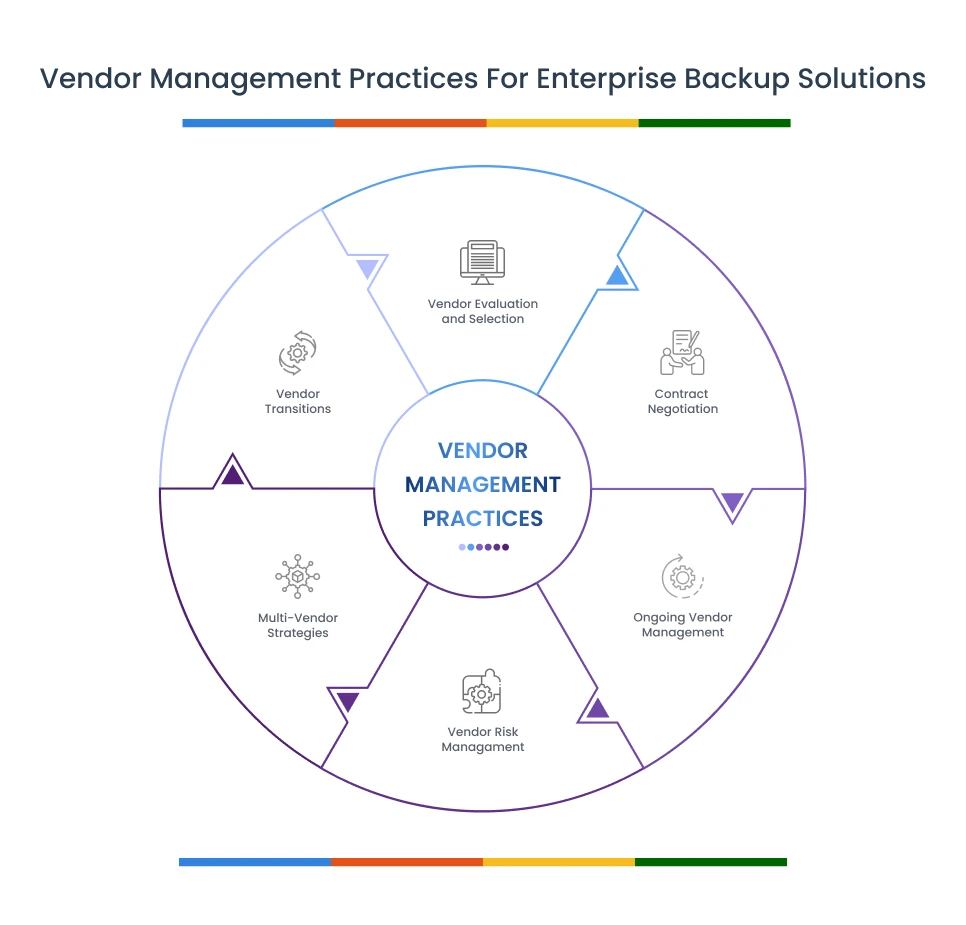
This guide covers six essential practices across the vendor lifecycle. From rigorous evaluation and selection through contract negotiation, ongoing management, risk mitigation, multi-vendor strategies and smooth transitions. Master these practices and you’ll reduce costs, eliminate vendor surprises and build partnerships that support your data protection strategy.
Want to skip ahead? Here’s a quick summary of the six practices you’ll master:
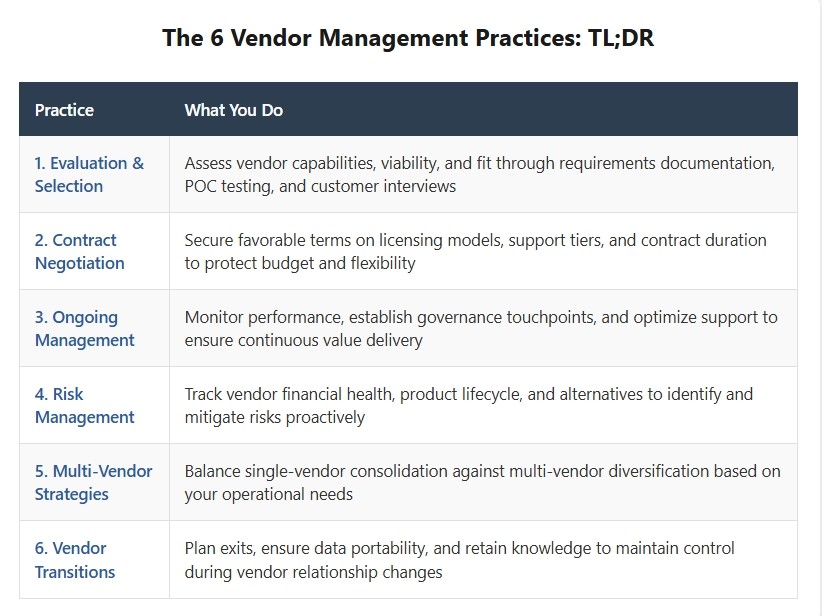
Vendor Management Practices for Enterprise Backup Solutions
Successful enterprise backup solutions require more than just selecting a vendor—they demand ongoing strategic management. The following six practices form a comprehensive framework for maximizing value from your backup software vendors throughout the entire relationship lifecycle.
1. Vendor Evaluation and Selection
The first step in building effective vendor relationships is conducting a thorough evaluation. This means moving beyond vendor marketing claims to objectively assess whether backup software vendors truly meet your technical, operational, and financial needs for your enterprise backup solutions.
The following table outlines key evaluation criteria for enterprise backup solutions and backup software vendors:
| Evaluation Category | Key Criteria | Information Sources | Relative Weight |
|---|---|---|---|
| Technical Capabilities | Platform support, scalability, features, performance | Product documentation, POC testing, reference architectures | 35-40% |
| Vendor Viability | Financial stability, market position, product roadmap | Financial reports, analyst assessments, customer references | 20-25% |
| Support & Services | Support quality, response times, professional services | Support SLAs, customer references, support portal evaluation | 15-20% |
| Total Cost of Ownership | Licensing costs, support fees, implementation costs, ongoing operations | Vendor quotes, reference customers, TCO modeling | 15-20% |
| Strategic Fit | Roadmap alignment, partnership potential, ecosystem integration | Vendor discussions, product roadmaps, integration documentation | 10-15% |
Enterprise backup solutions evaluation framework showing key criteria, information sources, and relative weighting for comprehensive assessment of backup software vendors.
Requirements Documentation
Establish detailed technical and business requirements that enterprise backup solutions must satisfy. Document platform support needs, scalability requirements, compliance mandates, integration points, and operational capabilities. Create evaluation scorecards for vendor comparison. Clear requirements enable objective vendor assessment while ensuring solutions align with organisational needs.
Proof of Concept Testing
Validate vendor claims through hands-on evaluation with representative workloads and use cases. Configure candidate enterprise backup solutions in test environments, execute backup and recovery scenarios, measure performance, and evaluate administrative interfaces. POC testing reveals practical implementation challenges and capability gaps that vendor marketing materials may not disclose. Leading backup software vendors offer trial programs enabling thorough evaluation before purchase commitments.
Reference Customer Interviews
Gather unfiltered perspectives from organisations using enterprise backup solutions in production environments. Contact references asking about implementation experiences, support quality, product reliability, and overall satisfaction. Reference discussions often reveal insights unavailable through vendor-controlled channels including workarounds for product limitations or support challenges.
Once you’ve identified qualified enterprise backup solutions through objective evaluation, the next critical phase is securing contract terms that protect your budget and give you operational flexibility.
2. Negotiating Enterprise Backup Solutions Contracts
With qualified backup software vendors identified and evaluated, the next step is securing contract terms that protect your budget and provide operational flexibility. Focus on three areas: the licensing model, support tiers, and contract duration when evaluating enterprise backup solutions.
Licensing Model Evaluation
Compare perpetual licenses, subscription models, capacity-based pricing, and hybrid approaches, determining which aligns best with organisational usage patterns and budget structures. Model costs under different scenarios, including infrastructure growth, technology refreshes, and changing data volumes. Unfavourable licensing models from backup software vendors can dramatically inflate costs as environments scale, requiring careful evaluation and negotiation.
Support Tier Assessment
Evaluate included support levels and premium support options, determining which balance cost and service needs. Review support SLAs, including response times, escalation procedures, and coverage hours. Many enterprises require 24/7 support for critical enterprise backup solutions, justifying premium support investments despite higher costs.
Contract Term Negotiation
Address license duration, renewal conditions, price protection, and exit terms. Negotiate multi-year commitments capturing volume discounts while securing price protection limiting renewal increases. Exit clauses addressing data portability and license transfers provide flexibility if vendor relationships deteriorate or business requirements change. When the negotiation expands to legal, security, and finance teams, structuring the response so that an AI RFP workflow can carry certification evidence and pricing baselines lets human reviewers stay focused on terms that actually shift between vendors.
Signing the contract is just the beginning. The real test of a successful relationship emerges through ongoing monitoring and active management of your enterprise backup solutions post-purchase.
3. Ongoing Vendor Management
Effective vendor management doesn’t end at contract signature. Continuous monitoring and active engagement ensure enterprise backup solutions deliver value throughout their lifecycle.
Relationship Governance
Establish structured touchpoints between organisations and backup software vendors including quarterly business reviews, technical advisory board participation, and executive sponsor engagement. Regular engagement enables proactive issue resolution, roadmap alignment, and relationship health monitoring. Organisations designate vendor relationship managers coordinating interactions and tracking commitments for enterprise backup solutions.
Performance Monitoring
Track vendor delivery against contractual commitments including support response times, product defect resolution, and service availability. Organisations maintain scorecards measuring vendor performance, flagging trends requiring attention. Performance data supports renewal negotiations and provides leverage when vendor performance falls short of commitments for your enterprise backup solutions.
Support Optimization
Ensure organisations extract maximum value from backup software vendors’ support relationships. Organisations leverage vendor technical account managers, submit feature requests influencing product roadmaps, and access vendor knowledge bases and training resources. Proactive support engagement prevents issues while building internal capabilities through vendor expertise in enterprise backup solutions.
While monitoring individual vendor performance is essential, smart organisations also plan for potential vendor problems before they become crises. This requires proactive risk management strategies.
While monitoring individual vendor performance is essential, smart organisations also plan for potential vendor problems before they become crises. This requires proactive risk management strategies. The framework aligns with ISO 27001 standards, ensuring consistent data protection and risk management across all vendor operations.
4. Vendor Risk Management
Vendor dependencies create organisational risks when providers experience financial difficulties, discontinue products, or fail to maintain adequate support quality. Proactive risk management protects your enterprise backup solutions investment.
Financial Viability Monitoring
Track vendor financial health through public filings, analyst reports, and market indicators. Organisations watch for warning signs, including declining revenues, executive turnover, or adverse analyst commentary that might indicate vendor instability. Early detection enables contingency planning before vendor failures disrupt your enterprise backup solutions.
Product Lifecycle Management
Track vendor product roadmaps, end-of-life announcements, and technology transitions. Organisations plan for platform upgrades, evaluate replacement options for discontinued products, and align infrastructure refresh cycles with vendor timelines. Proactive lifecycle management prevents situations where organisations run unsupported backup software creating security and compliance risks in enterprise backup solutions.
Alternative Vendor Assessment
Maintain awareness of competitive backup software vendors enabling informed decisions during renewals or if primary vendor relationships deteriorate. Organisations periodically evaluate alternatives assessing whether emerging enterprise backup solutions offer superior capabilities, better economics, or improved strategic fit. Maintaining alternatives provides negotiating leverage while enabling rapid vendor transitions if necessary.
Some organisations address vendor risk through a different approach altogether—distributing backup across multiple backup software vendors rather than consolidating on a single provider of enterprise backup solutions.

5. Multi-Vendor Strategies for Enterprise Backup Solutions
Multi-vendor approaches distribute risk and enable best-of-breed solutions for different use cases but increase complexity and management overhead. Organisations weigh vendor diversification benefits against consolidation advantages including simplified management, volume discounts, and consistent operational models.
Multi-Vendor Approaches
Many enterprises adopt hybrid strategies using primary backup software vendors for most workloads while maintaining specialised enterprise backup solutions for specific requirements. Multi-vendor approaches distribute risk and enable best-of-breed solutions for different use cases, but increase complexity and management overhead.
Vendor Consolidation
Reduce the number of backup vendors simplifying operations and improving economies of scale. Organisations analyse whether multiple enterprise backup solutions remain justified or whether consolidation onto fewer platforms reduces complexity without sacrificing capabilities. Comprehensive backup software vendors like Zmanda Pro support diverse use cases reducing the need for multiple specialised solutions.
Interoperability Requirements
Ensure enterprise backup solutions integrate with enterprise architecture, including monitoring platforms, IT service management systems, and compliance tools. Organisations establish integration standards that vendor solutions must satisfy, with APIs and standard protocols enabling consistent integration patterns across the technology portfolio.
Whether you adopt single-vendor, multi-vendor, or hybrid strategies, one reality remains: vendor relationships eventually change. Preparing for smooth transitions ensures you maintain control over your data and enterprise backup solutions.
6. Preparing Enterprise Backup Solutions for Vendor Transitions
Planning for vendor relationship changes protects your investment and ensures continuity of your enterprise backup solutions.
Exit Planning
Address potential vendor relationship termination through documented transition procedures, data portability requirements, and alternative vendor assessments. Organisations maintain current vendor evaluation data enabling rapid decision making if transitions become necessary. Exit planning provides insurance against vendor failures while improving negotiating positions during renewals of enterprise backup solutions.
Data Portability Assessment
Validate that backup data remains accessible if organisations terminate relationships with backup software vendors. Organisations verify that backup formats use open standards or vendor-provided migration tools enable transfer to alternative enterprise backup solutions. Proprietary formats creating vendor lock-in represent significant risk requiring mitigation through contractual commitments or architectural approaches.
Knowledge Retention
Ensure organisational backup knowledge exists independently of vendor relationships. Organisations document architectures, operational procedures, and troubleshooting approaches reducing dependence on vendor professional services. Strong internal capabilities provide flexibility for vendor transitions while reducing operational costs through reduced consulting needs for enterprise backup solutions.
Optimize Enterprise Backup Solutions Vendor Relationships for Maximum Value
Strategic vendor management transforms enterprise backup solutions from transactional purchases into value-generating partnerships. By implementing these six practices—from rigorous vendor evaluation through contract negotiation, ongoing monitoring, risk management, multi-vendor strategies, and smooth transitions—organisations gain control over costs, ensure reliable support, and build vendor relationships that truly scale with their business.
Ready to strengthen your backup vendor practices? Zmanda Pro is built for organisations that demand transparency, responsive support, and partnership-focused vendors. Start your free trial to experience enterprise backup with vendor management excellence.