Manufacturing enterprises protecting industrial IoT and operational systems need backup strategies engineered specifically for production environments—not generic IT solutions adapted for factory floors. Modern factories generating 50-500 TB of sensor telemetry daily face unique requirements: protecting OT networks, managing massive IoT data volumes, ensuring compliance, and maintaining production uptime simultaneously.
Most organizations underestimate this complexity until a sensor failure cascades into downtime, or regulatory auditors discover gaps in operational data protection. By then, the cost is measured in millions and lost credibility with stakeholders.
This guide examines how manufacturing giants build comprehensive IoT data backup strategies that address all these dimensions without operational disruption—the specific requirements that set manufacturing apart, and the operational practices that enable reliable protection across global factory networks.
Key Manufacturing Backup Requirements
The following table outlines the critical requirements organizations face when implementing IoT data backup across manufacturing environments:
| Requirement | Business Impact | Protection Strategy |
|---|---|---|
| Industrial IoT Sensor Data | 50-500 TB daily; 1000+ data points/second | Time-series databases, intelligent sampling, edge processing |
| Operational Technology Systems | SCADA, PLC, control systems; production-critical | Air-gapped backup, change window coordination, configuration focus |
| Production Continuity | Zero tolerance for backup disruption; $20K-$260K/hour downtime cost | Local on-site protection, rapid recovery procedures |
| Multi-Site Operations | Global facilities with varied network/regulatory requirements | Local protection + central replication, bandwidth optimization |
| Regulatory Compliance | IATF, FDA, AS9100, FSMA requirements vary by industry | Audit trails, retention enforcement, validation documentation |
| Intellectual Property | Product designs, manufacturing processes, trade secrets | Secure encryption, access controls, immutable archival |
Table: Critical requirements for implementing IoT data backup across manufacturing operations
Understanding these requirements is essential for building effective protection strategies. The first critical challenge emerges when managing the massive telemetry volumes that modern factories generate.
Why Do Manufacturing Enterprises Need Specialized IoT Data Backup Solutions?
Manufacturing environments combine traditional IT systems with operational technology that directly controls physical production processes. IoT data backup strategies must protect both realms while understanding their fundamentally distinct requirements and constraints.
Standard backup solutions weren’t built for this convergence. They treat all data equally—backing up a database file the same way they backup a time-series sensor stream. In manufacturing, that’s fatal. Your IoT data backup approach must be fundamentally different.
Key manufacturing backup manufacturing requirements include:
- Operational Technology: SCADA, PLC, and industrial control systems requiring specialized backup approaches; air-gapped networks that reject standard connectivity
- IoT Sensor Data: Massive telemetry volumes from connected machinery and production equipment; 1000+ data points per second from modern factories demanding intelligent data reduction
- Production Continuity: Zero-tolerance for backup operations disrupting manufacturing schedules; backup windows measured in minutes, not hours
- Supply Chain: ERP, MES, and logistics data critical for just-in-time operations; single data loss event can halt global supply chains
- Quality Systems: Compliance data for ISO, FDA, and industry-specific regulations; audit trails required for every production decision
- Intellectual Property: Product designs, manufacturing processes, and trade secrets; proprietary data worth millions
Organizations attempting to use traditional enterprise backup solutions for IoT data backup discover the approach breaks down at scale. Time-series data gets corrupted. OT networks reject agent connectivity. Multi-site replication consumes bandwidth budgets. Compliance validation fails.
IoT data backup solutions must address both IT infrastructure and OT environments with awareness of production schedules, regulatory requirements, and operational constraints. Purpose-built backup manufacturing platforms designed for this convergence achieve reliable protection across IT/OT integration without operational disruption.
How Do Manufacturers Backup Industrial IoT Sensor Data at Scale?
Modern factories deploy thousands of IoT sensors generating continuous telemetry about temperature, pressure, vibration, energy consumption, and equipment status. A single large manufacturing facility generates 50-500 TB of sensor data daily—data that supports predictive maintenance, quality control, and operational optimization but creates massive backup challenges.
The core challenge: traditional backup infrastructure collapses under IoT sensor data volume. You can’t backup everything. You don’t need to. But you must know what matters.
IoT data backup management strategies include:
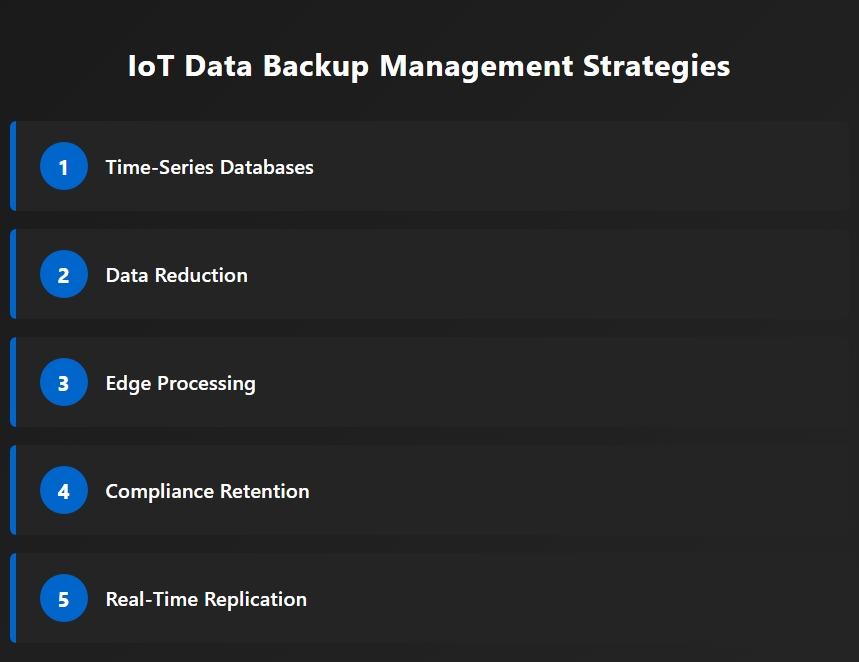
- Time-Series Databases: Specialized backup for InfluxDB, TimescaleDB, and industrial historians storing sensor telemetry; standard backup methods corrupt time-series data structure and query patterns
- Data Reduction: Intelligent sampling and aggregation reducing backup volumes by 70-90%; retaining critical insights while eliminating redundant data points
- Edge Processing: Local data processing and selective cloud synchronization; reducing WAN bandwidth requirements for remote factories to 10-15% of unoptimized approaches
- Compliance Retention: Long-term archival for quality and regulatory requirements; maintaining audit trails for years while managing storage costs through tiered retention
- Real-Time Replication: Continuous data protection for critical monitoring systems; ensuring production visibility survives any infrastructure failure
Manufacturers implementing intelligent IoT data backup achieve 70-90% storage reduction through specialized data management while maintaining compliance with quality system requirements and supporting predictive analytics initiatives. This translates directly to budget savings: facilities that reduced backup volumes by 75% typically cut annual backup costs by $100K-$300K annually.
Implementation timelines for IoT data backup typically span 6-9 months: 2-3 months for architecture design, 3-4 months for deployment and integration, 1-2 months for testing and validation. Common mistakes include attempting to backup all sensor data (instead of implementing intelligent sampling) and failing to separate IoT data backup from transactional systems backup.
Managing sensor data is one dimension. The greater challenge emerges when protecting systems that directly control production.

Operational Technology Backup: Protecting Industrial Control Systems Without Disruption
Industrial control systems, SCADA platforms, and PLCs require backup manufacturing approaches that respect air-gapped networks, change control procedures, and production schedules. OT backup cannot follow standard IT practices without risking production disruption or safety violations.
This is where most backup manufacturing solutions fail. They’re designed for IT environments where downtime is inconvenient. In OT environments, downtime is catastrophic. Your backup manufacturing approach must reflect that reality.
OT-specific backup manufacturing requirements include:
- Air-Gap Respect: Backup methods that don’t compromise network segregation; maintaining physical and logical isolation between IT and OT environments while still enabling protection
- Change Windows: Backup during scheduled maintenance rather than continuous operation; coordinating with production schedules, shift changes, and maintenance windows
- Configuration Focus: Emphasis on PLC programs and HMI configurations over transactional data; preserving the logic that controls physical equipment
- Version Control: Tracking changes to control logic and operational parameters; enabling rollback if updates introduce production issues
- Validation Testing: Verification that restored systems function correctly before production use; documented proof that backups actually work when needed
Industrial backup manufacturing platforms must understand OT constraints and integrate with manufacturing change control processes rather than imposing IT-centric approaches. Backup windows for OT systems typically require 2-4 hour maintenance shutdowns, making efficient backup critical. Solutions built specifically for this environment reduce actual backup time by 60-70% compared to adapted IT tools.
Protecting individual facilities is manageable. But modern manufacturing operates globally, across continents, with dozens or hundreds of production sites.
Multi-Site Manufacturing Backup: Global Production Protection Without Complexity
Global manufacturers operate dozens or hundreds of facilities across continents. IoT data backup strategies must accommodate geographic distribution, network constraints, and local regulatory requirements while maintaining central visibility and governance.
The complexity multiplies with every additional site. Different networks. Different regulatory requirements. Different production schedules. Different failure modes. Yet central IT teams must maintain visibility and governance without being bottlenecked by regional operations. To improve coordination across distributed facilities, manufacturers often complement their infrastructure with manufacturing order management software that centralizes order information and supports more efficient production planning and fulfillment management.
Multi-site backup manufacturing architectures provide:
- Local Protection: On-site backup for production continuity during WAN outages; ensuring single facility failures don’t cascade globally
- Central Replication: Aggregation to headquarters or regional data centers; creating backup copies for disaster recovery and analytics
- Cross-Plant Recovery: Ability to restore production systems to alternative facilities; enabling production to shift if primary facility fails
- Bandwidth Optimization: WAN efficiency for sites with limited connectivity; critical for manufacturing in emerging markets with poor infrastructure
- Unified Management: Global visibility with local operational control; central governance without over-constraining regional operations
Implementing enterprise backup manufacturing solutions enables manufacturers to balance local autonomy with corporate governance across global factory networks. Typical deployments include primary backups at each facility (24–48-hour retention), regional replication to distribution centers (7–30-day retention), and corporate archival for compliance (1–7-year retention).
Organizations managing 20+ facilities typically reduce backup management overhead by 40-60% with centralized backup manufacturing platforms, freeing IT teams to focus on strategic projects rather than backup firefighting.
Multi-site complexity is compounded by regulatory fragmentation. Different countries and industries impose different backup requirements, creating operational headaches.
Compliance Requirements Driving Manufacturing Backup Strategies
Manufacturing industries face varied regulatory requirements based on products and markets. Automotive suppliers comply with IATF standards, pharmaceutical manufacturers meet FDA requirements, aerospace companies follow AS9100, and food processors address FSMA regulations. Each imposes distinct IoT data backup and retention mandates.
Compliance failures aren’t abstract risks. They’re fines, production halts, and reputation damage. When auditors discover gaps in your backup manufacturing documentation, you’re not just failing an audit—you’re revealing operational risk.
Compliance-driven backup manufacturing capabilities include:
- Quality System Integration: Backup manufacturing supporting ISO 9001, AS9100, and industry standards; proving that quality data remains protected and recoverable
- Audit Trails: Complete documentation of all IoT data backup activities; satisfying external auditor requirements for traceability
- Retention Enforcement: Automated compliance with industry-specific retention periods; eliminating manual tracking of data destruction schedules
- Validation Documentation: Evidence that backup systems function as intended; supporting regulatory inspections and third-party audits
- Change Control: Integration with manufacturing change management processes; ensuring backup modifications follow established procedures
Regulated manufacturers must demonstrate backup manufacturing system validation and ongoing reliability through documented testing and audit trails that satisfy external assessors. Compliance validation typically requires 2-3 months of quarterly testing and documentation before achieving certification.
Implementing Manufacturing IoT Data Backup: From Strategy to Production
Manufacturing enterprises require backup manufacturing solutions that address both IT and OT environments, protect massive IoT sensor telemetry, support multi-site operations, and meet industry-specific compliance requirements. Successfully implementing IoT data backup across global manufacturing operations requires a phased approach spanning 12-18 months.
Recommended implementation roadmap:
- Assessment Phase (Months 1-2): Identify all systems requiring protection; classify by criticality, compliance requirements, and backup window constraints
- Architecture Design (Months 3-5): Design separated protection for IT and OT; plan IoT data reduction strategy; map multi-site replication paths
- Pilot Deployment (Months 6-9): Deploy to 1-2 representative facilities; test OT backup procedures; validate compliance approach
- Global Rollout (Months 10-15): Deploy to all facilities; establish regional backup centers; implement centralized management console
- Validation & Optimization (Months 16-18): Complete compliance testing; optimize backup manufacturing schedules; establish ongoing procedures
Cost considerations for IoT data backup:
- Small facility (single production line): $50,000-$150,000 annually
- Large facility (10+ production lines): $200,000-$500,000 annually
- Global program (20+ facilities): $2M-$5M annually
Organizations should allocate 20-30% of backup budget for IoT data management, 40-50% for infrastructure and licenses, and 20-30% for staffing and ongoing operations.
Implementation success metrics:
- RPO < 1 hour for production systems, < 15 minutes for critical sensors
- RTO < 4 hours for facility-wide failures, < 30 minutes for individual systems
- Backup validation success rate ≥ 99.5%
- Compliance audit pass rate on first attempt
Our customers—from automotive Tier-1 suppliers to Fortune 500 manufacturers—trust Zmanda because we solve the actual problems manufacturing faces, not the problems IT vendors imagine manufacturing faces.
Mastering Manufacturing IoT Data Backup: The Path Forward
Manufacturing giants protecting industrial IoT and operational data require purpose-built backup manufacturing approaches that respect production constraints while ensuring regulatory compliance. The complexity of modern manufacturing—combining massive sensor telemetry, air-gapped OT systems, global distribution, and diverse compliance requirements—demands solutions designed specifically for this environment, not adapted from consumer or generic IT applications.
Contact our manufacturing data protection team to discuss your facility’s specific IoT data backup and operational technology protection requirements across your global manufacturing network.