Enterprise backup encryption standards protect sensitive data from unauthorized access, regulatory violations, and security breaches. Large organizations managing sensitive information across hundreds of systems require robust encryption throughout the backup lifecycle – from initial capture through long-term storage and eventual restoration.
Selecting appropriate enterprise backup encryption standards involves balancing security requirements, compliance mandates, performance constraints, and operational complexity. Enterprise backup solutions must encrypt data both in transit and at rest while maintaining key management practices that prevent unauthorized decryption.
Which encryption algorithms meet enterprise security requirements?
Modern encryption algorithms protect data through mathematical transformations that make information unreadable without proper decryption keys. The table below compares encryption standards suitable for enterprise backup systems:
| Encryption Standard | Key Strength | Enterprise Use Case |
|---|---|---|
| AES-256 | 256-bit keys | Standard for most enterprise backups, regulatory compliance |
| AES-128 | 128-bit keys | Acceptable for less sensitive data, better performance |
| RSA 2048/4096 | 2048+ bit keys | Key exchange, certificate-based authentication |
| ChaCha20 | 256-bit keys | High-performance alternative to AES for mobile/cloud |
| Triple DES (3DES) | 168-bit keys | Legacy systems only, deprecated for new implementations |
Enterprise backup encryption standards and their recommended applications
AES-256 (Advanced Encryption Standard with 256-bit keys) represents the gold standard for enterprise backup encryption. Federal agencies require AES-256 for classified information, and most compliance frameworks specify AES-256 as the minimum acceptable encryption strength. The algorithm provides security against brute-force attacks for decades to come.
Organizations should avoid legacy encryption algorithms like DES or MD5. These older standards contain known vulnerabilities that attackers can exploit. Compliance frameworks explicitly prohibit weak encryption, and security auditors will flag systems using deprecated algorithms.
What is the difference between encryption in transit and at rest?
Enterprise backups require encryption at multiple points throughout the backup process. Understanding where to apply encryption ensures comprehensive data protection.
Encryption in Transit protects data moving across networks from source systems to backup servers and from backup servers to storage repositories. Network traffic encryption prevents interception during transmission. Enterprises should use TLS 1.2 or newer for network transport encryption, with perfect forward secrecy to protect against future key compromises.
Backup traffic crossing public networks like the internet requires mandatory encryption. Even traffic within private networks benefits from encryption as defense against internal threats and network tap attacks. Modern enterprise backup solutions like Zmanda Pro encrypt all network communications by default.
Encryption at Rest secures backup data stored on disks, tapes, or cloud storage. This protection remains active regardless of where backup media resides – in data centers, offsite storage facilities, or cloud provider infrastructure. Encryption at rest prevents unauthorized access if backup media is stolen, lost, or improperly disposed.
Cloud storage encryption deserves special attention. Organizations should encrypt data before sending it to cloud providers rather than relying solely on provider-side encryption. Client-side encryption ensures backup data remains protected even if cloud provider security fails or government agencies compel providers to surrender data.
How should large enterprises manage encryption keys?
Encryption key management often determines whether encryption provides real security or creates a false sense of protection. Poor key management undermines strong encryption algorithms.
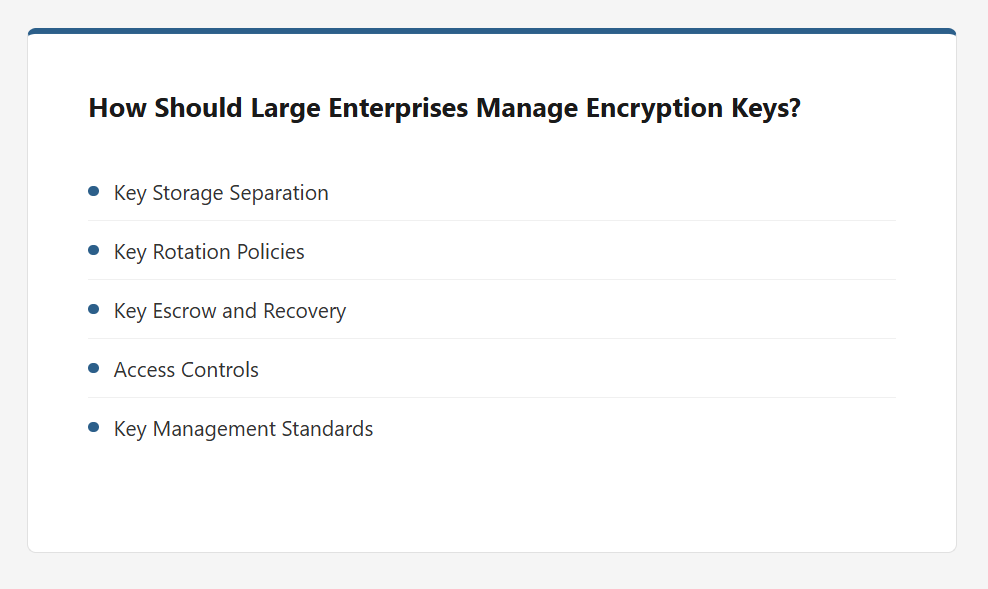
Key Storage Separation: Store encryption keys separately from encrypted backup data. Keeping keys and encrypted data together offers no security – anyone accessing backups can also access decryption keys. Use dedicated key management systems or hardware security modules (HSMs) for key storage.
Key Rotation Policies: Rotate encryption keys periodically to limit exposure from compromised keys. Large enterprises should rotate backup encryption keys quarterly or after any security incident. Key rotation balances security benefits against operational complexity of re-encrypting existing backups.
Key Escrow and Recovery: Implement secure key escrow procedures allowing authorized recovery if primary keys are lost. Key escrow requires multiple authorized parties to reconstruct keys, preventing single-person key access. Document key recovery procedures and test them regularly.
Access Controls: Limit encryption key access to specific authorized administrators using role-based access control. Audit all key access attempts and investigate unusual patterns. Compromised keys provide attackers complete access to encrypted backups.
Key Management Standards: Follow NIST SP 800-57 guidelines for cryptographic key management or equivalent standards. Compliance frameworks often reference these standards, and following established practices simplifies regulatory audits.
What enterprise backup encryption requirements do compliance frameworks mandate?
Regulatory compliance frameworks specify encryption requirements that enterprises must meet. Understanding these mandates ensures backup encryption configurations satisfy legal obligations.
HIPAA (Healthcare): Requires encryption for protected health information (PHI) in backups. While HIPAA allows addressable implementation of encryption, the practical reality makes encryption mandatory due to breach notification requirements. Unencrypted backup theft triggers expensive breach disclosure obligations.
PCI DSS (Payment Cards): Mandates strong encryption for cardholder data in backups using industry-accepted algorithms (AES-256). Requires encryption key management procedures that restrict access and prevent unauthorized decryption.
GDPR (European Privacy): Specifies encryption as appropriate security measure for personal data. GDPR’s data breach notification requirements essentially mandate encryption – properly encrypted data stolen in breaches may not constitute reportable incidents.
FISMA (Federal Systems): Requires FIPS 140-2 validated encryption for federal information systems. Backup solutions must use cryptographic modules certified through NIST validation programs.
Organizations operating across multiple jurisdictions must ensure their enterprise backup encryption satisfies the most stringent requirements applicable to their data.” Global enterprises typically standardize on AES-256 encryption to meet all regulatory requirements simultaneously.
Does encryption impact backup performance?
Encryption processing adds computational overhead to backup operations. Understanding performance implications helps organizations plan backup windows and infrastructure capacity.
Modern processors include AES acceleration through AES-NI instruction sets, dramatically reducing encryption overhead. Systems with AES-NI support experience minimal performance impact from AES encryption – typically 2-5% compared to unencrypted backups. Organizations should verify backup servers include processors with hardware encryption acceleration.
Network bandwidth typically represents the larger bottleneck than encryption processing. Once backup data is encrypted, deduplication effectiveness decreases because encrypted data appears random. Organizations should apply deduplication before encryption when possible, though security requirements sometimes mandate encryption-first architectures.
Cloud backup encryption deserves performance consideration. Encrypting data locally before cloud transmission adds processing time but eliminates concerns about cloud provider access to decryption keys. The security benefits typically outweigh minor performance penalties. Zmanda Pro optimizes encryption workflows to minimize performance impact while maintaining strong security.
How do enterprises implement encryption across backup infrastructure?
Implementing enterprise encryption requires systematic deployment across backup infrastructure components.

Centralized Policy Management: Define encryption policies centrally and enforce them across all backup systems. Centralization prevents configuration drift and ensures consistent encryption standards. Policy management systems should prevent administrators from weakening encryption or disabling it entirely.
Automated Encryption: Configure backup systems to encrypt automatically without requiring manual intervention. Automated encryption eliminates human error and ensures all backups receive protection. Manual encryption inevitably results in unencrypted backups when administrators skip steps under time pressure.
Verification and Monitoring: Continuously monitor backup encryption status and alert on any unencrypted backup data. Verification processes should confirm encryption algorithms meet standards and validate that encryption keys remain properly secured.
Testing and Recovery: Test encrypted backup recovery regularly to verify decryption processes work correctly. Recovery testing validates key management procedures and confirms backups can be restored when needed. Document recovery procedures including key retrieval steps.
Integration with Ransomware Protection: Combine encryption with immutable backup copies for comprehensive security. Encryption protects confidentiality while immutability prevents unauthorized modification or deletion. Together these controls defend against both data theft and ransomware attacks.
Building secure enterprise backup encryption standards
Enterprise backup encryption protects sensitive data throughout the backup lifecycle. Organizations should standardize on AES-256 encryption for both data in transit and at rest, implement rigorous key management practices, and automate encryption processes to eliminate human error.
Compliance requirements drive encryption mandates across industries, making robust encryption non-negotiable for regulated enterprises. Performance considerations remain manageable with modern hardware acceleration, allowing organizations to achieve strong security without sacrificing backup windows.
Zmanda Pro delivers enterprise-grade encryption with AES-256 protection, automated key management, and compliance-ready configurations. The solution encrypts data during transmission and storage while maintaining the performance needed for large-scale backup operations. Both SaaS and self-hosted deployment options support organizational security requirements. Start your Zmanda Pro free trial to implement enterprise encryption standards that protect your backup infrastructure.